
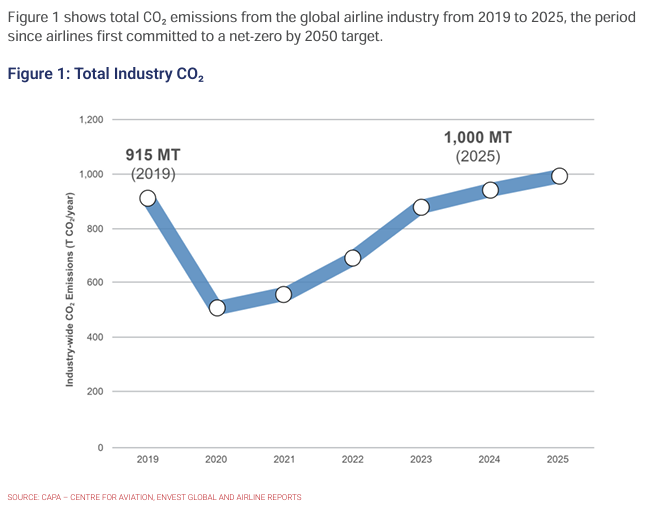
A new report from the Centre for Aviation and Envest Global has found that since 2019, carbon emissions produced by commercial airlines have increased by 10%, reaching one billion tonnes in 2025, which was the highest on record:
The airline sector has a target of sustainable aviation fuel (SAF) accounting for 10% of its overall fuel use by 2030. SAF is a synthetic, low‑carbon alternative to conventional kerosene-based jet fuel, made from renewable feedstocks such as used cooking oil, fats, plant oils, and various biomass or waste materials.
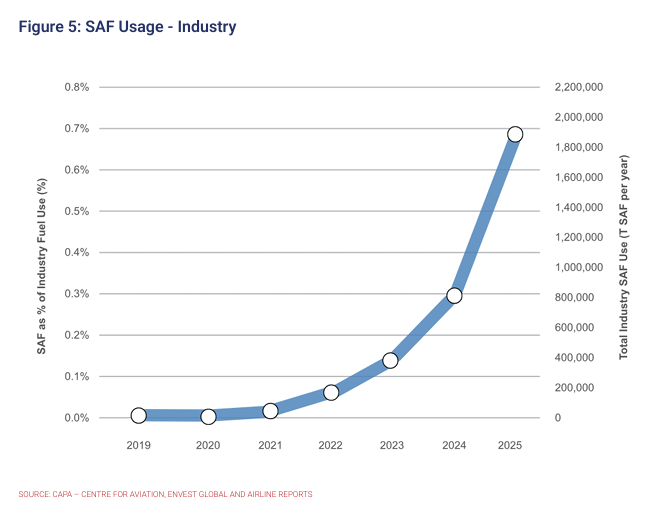
SAF has proven uneconomic to produce. As a result, it accounted for just 0.7% of the aviation sector’s overall fuel use in 2025:
Producing SAF requires significant energy, primarily to process biomass feedstocks into suitable fuel. The process involves large quantities of green hydrogen, which is essential for processing biomass feedstocks and, in the longer term, serves as a feedstock itself. Producing this green hydrogen requires large amounts of renewable energy and has also proven uneconomic, with billions of dollars wasted and projects cancelled.
Thus, the key challenges to SAF include limited feedstock availability, high production costs, and the need for large‑scale investment and supportive policy frameworks.
Simon Elsegood from the Centre for Aviation says SAF is as much as five times more expensive than jet fuel, even at the current high price.
As a result, the report warns that some airlines would need to increase revenue by as much as 85% to cover SAF costs in the years ahead, making fare increases a certainty.
“I think it’s inevitable that sustainability is going to raise the cost of air travel”, Elsegood said.
Grattan Institute wants Australia to mandate and subsidise SAF use:
As part of its plan to reduce Australia’s dependence on imported liquid fuels, the Grattan Institute has recommended that the federal government set mandatory SAF targets and spend $6 billion of taxpayers’ money to build SAF refineries:
In aviation, the government should set a mandatory target for clean fuels and put $6 billion towards building the country’s first fleet of clean refineries, it said. That should deliver 9.8 billion litres of clean jet fuel a year.
Australia has already wasted billions of dollars on the green hydrogen fantasy.
It must not waste billions more taxpayer dollars and drive up airfares by pursuing the SAF fantasy.
