
A ‘technical recession’, defined as two consecutive quarters of negative economic growth, is rare in Australia due to its world-leading population growth.
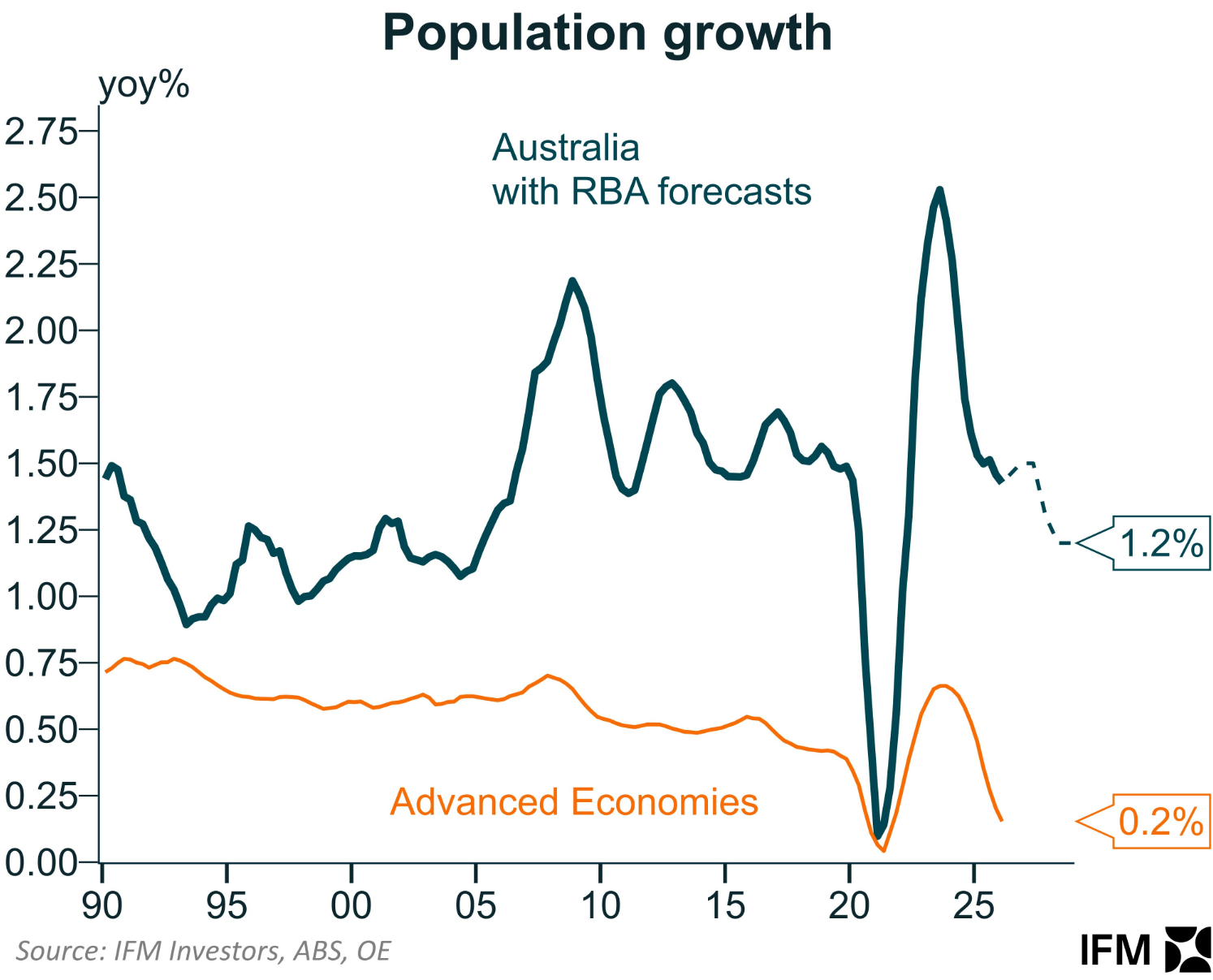
Chart from Alex Joiner (IFM Investors)
Because the nation’s population has typically grown by around 0.4% every quarter due to high immigration, it is very hard for overall economic activity (GDP) to decline in Australia.
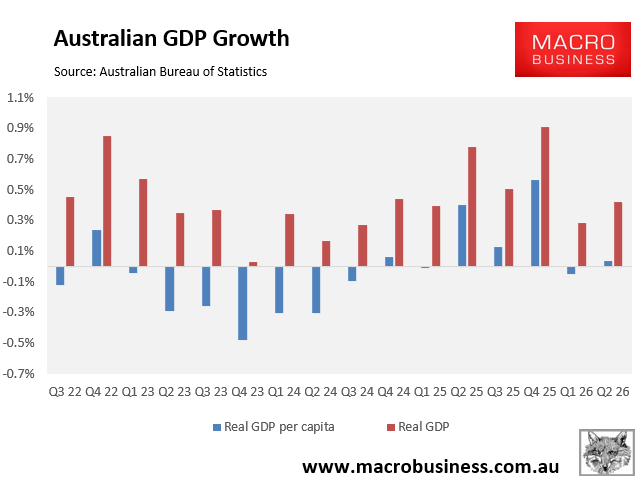
However, per capita recessions, whereby the economy grows more slowly than the population, have become increasingly common.
Indeed, since the Albanese government took office in mid-2022, Australia’s per capita GDP has fallen by 0.5%. It is also highly likely that the economy is currently experiencing a decline in per capita GDP, although we won’t receive the September quarter results until early December.
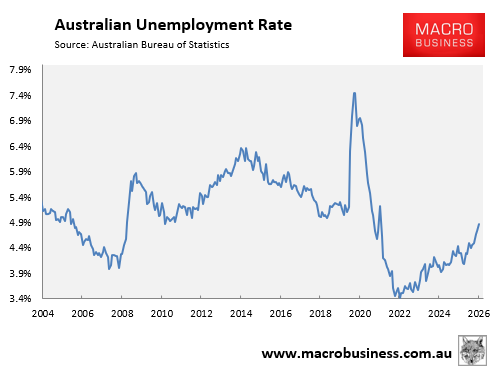
Last week, the Australian Bureau of Statistics (ABS) reported that the nation’s unemployment rate had jumped to 4.86% in October, its highest level in five years, and up around 0.8% from the 4.08% low recorded in January:
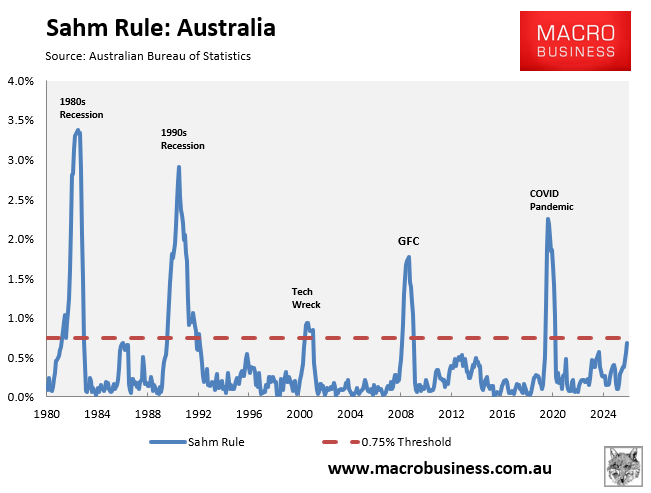
The sharp increase in unemployment has raised the prospect that the economy could be headed into recession, according to the Sahm rule, which identifies recession-like conditions when unemployment rises rapidly. It is an alternative recession indicator developed by former US Federal Reserve economist Claudia Sahm that measures how quickly unemployment rises.
Sahm argues that the speed of unemployment increases is often a better recession warning signal than the unemployment rate itself because rising joblessness can become self-reinforcing.
Previously unpublished RBA research, reported by the ABC, found the Sahm rule could be adapted for Australia, using a 0.75 percentage point threshold rather than the US threshold of 0.5 percentage points.
The Sahm Rule is measured as follows for Australia:
Take the average unemployment rate for the past three months of unemployment data, and if that number happens to be 0.75 percentage points higher than the lowest unemployment rate recorded in the past 12 months, a recession will likely begin.
RBA researchers concluded that the indicator successfully identified Australia’s major recessions in the 1980s and 1990s, while also capturing milder downturns such as the 2001 dotcom slowdown and the Global Financial Crisis, which caused meaningful labour-market pain despite not meeting the technical recession definition.
The RBA has described labour-market indicators like the Sahm rule as useful because they provide earlier warnings than GDP data, which are backwards-looking and reported with a three-month lag.
The current three-month average seasonally adjusted unemployment reading in Australia is 4.76%, meaning it is tracking around 0.68% above January’s 4.08% unemployment low, suggesting it is close to crossing the Sahm rule threshold:
RBA Governor Michele Bullock recently warned that people may soon feel they are living through a recession, even if the GDP figures do not record one.
“It is going to make people feel like it’s a recession because they feel poorer”, she said.
Technical recession or not, 2027 is going to feel like one for many Australians.
