
Why has Ross Gittins sold-out to the immigration lobby?
Ross Gittins was one of the few mainstream media commentators who took a principled stand on immigration.
If you search for “immigration” on Ross Gittins’ website, you’ll find a slew of articles arguing against a “Big Australia” for economic, environmental, and liveability reasons (see sample below).
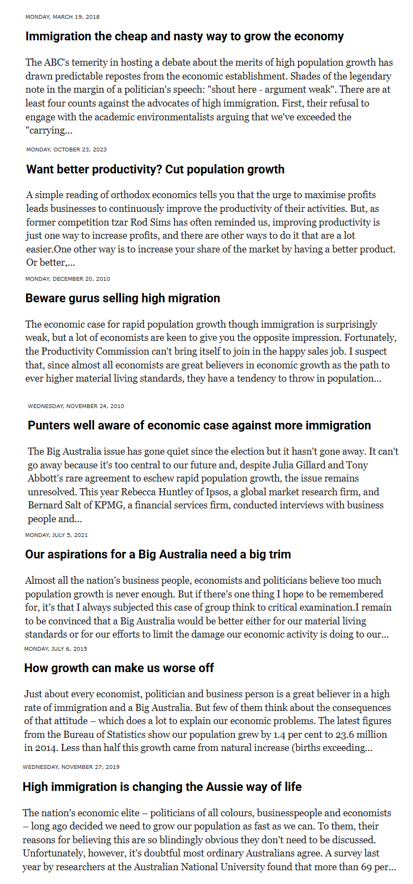
Sample of Gittins’ articles against high immigration
Gittins sensibly argued that immigration was the “cheap and nasty way to grow the economy” and that “punters are well aware of the economic case against more immigration.” He warned Australians to “beware gurus selling high immigration” because “growth can make us worse off”. He argued that “our aspirations for a Big Australia need a big trim”, because if we “want better productivity”, we should “cut population growth”. He also lamented that “high immigration is changing the Aussie way of life”.
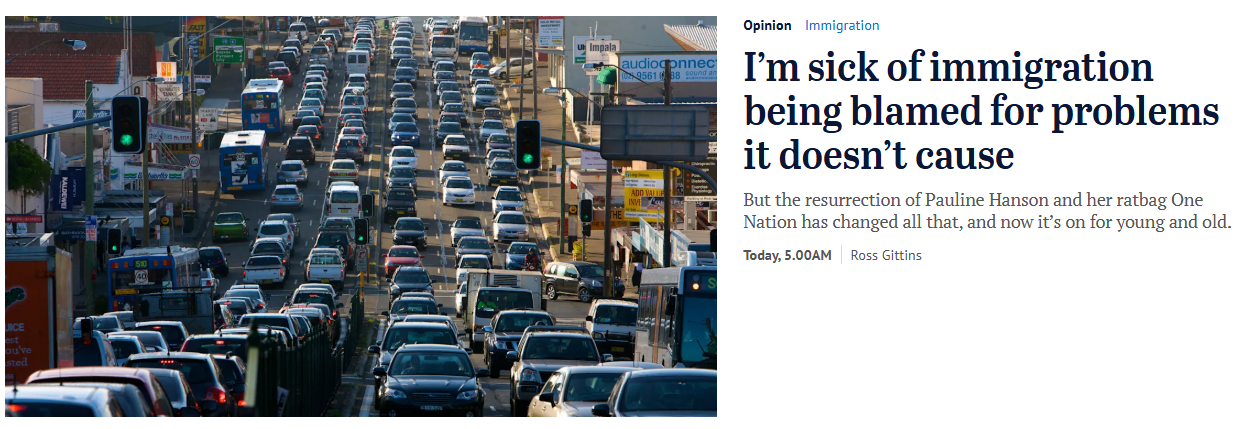
Last week, Gittins contradicted more than 15 years of sensible commentary on immigration, arguing that he “is sick of immigration being blamed for problems that it doesn’t cause”:
It’s worth unpacking some of Gittins’ latest arguments and comparing them with his previous positions.
Below is Gittins claiming that voters are unhappy about falling real wages but that high immigration is playing no role:
“What’s eating the voters – and driving much of the surge in support for One Nation – is the high cost of living which, as I’ve argued repeatedly, is not so much because of high prices as it is lower wages to pay for stuff. That’s hard to fix; bulldusting on about migrants is much easier”.
This argument contradicts Gittins’ article from March 2018:
[Immigration is] the cheapest and nastiest way to pursue economic growth. You get a bigger economy, but not the promised benefits. The studies repeatedly fail to show high immigration leads to a significant increase in real income per person…
As we’ve seen, high immigration probably comes at the expense of productivity-enhancing (capital-deepening) business investment and public infrastructure. To the extent that inadequate capital-widening leads to overcrowding and congestion, it worsens productivity…
It’s not clear the benefits of our skill-pinching program exceed the cost of discouraging businesses from incurring bother and cost training enough of our own young people, when you can always get the government to let you bring in someone ready-trained.
High immigration may suit our rent-seeking business people, but it’s a hell of a way to pursue the professed benefits of economic growth…
It also contradicts his position from 2023:
Is it mere coincidence that productivity improvement has been weak during the period in which immigration-driven population growth has been so strong? I doubt it..
Another thing to remember is that the easier you make it for businesses to get the skilled workers they need by bringing them in from abroad, the more you tempt them not to go to the expense and inconvenience of bothering with apprentices and trainees.
Have you joined the dots? If giving business what it wants – high immigration to grow the market and provide ready access to skilled and unskilled workers – hasn’t induced business to increase the productivity of its labour, why don’t we try the opposite?…
The strange thing is that the virtue of rapid population growth goes almost wholly unquestioned by the nation’s economists.
Population growth is an article of faith for almost every economist. For a profession that prides itself on being so “rational”, it’s surprising how little thinking economists do about the pros and cons of immigration…
In Gittins’ latest salvo, he suggests that cutting immigration would lower economic growth and age the population. Therefore, it is undesirable:
Negative population growth would tank the economy. About three-quarters of the 2.1 per cent growth in gross domestic product over the year to June was accounted for by population growth…
Our opposition to immigration is primordial – deeply instinctive. But we mustn’t let it blind us to the benefits immigration brings. Don’t forget that, without immigration, our low natural increase (births minus deaths) thanks to a fertility rate (number of kids over a woman’s lifetime) of 1.48 and likely to go lower, our population would be falling.
Any economist will tell you that you don’t want to live in an economy with a falling population. Opportunity doesn’t grow, it contracts.
Like almost all countries, we have an ageing population. That means an ever-growing population of oldies who pay little tax but generate a huge bill for pensions, healthcare and aged care. Without immigration, that burden would be borne by an ever-smaller working population.
Yet, Gittins’ current position directly contradicts his position in July 2021:
Slower growth in the population means slower growth in the size of the economy, of course. But I can’t see why this should be a worry.
It’s notable that, though the intergenerational report projects a consequent slowing in economic growth over the next 40 years, it expects this to have little effect on economic growth per person and thus on living standards.
Whereas real GDP growth is projected to slow from 3 per cent a year over the past 40 years to 2.6 per cent over the coming 40, annual growth in real GDP per person is projected to slow only marginally from 1.6 per cent to 1.5 per cent.
Even that small slowing seems to be explained not by lower population growth, but by a similar fall in the assumed rate of average annual productivity improvement.
Taken at face value, this is an admission by the report’s authors that faster population growth makes little or no contribution to the improvement of our material living standards. The immigrants may gain by moving to Australia, but the rest of us don’t gain from their coming…
Looking at the economic effects, the advocates of high immigration always point to the benefit of greater economies of scale, while brushing aside the costs of the increased housing, capital equipment and public infrastructure that a bigger population and workforce must be provided with to ensure the productivity of its labour doesn’t fall.
Indeed, it’s possible our high rate of population growth is a factor contributing to our weak rate of productivity improvement…
Finally, there are the environmental consequences of a bigger population that both the intergenerational report and most business people, economists and politicians refuse to come to grips with…
Or his position in July 2015:
Slower population growth meant slower growth in real gross domestic product and this would also make it harder to get the federal budget back into surplus, we were told.
Really? This is crazy talk. It shows even our economists have turned off their brains on the question of immigration and lost their way between means and ends. Now they believe in growth for its own sake, not for any benefits it may bring us.
Of course slower growth in the population means slower growth in the size of the economy. But what of it? What do we lose?
The economic rationale for economic growth is that it raises our material standard of living. But this happens only if GDP grows faster than the population grows. So it doesn’t follow that slower GDP growth caused by slower population growth leaves us worse off materially.
That would be true only if slower population growth caused slower growth in GDP per person. I suspect many people unconsciously assume it does, but where’s the evidence?
I doubt there is any. The most significant recent study, conducted by the Productivity Commission in 2006, concluded that even skilled migration would do little to increase income per person. And what little growth the commission could find was appropriated by the new arrivals…
As for the claim that slower population growth will make it harder to reduce the budget deficit, it reveals just how unthinking we’ve become on immigration. It’s true enough that slower growth in the workforce means slower growth in tax collections.
But is that all there is to it? What about the other side of the budget? Aren’t we assuming a bigger population is costless? Skilled immigrants and their dependents never use the health system? They don’t have kids needing to be educated?
They don’t add to traffic congestion, wear and tear on roads and 100 other taxpayer-provided services? Since there’s often a delay while they find jobs, who’s to say budgets, federal and state, wouldn’t be better off with fewer immigrants?
But what’s strangest about the economic elite’s unthinking commitment to high immigration is the way they wring their hands over our weak productivity growth and all the “reform” we should be making to fix it, without it crossing their minds that the prime suspect is rapid population growth.
It’s simple: when you increase the population while leaving our stock of household, business and public capital unchanged, you “dilute” that capital. You have less capital per person, meaning you’ve automatically reduced the productivity of labour.
So you have to do a lot more investing in housing, business structures and equipment and all manner of public infrastructure – a lot more “capital widening” – just to stop labour productivity falling…
Gittins’ latest salvo also argues that more immigration is required to pay for new infrastructure, completely ignoring the fact that new infrastructure and housing wouldn’t be needed without the said immigration:
With more people to share the cost, a bigger population makes it possible to afford improved infrastructure…
It’s true, for instance, that our recent high migration (which was bigger than the government intended) contributed to the rising cost of housing. But that’s not true historically, and if you think a cut would make much difference, you’d be disappointed…
Immigration is often blamed for road congestion but, should a cut come about, we’d be hard pressed to notice much difference.
It’s a pity our more sensible politicians are so quick to jump on a populist bandwagon, but so reluctant to explain to voters why the populism makes little sense.
Yet, this completely contradicts Gittins’ previous position in October 2023:
Whatever economic benefits immigration may or may not bring, it comes with inescapable economic costs.
Which are? That every extra person dilutes our existing per-person investment in business equipment and structures, housing stock and public infrastructure: schools, hospitals, police stations, roads and bridges, and much else.
In other words, every extra person requires us to spend many resources on preventing this population growth from diminishing our economic and social capital per head, and thereby making us worse off”.
Economists call this “capital widening”, as opposed to “capital deepening”, which means providing the population with more capital equipment and infrastructure per person…
Using immigration to raise our living standards is like trying to go up a down escalator. You have to run just to stop yourself going backwards. This is smart?…
In November 2019, Gittins lamented that high immigration was “changing the Aussie way of life” and wrecking the Aussie dream of owning a house with a backyard:
The biggest issue is infrastructure.
When governments fail to keep up with this need – as they have been, despite a surge in spending lately – congestion on roads and public transport is just the most obvious disruption we suffer.
High immigration is changing the Aussie way of life. Before long, only the rich will be able to afford a detached house with a backyard.
Gittins in November 2010 also believed that voters’ concerns about high immigration were genuine and were about an erosion in their quality of life:
People’s resistance to high immigration focuses on their concerns about the present inadequacy of public infrastructure: roads, transport, water and energy. We’re not coping now, what would it be like with more people?
And the punters have a point. In their instinctive reaction to the idea of more foreigners they’ve put their finger on the great weakness in the economic case for immigration.
As economists know – but don’t like to talk or even think about – the reason immigration adds little or nothing to the material living standards of the existing population is that each extra person coming to Australia – the workers and their families – has to be provided with extra capital equipment: a home to live in, machines to use at work and a host of public infrastructure such as roads, public transport, schools, hospitals, libraries, police stations and much else.
The cost of that extra capital has to be set against the benefit from the extra labour. If the extra capital isn’t forthcoming, living standards – and, no doubt, quality of life – decline.
If we don’t build the extra homes – as we haven’t been doing for some years – rents and house prices keep rising, making home ownership less affordable. To build the extra public facilities, governments have to raise taxes and borrow money.
Gittins in October 2023 also lambasted economists for irrational, undying faith in immigration-driven population growth, which empirically has failed:
Population growth is an article of faith for almost every economist. For a profession that prides itself on being so “rational”, it’s surprising how little thinking economists do about the pros and cons of immigration. There’s little empirical evidence to support their unwavering commitment to high immigration, but they don’t need any evidence to keep believing what almost all of them have always believed.
Yet his latest article in October 2026 completely reversed his position and turned him into a defender of Big Australia immigration.
What changed? Why did Ross Gittins sell-out to the immigration lobby?
