
Changes to negative gearing and capital gains tax in the federal budget have sharply reduced investor credit growth.
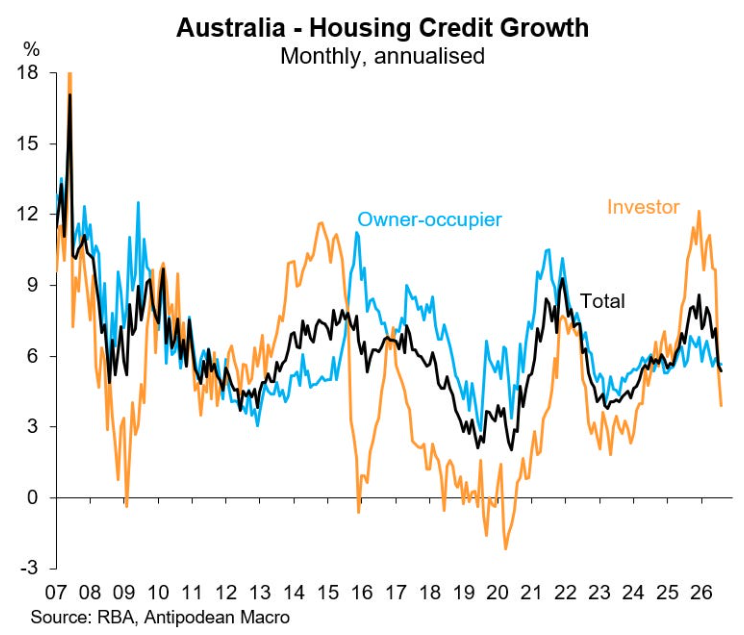
The Reserve Bank of Australia’s (RBA) credit aggregates data for August, illustrated below by Justin Fabo from Antipodean Macro, show that investor housing credit growth decelerated sharply to 0.32%, down from the recent peak of 0.95% in December 2025:
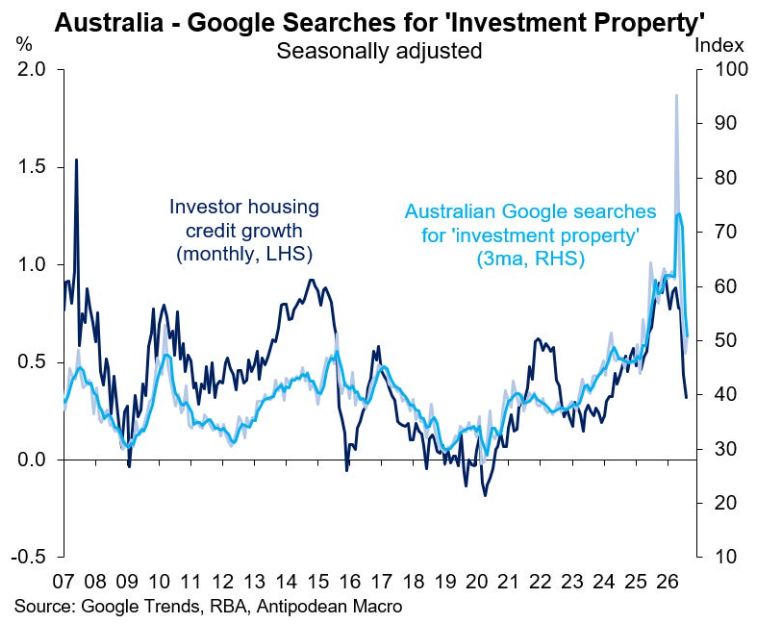
“The slowing in investor housing credit growth in Australia is broadly consistent with a decline in related Google search activity”, Fabo notes:
The federal budget’s changes to negative gearing and capital gains tax have reduced investors’ borrowing capacity by around 30% because of lower after-tax cash flow.
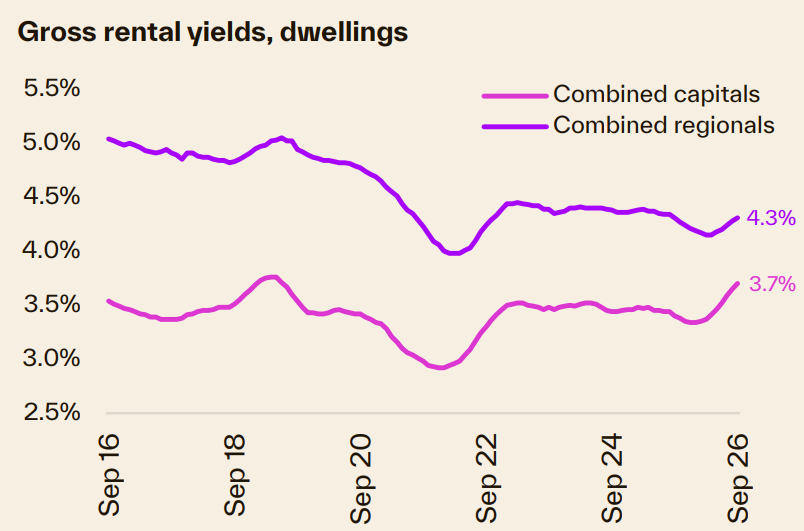
As a result, investors now require higher rental yields for deals to stack up financially. And while gross rental yields have risen recently due to falling property prices and rising rents, they remain at low levels overall:
Source: Cotality
As illustrated above, the gross capital city rental yields of 3.7% compare poorly to a high-interest savings account at an Australian bank, where risk-free yields of 5% or above are available.
A property investor must also deduct maintenance, land taxes, mortgage interest, and other costs.
Moreover, with Australian dwelling values facing their sharpest decline in more than 40 years, already down 5.2% nationally since March, and more significant falls likely amid rising interest rates, the numbers no longer stack up for property investors.
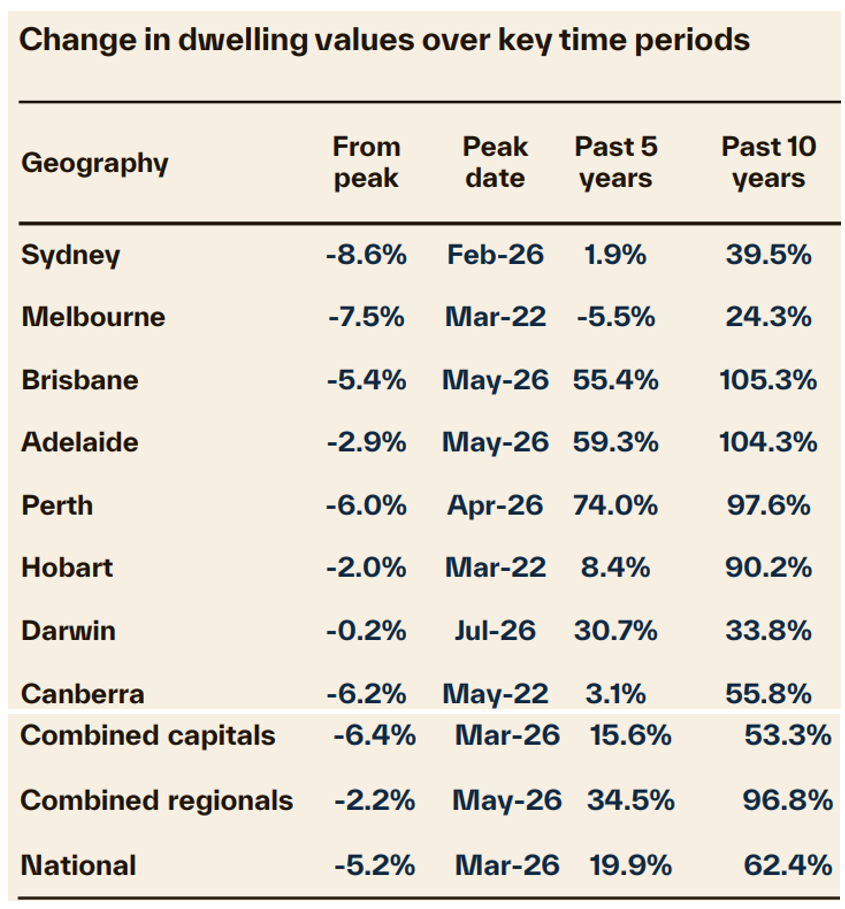
Decline from peak as of 30 September 2026 (Source: Cotality)
After all, why leverage into a falling market for negative cash flow when juicy risk-free deposit rates are available?
There is also a chicken-and-egg element at play. That is, one reason why home prices are falling is that investors have exited the market following the federal budget’s changes to negative gearing and capital gains tax. These falling home values further discourage investors from buying, reinforcing the downward cycle.
Ultimately, home prices need to reset lower and rental yields higher. And we are nowhere near the bottom.
