
Federal and state governments careen off debt cliff
Australia is heading into a steep debt‑refinancing cliff that will impact both federal and state governments.
Federal gross debt surpassed $1 trillion (33% of GDP) in August and is projected to reach $1.25 trillion by 2030 due to persistent deficits.
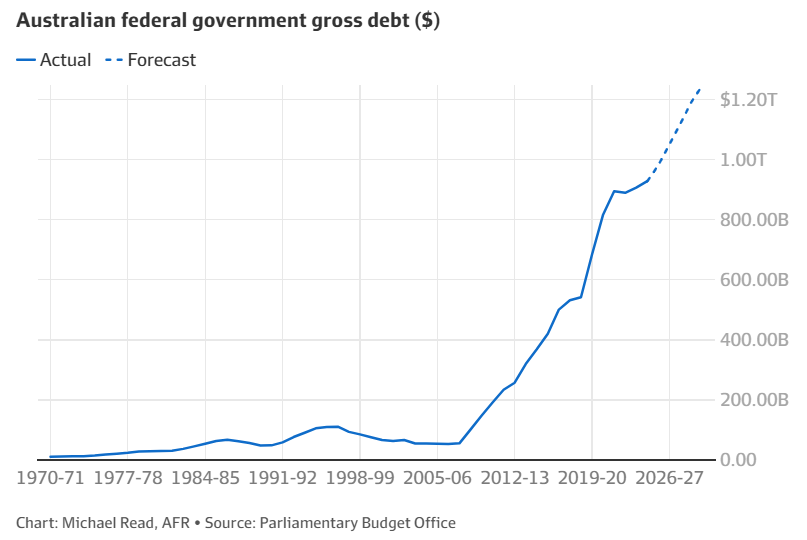
As reported by Michael Read at The AFR, $165 billion of ultra‑cheap COVID‑era federal debt will roll over from a 0.5% interest rate to more than 5% by 2030, which will increase interest repayments by $7.7 billion every year.
This will add to the $29.6 billion already forecast for interest payments this year.
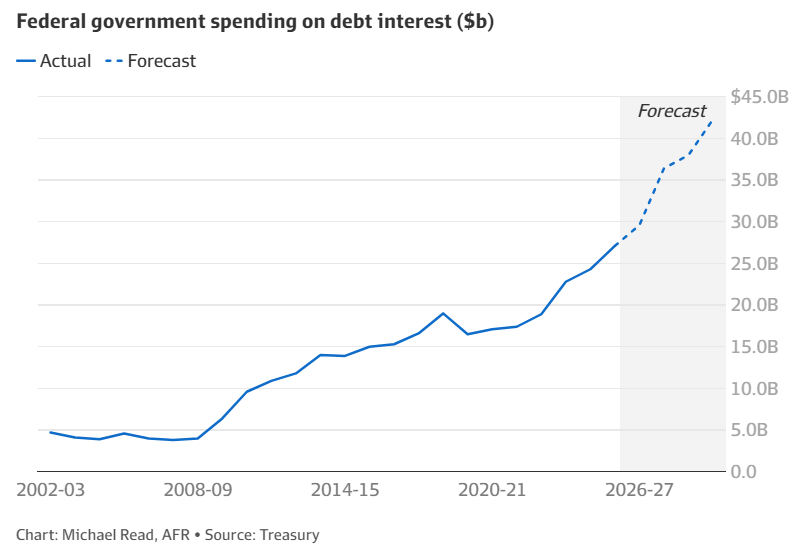
Taxpayers will spend $29.6 billion on interest this year — 3.6% of federal revenue. This is more than spending on:
- PBS: $23.4 billion
- JobSeeker: $18.3 billion
- Childcare subsidy: $16.9 billion
- Public schools support: $13 billion
- Army: $10.8 billion
By 2030, interest costs are projected to reach $42.3 billion (4.6% of revenue).
Economist Richard Holden from UNSW argues Labor has “frittered away” the unexpected tax windfall since 2022, adding debt instead of paying it down.
“If we’d had a much tougher fiscal stance coming out of the pandemic and onwards, including in Josh Frydenberg’s final budget, but most importantly in all the Chalmers budgets, we’d have a lot less debt”, he said.
Holden also says the AOFM should have issued more long‑dated bonds during the pandemic to lock in ultra‑low rates.
States face the same borrowing cliff:
NSW, Victoria, Queensland and SA borrowed $226.5 billion in cheap long‑term bonds. Refinancing will add $8.1 billion (24%) per year in extra interest over the next decade, according to the Institute of Public Affairs (IPA):

The IPA’s analysis is based on $226.5 billion of state debt refinancing from a rate of around 2.0% to 5.5%:

The property downturn and credit rating downgrades pose additional risks for state governments.
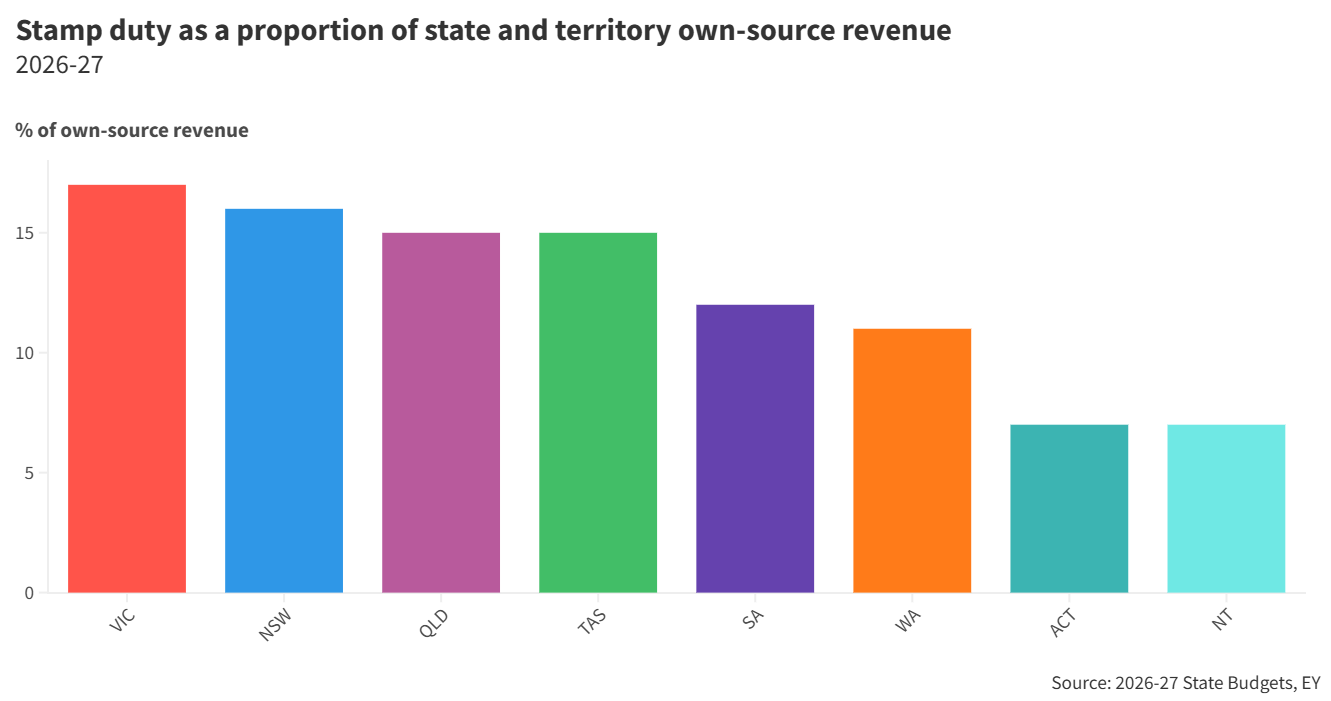
Both dwelling values and property transaction volumes have fallen heavily, with the nation facing its largest downturn in at least 40 years. This property downturn will wipe billions from state government revenues.
Credit rating downgrades will also drive up the cost of debt.
This month, ratings agency S&P downgraded Queensland’s credit rating one notch from AA+ to AA, reflecting that “Queensland’s budgetary performance will remain weak over the next few years as the state ramps up its infrastructure spending, resulting in debt being structurally higher than in the past”.
“Property tax changes by the Australian government in its May budget will also hit Queensland’s stamp duties”, S&P noted.
The Queensland Treasury forecast in the June budget that interest costs on total borrowings will top $10.87 billion in 2029-30, up from $5.48 billion in 2025-26.
However, analysis by Tulipwood Economics suggests the state government may have to pay up to $1.1 billion more in interest to bondholders by 2030 because of the ratings downgrade.
The reality is that Australia’s governments have been living beyond their means for too long, and voters will now have to accept a prolonged period of austerity to reduce debt levels and return budgets to a sustainable position.
