
Cotality’s daily dwelling values index has declined by 2.9% from its peak at the 5-city aggregate level, with all major capitals recording falls.
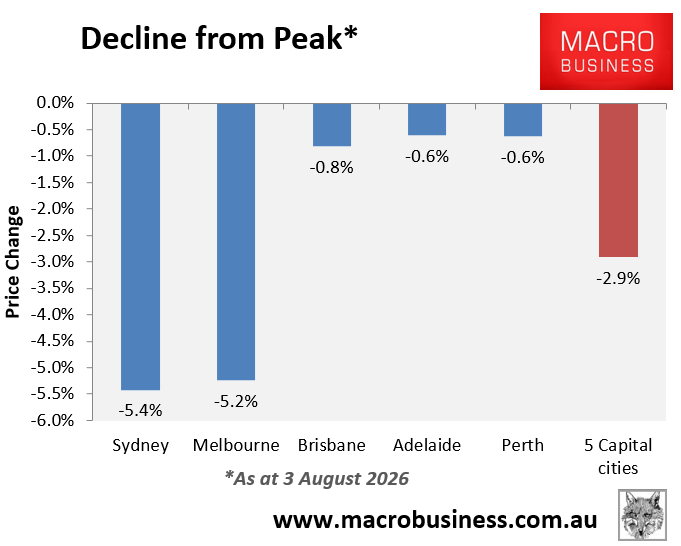
As noted by CBA on Monday, “the housing market is under increasing pressure, with higher interest rates, tighter financing conditions, weak sentiment, and changes to housing tax policy all weighing on demand”.
Regional markets also lost momentum, with the combined regional index falling by 0.2% in July, its first monthly decline since January 2023.
The following chart from CBA shows that the losses have been overwhelmingly concentrated in higher price points, whereas the most affordable homes have held up.
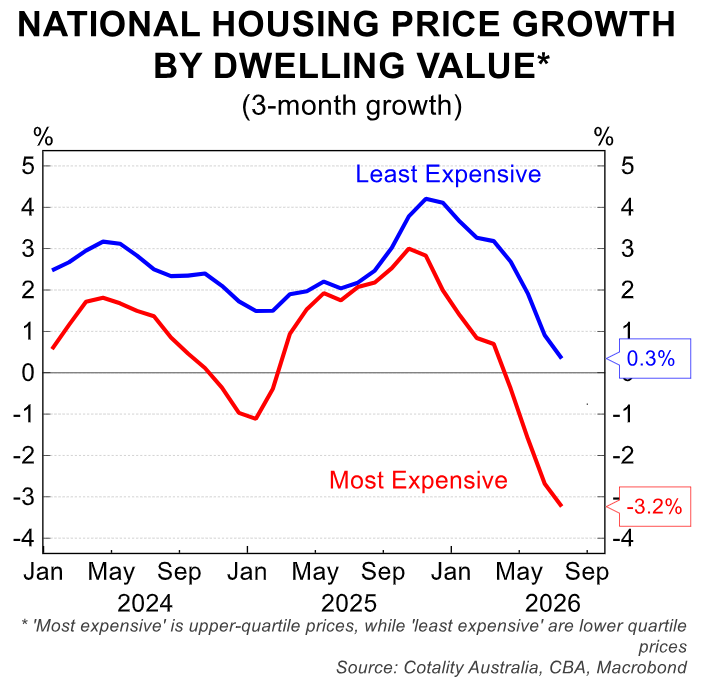
Nationally, upper-quartile values fell 3.2% over the three months to July, while the lower quartile rose 0.3%.
A similar pattern is evident across the capital cities. For example, Sydney’s upper-quartile home values fell by 5.2% over the three months to July, compared with a 1.4% decline across the lower quartile.
In Melbourne, upper-tier values fell by 4.6% over the July quarter, while lower-tier values saw a more modest decline of 1.2%.
“Affordability constraints are likely channelling more demand towards lower-priced homes, while first-home buyer support may also be providing some support at the lower end”, noted Trent Saunders from CBA.
“Even so, lower-tier properties have not been immune to the downturn. On a monthly basis, lower-tier values fell in Sydney, Melbourne, Brisbane and Canberra in July, as well as across the combined capital-city index”.
“This suggests the downturn has broadened further down the price spectrum, even though lower-priced properties continue to outperform”, noted Saunders.
Indeed, the Albanese government’s expanded 5% deposit scheme for first home buyers has increased demand for lower-tier homes.
Reduced borrowing capacity, following the federal budget changes to negative gearing and capital gains tax, has also likely compressed investor demand towards lower-priced properties.
The upshot is that the bottom has fallen out of the expensive end of the market, resulting in heavily falling prices, whereas bottom-end demand remains solid.
