
Data centres increase Australia’s fuel dependency
The spurious claim that intermittent, weather-dependent energy is best to power data centres has been thoroughly debunked by the operators of such sites.
Over the weekend, The Age reported that Singapore-backed Zerra DC has proposed to build a $1.1 billion, 336‑MW data centre campus on Melbourne’s former Ford factory site, which could double the city’s total data‑centre power demand.
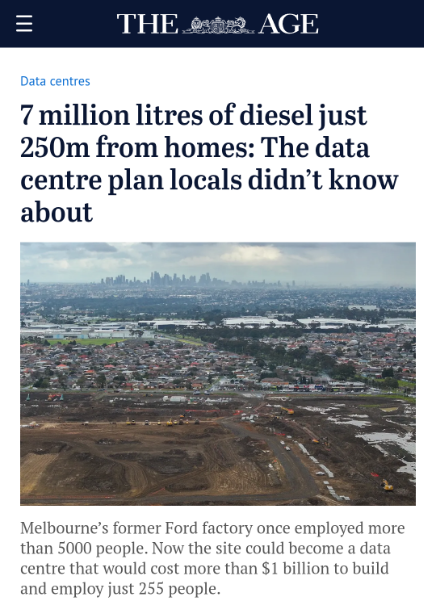
The proposal has gone direct to planning minister Sonya Kilkenny under fast‑track provisions that bypass council and VCAT challenges.
The six‑stage campus, ultimately 336 MW, would equal all 55 existing Melbourne data centres combined, and its footprint would be more than ten times the MCG playing surface.
Stage One would comprise a 48‑MW data hall with 48 diesel generators and 1 million litres of diesel stored on‑site – the equivalent of almost three Olympic swimming pools.
The full build would comprise 294 rooftop chillers, dozens of condensers/exhaust fans, and closed‑loop air‑cooled chillers that reduce water use but increase electricity demand.
As continuous cooling is required, the site would create a significant heat island around the local area. Cambridge research suggests local warming of 2–9°C around data centres.
“In summer, we open up our windows at nighttime to let the cool breeze come in. With the noise, will we even be able to?”, local resident Anastasia Drapaniotis asked.
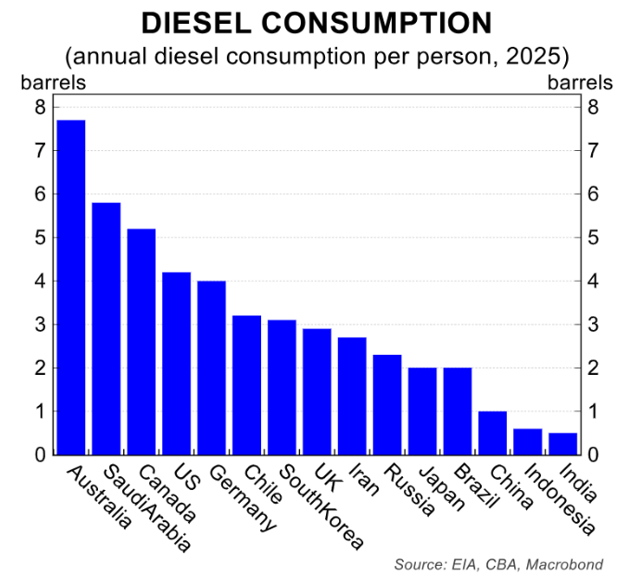
The proposal would increase Australia’s diesel dependence:
Australia is already one of the most diesel-dependent economies in the world, and proposals like this, which include 48 diesel generators to power the site when renewables fail (because of intermittency), will merely increase Australia’s diesel dependence.
Incompatible with Victoria’s renewable energy target:
Victoria has legislated a target to source 95% of its electricity from renewable energy by 2035. This is one of the most ambitious renewable energy goals in Australia and globally, designed to accelerate the state’s transition away from cheap brown coal and towards cleaner energy sources, such as wind, solar, and storage.
The target is embedded in the Renewable Energy (Jobs and Investment) Act 2017 (Vic), giving it legal force. The following timelines have been set to reach the 95% renewable energy target:
- 25% renewables by 2020
- 40% by 2025
- 65% by 2030
- 95% by 2035
The target coincides with the planned closure of the Loy Yang A coal power station in 2035, a decade earlier than originally scheduled.
Data centres require continuous, stable 24/7 power, and the entire facility is engineered around that assumption. Even a brief outage of a few seconds can crash running training jobs, corrupt model checkpoints, or take thousands of GPUs offline.
Cooling systems must also run continuously. If power drops, thermal runaway can damage hardware within minutes.
Sudden power outages also cause data loss.
For these reasons, data centres around the globe have been built with on‑site generation — diesel generators or gas turbines sized to carry the full load.
Indeed, the data centre build-out in the United States has caused a massive rise in fossil fuel generators (mostly gas):
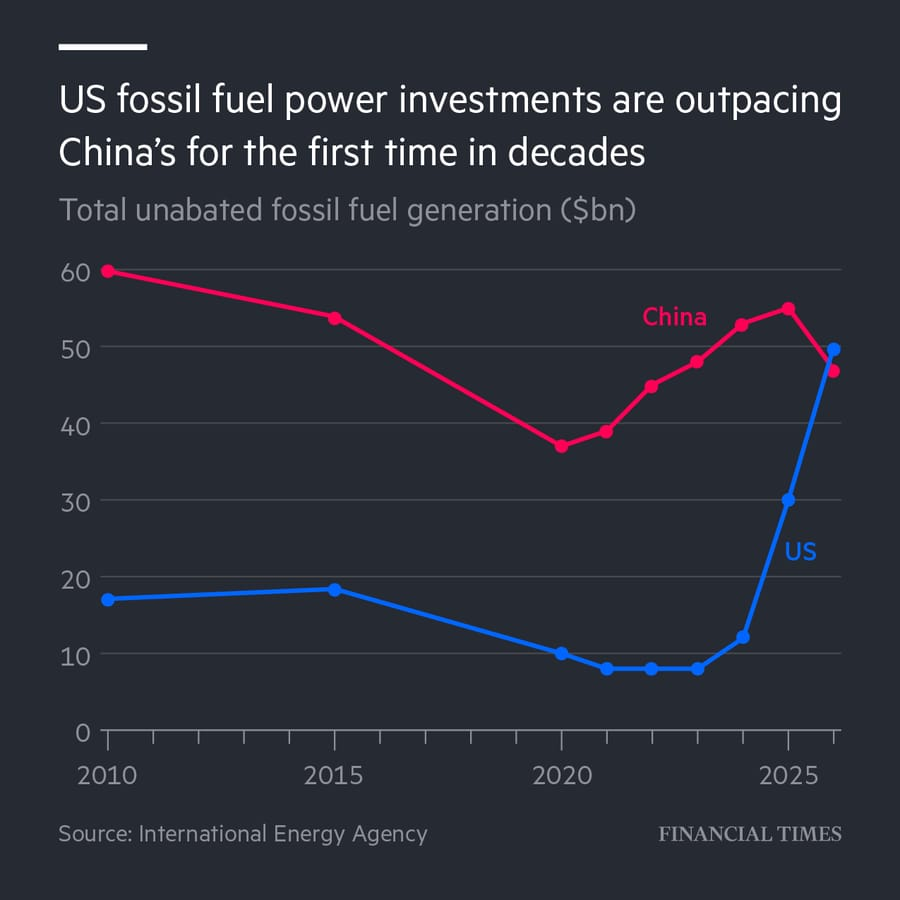
Presumably because of Victoria’s lack of sunshine in winter and regular wind droughts, the proposed data centre is planned to have 48 diesel generators and 1 million litres of diesel stored on‑site.
Inconvenient truths:
The reality is that the planned 95% RET for Victoria is incompatible with the mass build of data centres, as well as with the planned strong population growth, the electrification of the vehicle fleet, and water desalination plants.
Just as humans need a balanced diet to remain healthy, the electricity grid requires a balance of supply.
Australia needs more energy from a diversity of sources, not only weather-dependent wind and solar.
