
Economist Chris Richardson is one of the nation’s best analysts on budget finances.
Sadly, his expertise does not extend to the housing market, where, like many others, he fails economics 101 by only seeing the supply side and ignoring demand.
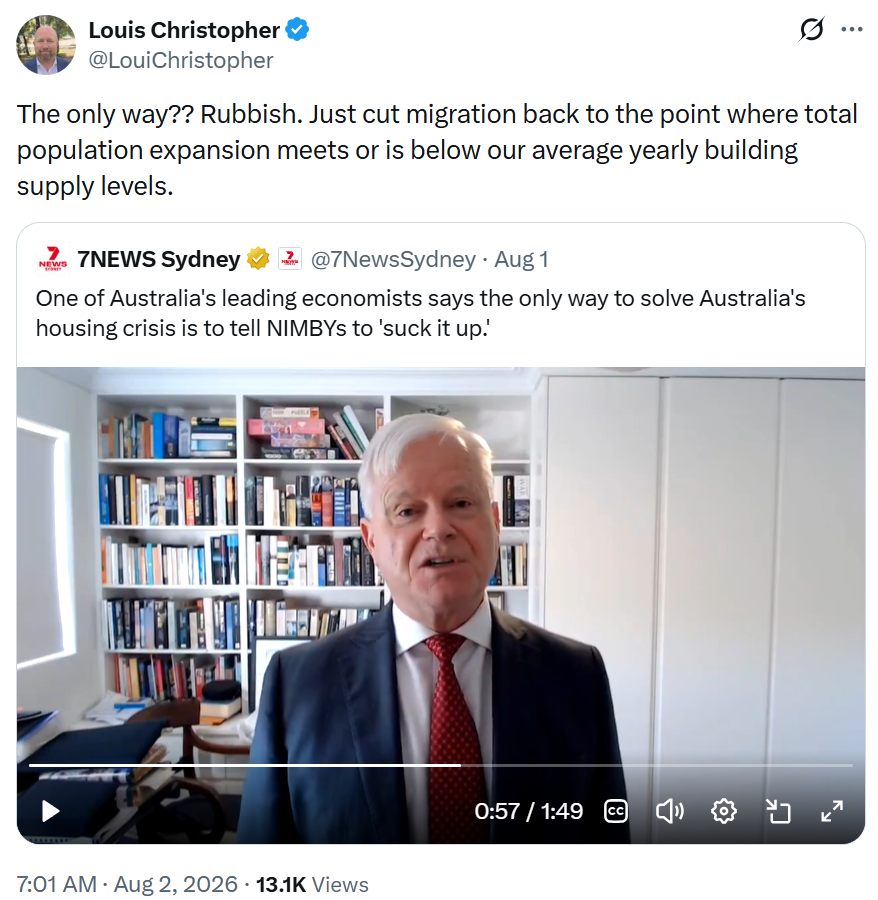
Richardson told 7News’ The Issue Podcast that the only way to solve Australia’s housing shortage is to tell NIMBYs to “suck it up”.
He says the country’s housing policy for decades has been the word no.
“No, you can’t do that. No, you can’t build here, you especially can’t build there, and on those occasions where you are allowed to build, there are a whole heap of rules and regulations that mean that that building’s going to be incredibly expensive”.
“You need the Federal Government to bully the states, to bully the councils, to get stuff done”.
SQM Research founder Louis Christopher rightfully fired back at Richardson’s myopic view, noting that the shortage could be ‘solved’ by simply cutting Australia’s extreme rate of immigration “back to the point where total population expansion meets or is below our average yearly building supply levels”.
Independent property analyst Cameron Kusher also responded questioning why everyone should have to “suck it up and live in a worse way than previous generations did”.
The reality is that Australia’s dwelling construction rate over the past 20 years has easily exceeded that of the 20 years prior.
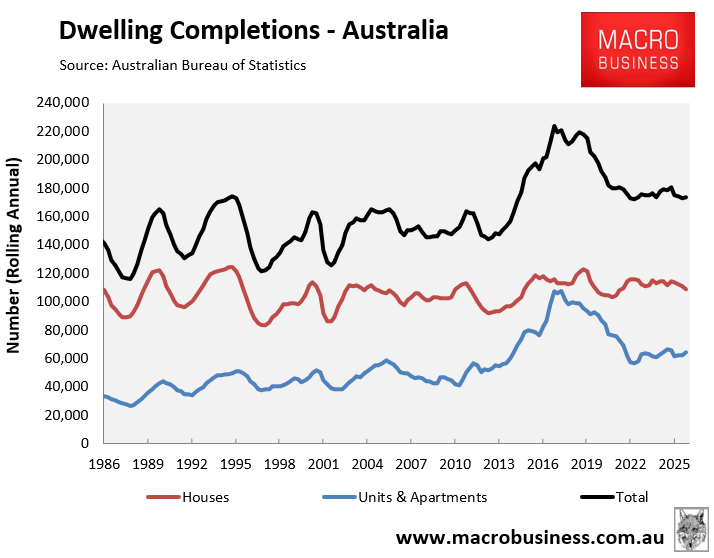
Over the 20 years to the March quarter of 2026, an average of 174,500 homes were built annually. This was 28,200 (19%) more than the 146,300 homes built annually in the previous 20-year period.
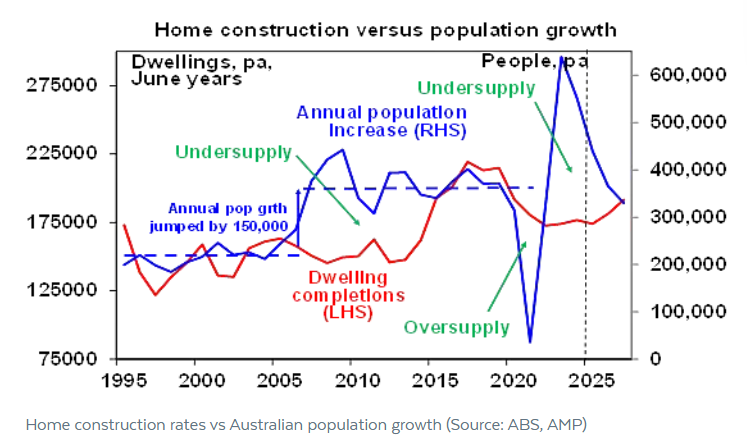
The problem for supply was that demand via immigration-driven population growth easily exceeded the rise in construction.
In the 20 years to December 2025, Australia averaged 236,200 net overseas migration (NOM) and population growth of 372,600. This was well in excess of the 101,900 average NOM over the prior 20 years and population growth of 219,900.
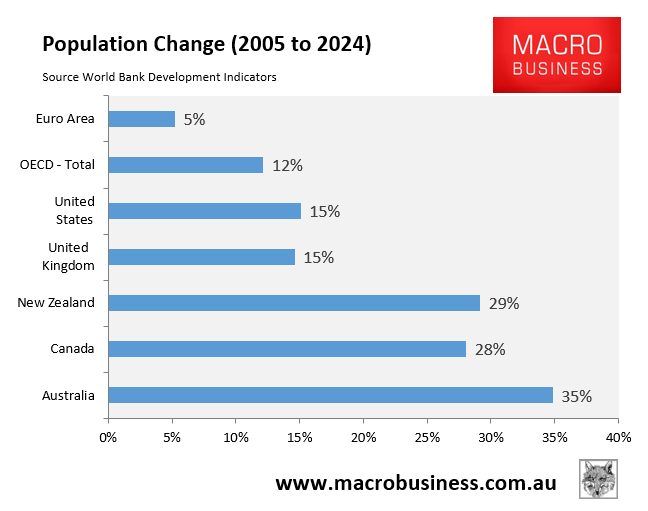
Australia’s population growth was also among the strongest in the developed world:
Indeed, AMP chief economist Shane Oliver estimated in November 2025 that Australia’s cumulative housing shortage was at least 220,000 dwellings, which he attributed to the step-change in immigration from 2005.
“Up until 2005, the housing market was in rough balance. It then went into a massive shortfall of about 250,000 dwellings by 2014 as underlying demand surged with booming immigration. This shortfall was then cut into by the 2015-20 unit building boom and the pandemic-induced hit to immigration”.
“But it’s since rebounded again to around 220,000 dwellings, or possibly as high as 300,000 if the pandemic-induced fall in household size is allowed for. The shortfall is confirmed by low rental vacancy rates”.
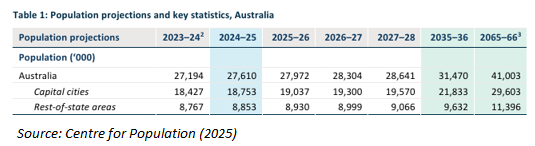
The Centre for Population expects this extreme, city-centric population growth to continue indefinitely, with the combined capital cities projected to balloon in size by 10,850,000 over the 41 years to 2065-66:
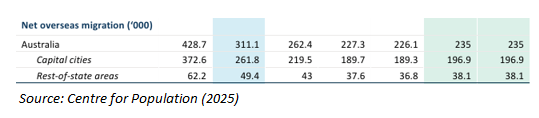
This extreme growth will be driven by net overseas migration (NOM), with the capital cities projected to receive 196,900 net migrants a year. In contrast, the regions are only expected to receive 38,100 migrants a year:
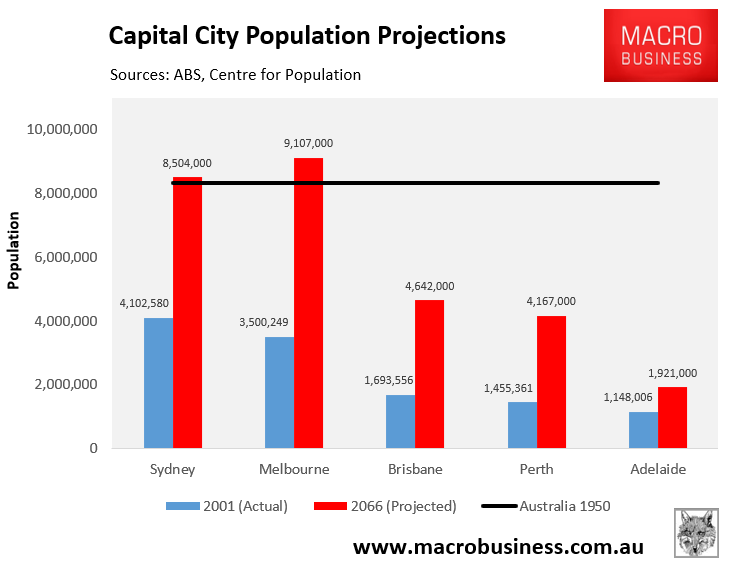
As a result, Sydney and Melbourne are projected to balloon in size into megacities of more than 8 million people. Both are also projected to be larger in 2065-66 than the entire Australian population was in 1950:
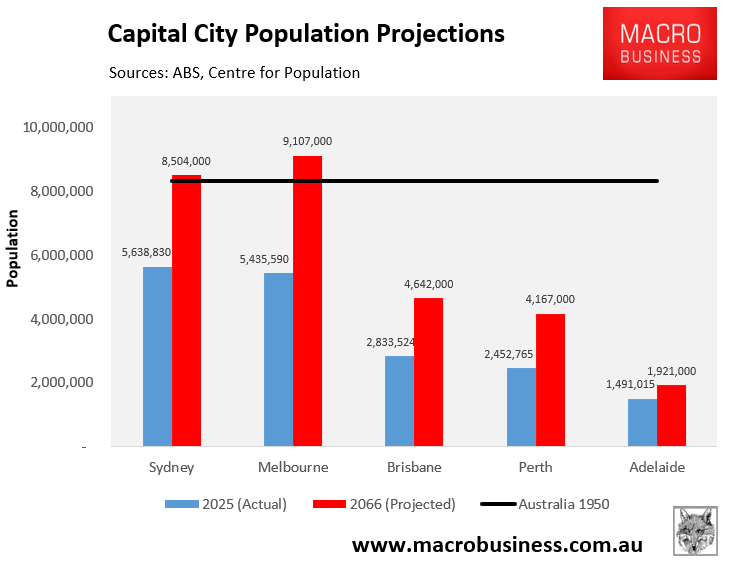
Strong growth is also projected for the other major capital cities.
This volume of population growth in Sydney and Melbourne needs to be put into context:
- It took Sydney roughly 210 years to reach a population of 4.1 million in 2001. Yet the official Centre for Population projection projects Sydney will more than double that number to 8.5 million people in only 65 years.
- It took Melbourne nearly 170 years to reach a population of 3.5 million in 2001. However, the official Centre for Population projection expects Melbourne’s population will increase by 160% to 9.1 million in only 65 years.
The reality is that Australia’s immigration levels and population growth are well beyond what our cities can absorb, and Australia’s housing and infrastructure supply is not keeping up with demand, despite our best efforts.
The result is that individual living standards are continually eroded by rising congestion costs, declining housing affordability, higher infrastructure costs (e.g., toll roads and water), environmental degradation, and overall reduced amenity.
No amount of “planning” can mitigate such extreme population growth.
Thus, for Chris Richardson to blame so-called NIMBYs while entirely ignoring mass immigration is disingenuous and fails both economics and housing 101.
