
The Institute of Public Affairs (IPA) published the following chart, derived from the Australian Bureau of Statistics (ABS) national accounts, showing that the Albanese government is the first in modern history to preside over a fall in GDP per capita.
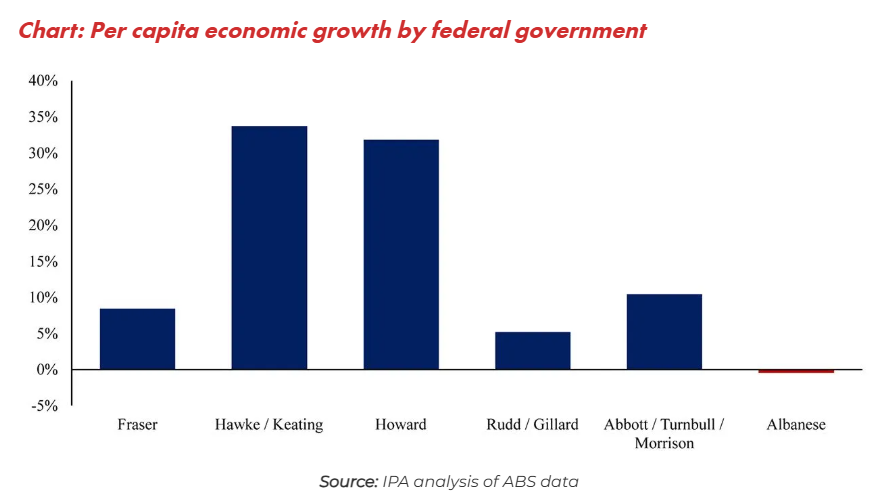
“Per capita real gross domestic product has grown by less than zero (-0.49%) in real terms since the start of the Albanese government in the June quarter of 2022”, Dr Kevin You, Senior Fellow at the IPA, noted.
“Ten out of the fifteen full quarters under the Albanese government has experienced a fall in per capita real economic output”.
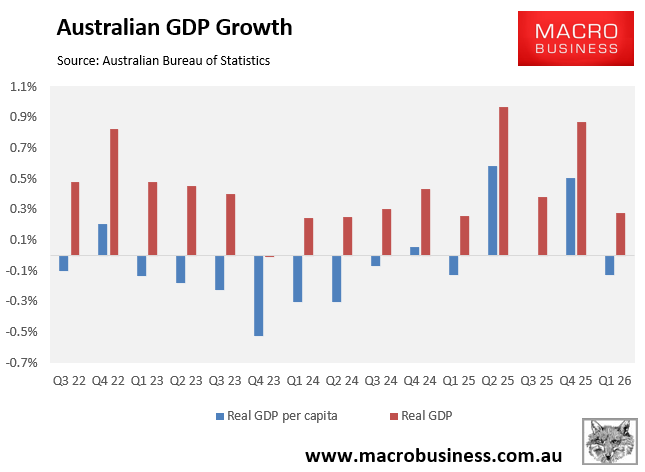
“The Albanese government has overseen the worst set of economic numbers at least since digitised records began in the early 1970s”, he says.
You argues that the Albanese government has masked Australia’s economic decline by running the largest immigration program in the nation’s history.
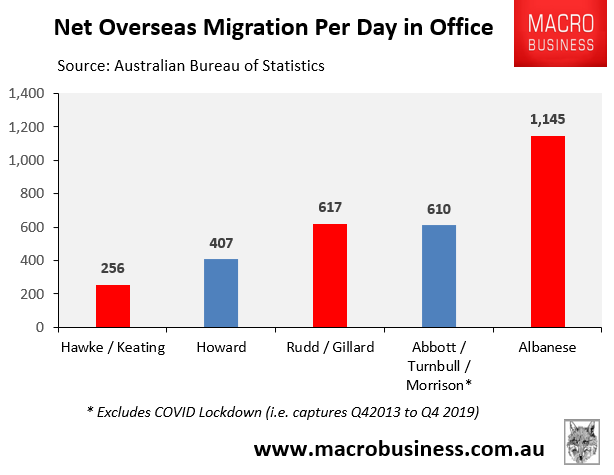
“The latest official economic data show once again that mass migration is making Australians poorer, and gaslighting from the Treasurer that the results are strong will only further drive anger”, he says.
“If mass migration is considered to be so good, then why are Australians getting poorer, for longer, than at any time in living memory?”
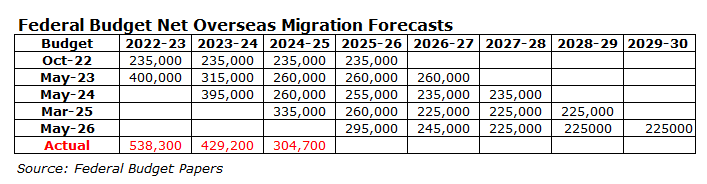
In a separate article published in the Spectator, IPA Research Fellow Cian Hussey warns that Labor has budgeted for 1.22 million new net migrants before the end of the decade:
Over the next five years, Labor now wants to bring in 55,000 more people than previously planned, with a total of 1.22 million new migrants on a net basis before the end of the decade. Considering the fact that they have failed to meet their own (very high) migration targets, letting in more people than they said they would every single year, it is likely that the Albanese government will exceed even this number.
What the Budget reveals is a doubling down on the strategy of high migration to prop up headline economic growth. The size of the economic pie does grow when more people are brought into Australia, but that growth rate has to be higher than the migration rate, otherwise the slice given to each Australian will get smaller.
A smaller slice is exactly what Australians have been given over the past four years…
This is one of the core problems of Australia’s current migration system: it is making Australians poorer.
The uncomfortable reality is that Australia’s recent productivity performance has been among the worst in the OECD.
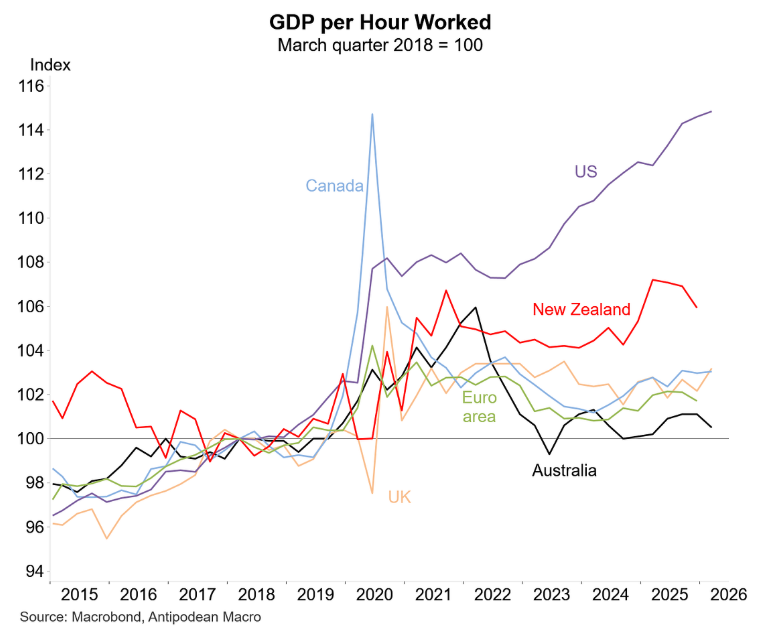
As a result, headline GDP growth has remained soft due to rapid net overseas migration (NOM), while per capita GDP has gone backwards.
In fact, falling labour productivity and per capita GDP growth have been a defining feature of the Australian economy ever since NOM was more than doubled in the mid-2000s:
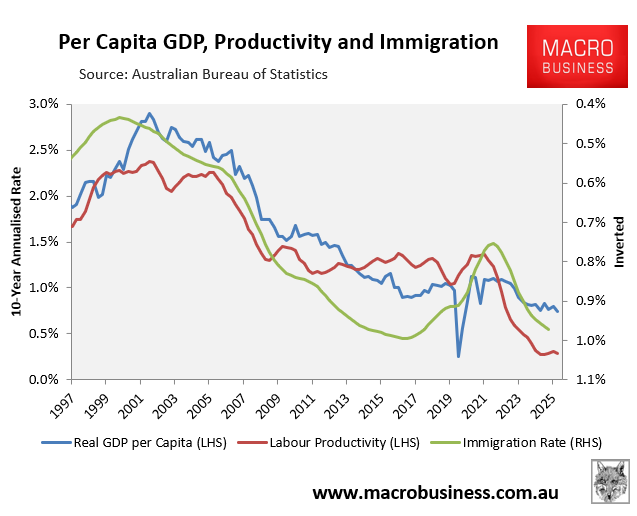
The data is clear: mass migration has made Australian living standards worse, not better.
