
Excise revenue collapse backs federal budget into a corner
The AFR’s John Kehoe argues that “the government has inadvertently underwritten a tobacco crime wave and is now trying to plug the revenue hole by increasing taxes on capital income”.
He argues that the Treasury has a history of underestimating consumer responses to tax increases and overestimating receipts.
Tobacco excise has risen 28% since 2023, following earlier Coalition increases. Treasury assured the government that higher taxes would raise revenue and reduce smoking.
Instead, the result has been an unmitigated disaster, namely:
- A $25 billion collapse in revenue;
- A surge in black-market cigarettes and vapes; and
- Growth in organised crime, fire‑bombings and violence.
Kehoe calls this “a grave public policy failure” and said that “Treasury told Jim Chalmers what he wanted to hear”.
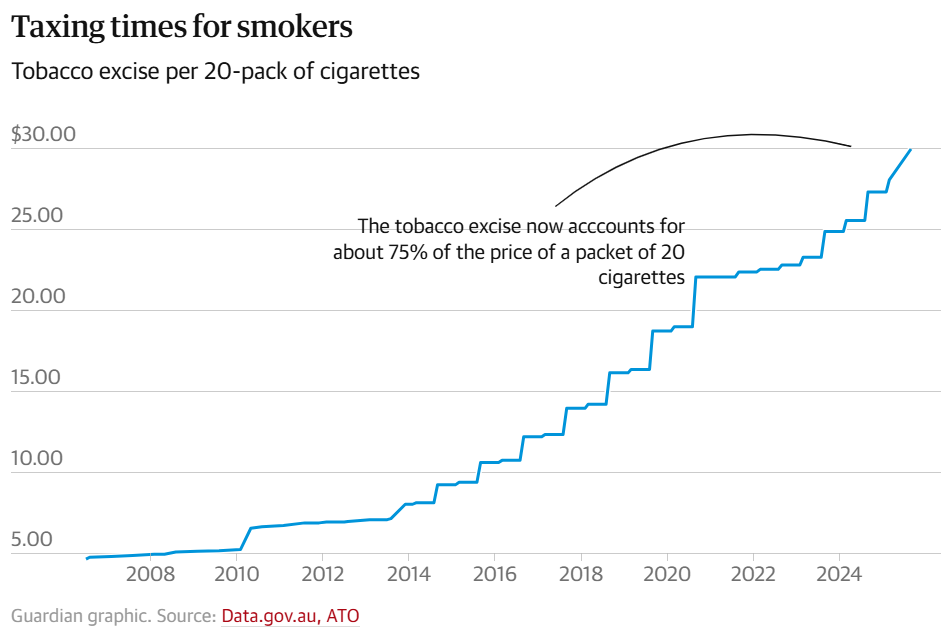
You can add the loss of fuel excise into the mix, caused in part by the federal government’s heavy subsidisation of electric vehicles, which have cost the federal budget far more than expected.
Kehoe argues that the government is trying to plug the excise revenue hole by taxing capital income more heavily and risks repeating Treasury’s policy mistakes by, once again, underestimating behavioural responses and overestimating revenue.
The article argues that Australia already has the following:
- A high company tax rate (30% for foreign investors).
- A high top marginal income tax rate (47% at $190,000).
Accordingly, there is the risk that globally mobile entrepreneurs and investors may leave Australia. Kehoe asks whether this risk is worth taking when Australia is struggling to attract investment and has stagnant productivity?
Kehoe argues that Treasury has lost senior tax expertise and become a “Department of Revenue” focused on raising money, not productivity.
He also argues that the designed CGT changes are aimed at maximising revenue, not neutrality, and cites the following:
- Indexation only to inflation
- No indexation of losses
- No income averaging
- A 32% minimum CGT rate (including the Medicare Levy)
Kehoe also argues that the main distortion is Australia’s absurdly high 47% top marginal tax rate that kicks in at $190,000, which is only 1.9 times median full-time earnings.
Former Treasury secretary Ken Henry has said that high labour taxes discourage investment in human capital.
Kehoe argues that cutting the top rate to 39% (Paul Keating’s target) would solve many of the problems, including:
- Reducing the need for complex CGT indexation;
- Improving incentives for skilled workers;
- Make the CGT debate “largely irrelevant”.
“But Chalmers wants to align the taxation of capital and labour by taxing gains more, instead of taxing the most productive workers less”, Kehoe concludes.
I largely agree with Kehoe. Personal income taxes are too high and need to be lowered. I also believe that the changes to capital gains taxes should have been limited to residential property, given that is where the distortion in terms of fuelling home prices lay.
Instead, the Albanese government chose a tax grab rather than tax reform. And the budget has landed like a lead balloon.
