
At 48, I am officially part of Australia’s “sandwich generation”, busy caring for both teenage children and elderly parents.
While I am earning more than I did in my 30s, my family’s expenses have also never been higher, as has my tax bill.
Analysis by Taylor Fry for the Actuaries Institute, presented in The Australian newspaper, shows that age 43 is the peak tax‑paying age in Australia, with the average 43‑year‑old paying $59,000 per year across income tax, GST, superannuation taxes, housing taxes and other levies.
This is roughly four times what a 20‑year‑old pays, 60% more than a 30‑year‑old, and more than retirees pay by a wide margin.
People in their 40s pay the most because they earn the highest wages, pay more superannuation contributions tax, spend more on families (resulting in higher GST), and move homes more often (resulting in stamp duty payments).
The analysis also shows that Australians under 25 and over 65 are net beneficiaries of government spending, with middle‑aged Australians funding the gap.
Taylor Fry principal Hugh Miller noted that Australia’s tax system falls disproportionately on working-age people because Australia relies heavily on personal income tax, unlike countries with higher GST rates.
Superannuation is also taxed mainly during accumulation, not retirement, and housing taxes (especially stamp duty) hit people before retirement, when they move more often.
OECD data shows Australia has one of the highest income‑tax burdens on average workers in the developed world.
Financial adviser Darren James also warns that the new capital gains tax (CGT) rules will hit younger Australians.
This is because the new 30% minimum CGT removes the tax-free-threshold benefit for lower‑income spouses, and the changes penalise younger Australians who used shares to build deposits.
“You don’t get any tax-free threshold, so if you were a couple with a spouse on a lower income because they were looking after kids, if you sold a joint investment property you might have got the $20,000 tax-free threshold for her or him on the lower income, but under the new rules it a flat minimum 30% tax rate”, James said.
“Specifically for shares, it just doesn’t make any sense as to how changing the capital gains tax rules on shares has any influence on how new homeowners can get into housing”.
“It actually makes it worse because a lot of new homeowners were using shares to build their wealth because they couldn’t afford to buy a house, and now they’re going to be penalised with a change in tax rules as a result”, he said.
Meanwhile, older Australians keep the 50% CGT discount for all gains made before July 2027.
My biggest issue with last month’s federal budget was that it raises billions in tax revenue via changes to negative gearing, CGT, and the 30% minimum tax rate on discretionary trusts, but it hasn’t done anything to ease the federal budget’s egregious reliance on personal income taxes, which are forecast to grow.
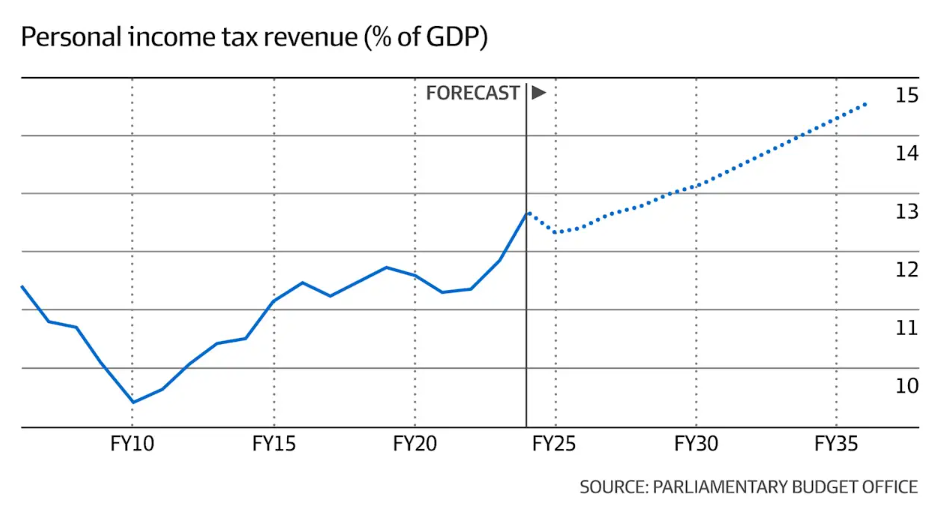
The budget papers show that government revenue from individuals’ income tax is forecast to exceed $382 billion in 2027-28, equating to 52% of the total tax take. It is also expected to rise to 54.5% by 2029-30 – the highest level since 1999-2000, before the GST was introduced.
The absurdity of the situation is illustrated in the table below:
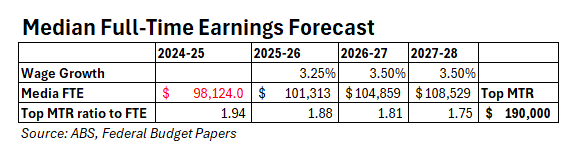
According to the Australian Bureau of Statistics (ABS), median full-time cash earnings (i.e., the regular, gross (pre‑tax) cash wages and salaries paid to employees for work done, including paid leave, but excluding irregular payments, superannuation, and non-cash benefits) were $98,124 per annum as of May 2025. They would be more than $100,000 now, given wage growth.
The top marginal tax rate (MTR) of 45% (excluding the Medicare Levy) currently applies to income above $190,000. As a result, in 2025-26, one only has to earn around 1.9 times the median full-time earnings to pay the top MTR.
According to the federal budget’s wage growth forecasts, the median full-time earnings will rise to $108,529 by 2027-28. By that year, one would need to earn only about 1.75 times the median full-time earnings to pay the top MTR.
The following table shows that over a decade, if earnings grew by just 3.25% annually, median full-time earnings would be around $140,000 by 2035-36.
In this scenario, one would only need to earn around 1.35 times median full-time earnings to pay the top MTR, assuming income tax thresholds remain unchanged:

Therefore, without reform, Australians will pay significantly more in personal income tax every year, courtesy of wage rises that barely keep pace with inflation.
The solution is to index the income tax scales to 2.5% – the midpoint of the RBA’s inflation target – to eliminate bracket creep over the long term.
The government also wouldn’t be able to rely on ever-growing income taxes; therefore, it would have to be more careful with how it spends our money.
Sadly, the Albanese government instead chose a ‘tax grab’ rather than genuine ‘tax reform’.
