
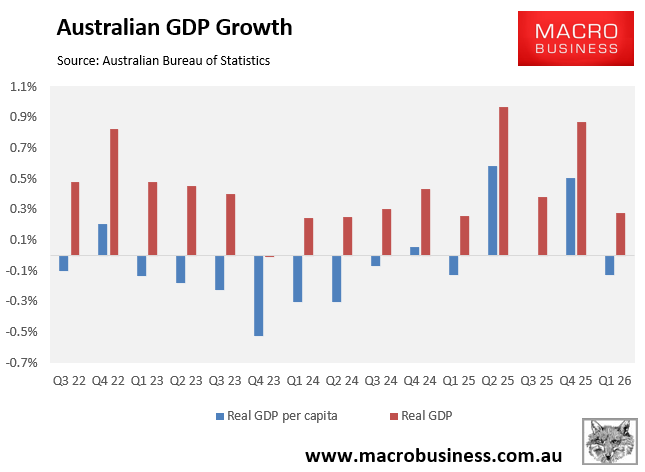
This month’s national accounts from the Australian Bureau of Statistics (ABS) reported that the economy is sliding back into a per capita recession, with real per capita GDP declining by 0.1% in the March quarter – the 10th decline in 15 quarters since the Albanese government came to office:
The Westpac-Melbourne Institute leading index has been released, which indicates the likely pace of economic activity relative to trend three to nine months into the future.
The six-month annualised growth rate remained weak at –0.17% in May, suggesting slugging momentum into the second half of 2026:
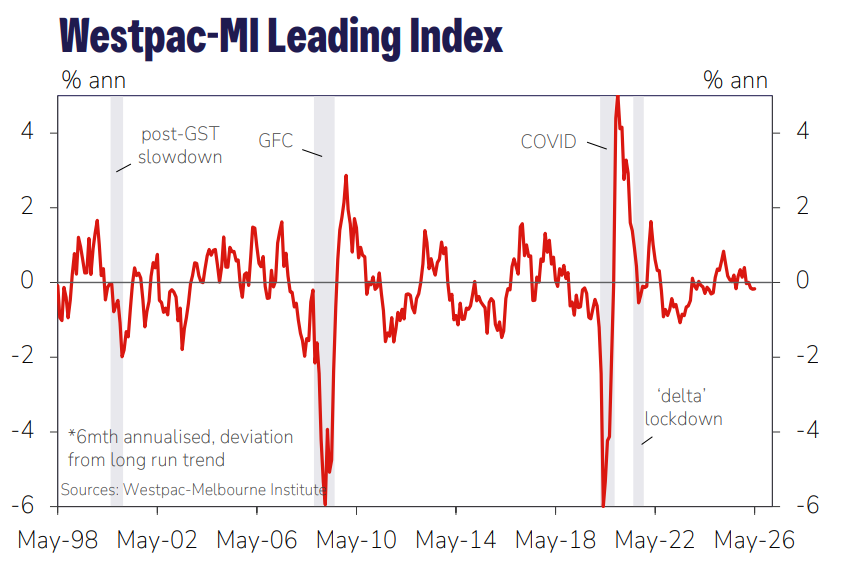
“The last six months have seen the Leading Index growth rate swing from a solid positive +0.40% in December to a decidedly sluggish –0.18%”, Westpac’s Head of Australian Macro-Forecasting Matthew Hassan said.
“The deterioration has been fairly broad-based with five of the eight components contributing to the slowdown”.
“The Australian economy is showing clearer signs of a loss of momentum”, Hassan said. “The March quarter national accounts revealed a clear softening in activity with demand near flat outside of a pick-up in data centre related investment”.
“The May Leading Index shows this sluggish, below-trend growth momentum is likely to continue through the second half of 2026 and into early 2027. While the growth pulse is still not overly weak, it’s likely to take some time yet before the full negative impacts from higher interest rates and the spike in fuel costs become apparent”.
Meanwhile, as Justin Fabo from Antipodean Macro illustrated below, Jobs & Skills Australia data released this week also shows that the share of employers in Australia actively recruiting has softened recently, sending a similar signal to the NAB employment index:
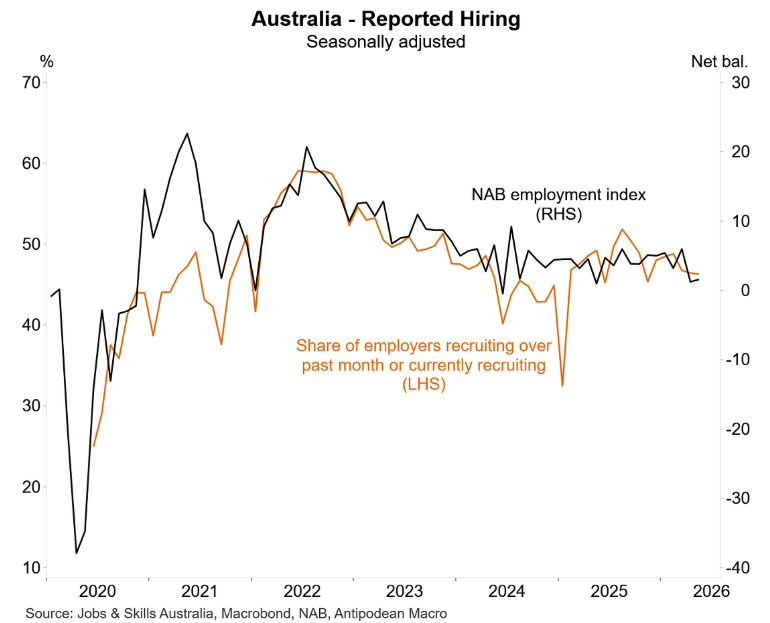
The economy is clearly slowing, as we would expect given recent interest rate rises and poor productivity growth.
