
Australia’s electricity grid must be built to handle the worst moments, not averages.
This week, Australia’s National Energy Market (NEM) has experienced a prolonged wind drought, which, alongside low solar generation due to winter, has made the grid overly reliant on coal and gas.
As I began writing this article at 9.50 am on Wednesday, only 26% of the NEM’s power generation is coming from solar (21%) and wind (5%), while coal (54%) and gas (9%) are carrying the load:
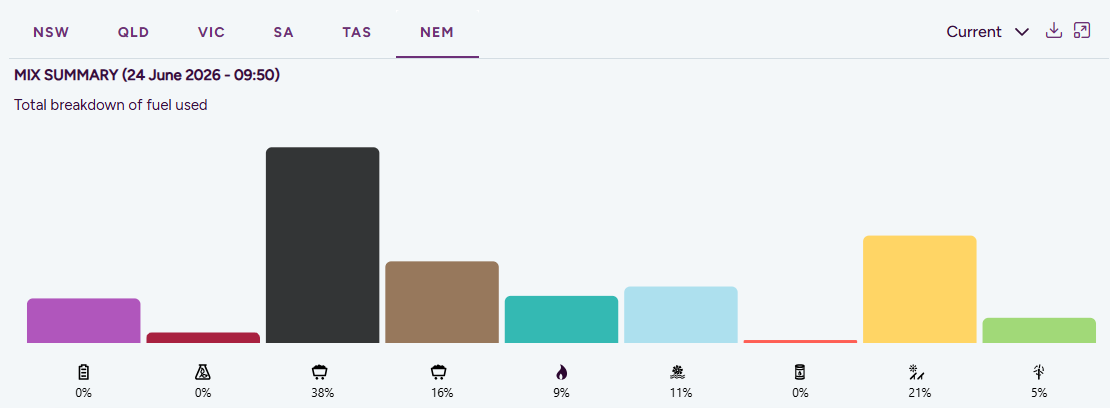
NEM Power Mix – 24 June, 9.50am
Later in the evening, at 7.40pm, only 5% of power was coming from wind with solar offline (nighttime), and batteries were providing only 7% of the load. Meanwhile, coal (54%) and gas (19%) were powering the system, providing nearly three quarters of the generation.
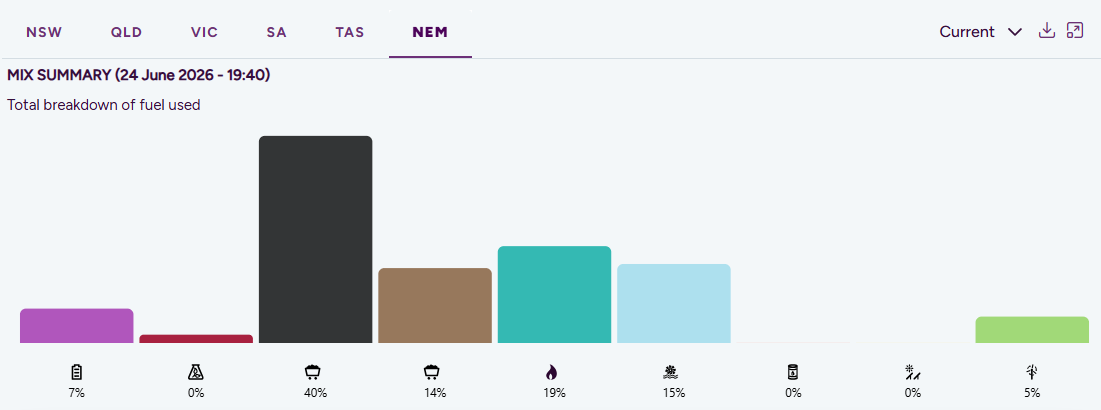
NEM Power Mix – 24 June, 7.40pm
The situation was equally bad over the prior 48 hours, with only 11% of the NEM’s power generated by solar (6%) and wind (5%), and batteries (partly charged with coal power) only providing 2% of the load:
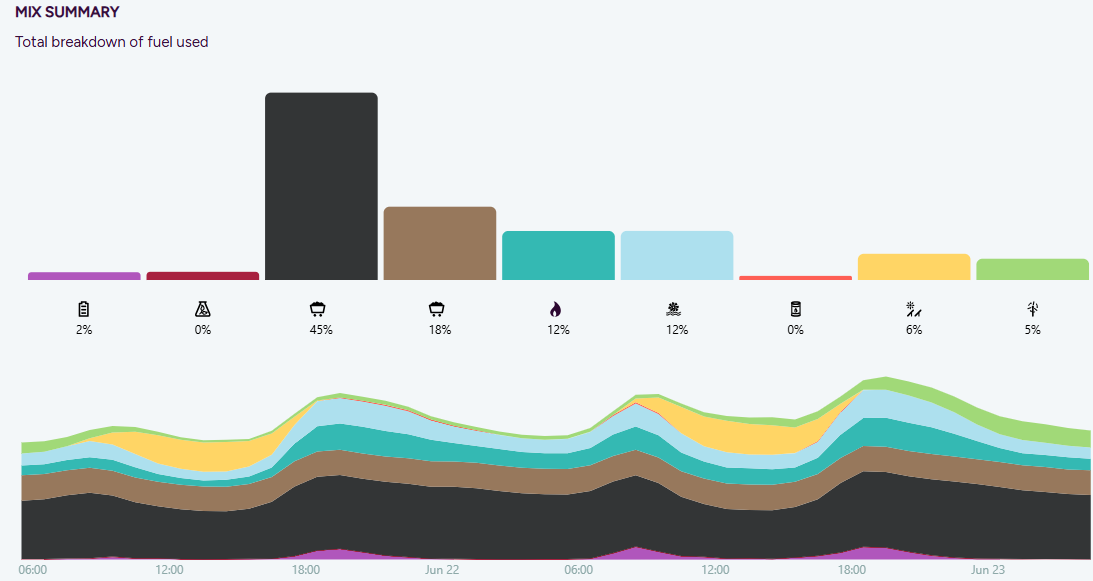
NEM Power Mix – 48 hours
By contrast, coal (63%) and gas (12%) provided 75% of total power generation over the 48-hour period.
Recall that Australia’s governments plan to progressively shutter Australia’s coal generation over the next 15 years, with the nation expected to be powered almost fully by renewable sources:
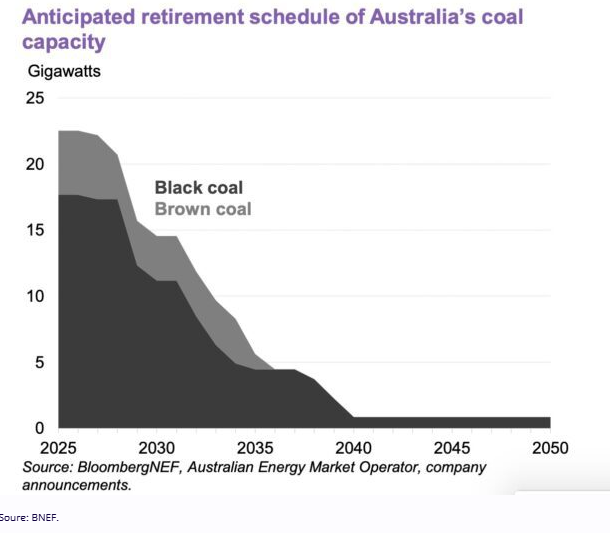
At the same time, Australia’s electricity demand is expected to balloon due to:
- A projected increase in population of 13 million over the next 40 years;
- The electrification of the vehicle fleet;
- The rapid expansion of data centres; and
- The expansion of water desalination plants.
Data centres, and the economy more broadly, require stable 24/7 power to function, which, as we have just seen over the past several days, cannot be provided by weather-dependent, intermittent sources like wind and solar.
Weather events like wind droughts often synchronise, so no amount of north-south interconnectors and batteries can bridge the gap when renewable generation goes AWOL.
Batteries also charge up overnight with coal power and are discharged during the morning peak. Thus, when coal generation shuts down, battery utilisation will also decline.
The notion that Australia can magically shut down its baseload coal, pivot to near 100% renewable energy, and still massively increase energy demand is delusional.
Australia will need more non-weather-dependent baseload generation, not less.
Our FAFO moment will arrive once the remaining coal generators begin to close.
