
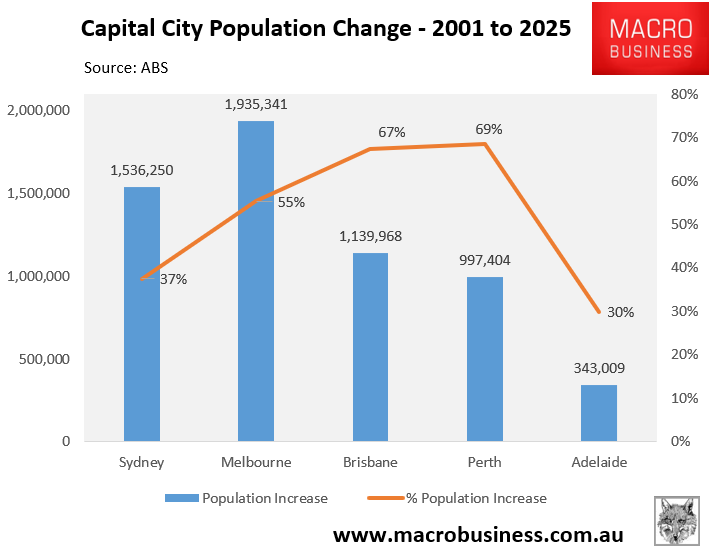
Sydney’s population has ballooned by 1.5 million people since 2001, according to the Australian Bureau of Statistics (ABS), with most of this growth concentrated in the city’s west.
According to the SMH, Sydney’s urban fringe is buckling under the pressure.
Sydney’s north-west growth corridor — especially suburbs like Riverstone and Schofields — has become a case study in how decades of infrastructure‑last planning have created daily dysfunction for residents.
A couple, Raj and Rathiga, moved from Epping to a new estate marketed as “Oasis”, only to find:
- Bus services unreliable, often cancelled or diverted without notice.
- Single‑access roads frequently blocked by nearby construction.
- Commutes blowing out from an expected 8 minutes to 30-plus minutes.
- No footpaths, despite bus stops being installed.
- No clear accountability between Transport for NSW, councils, and developers.
Their experience reflects a broader pattern across Sydney’s fringe: population growth has far outpaced the delivery of roads, transport, schools, and community facilities.
Promises made in 2006 were slowly dismantled. When the North West Growth Area was announced, the NSW government promised not to repeat the mistakes of Kellyville, where homes were built long before infrastructure.
But over time, developers successfully lobbied to accelerate housing approvals, planning controls were repeatedly loosened, and infrastructure commitments did not keep pace.
These changes resulted in homes appearing years before transport, schools, or services.
The story of high-density Schofields, at the centre of the north-west growth area, is illustrative. The precinct, originally zoned in 2012 for around 2950 homes, saw:
- 2014: Minimum lot sizes halved from 250 to 125 m².
- 2016: Semi‑detached homes allowed.
- 2017: Government increased the north‑west housing target from 70,000 to 90,000.
Each change increased density without any matching infrastructure investment.
As a result, congestion is now extreme. Data from The Hills Shire Council shows that Windsor Road and Old Windsor Road have slowed to 21.8 km/h in the morning peak, with speeds now 10% slower than a year earlier. Residents face daily gridlock simply leaving their estates
This situation is the clearest sign that the road network was never designed for the population now living there.
Multiple agencies — the Growth Centres Commission, Greater Sydney Commission, Department of Planning — were meant to coordinate growth.
However, agencies cannot spend money governments don’t allocate and political decisions repeatedly overrode planning frameworks. Housing targets were also increased without infrastructure funding.
As Estelle Grech, an adviser to former planning minister Rob Stokes and now a policy adviser at the Committee for Sydney, put it: “Was the planning useless, or was the planning helpful until the politics interfered and made it useless?”
Sydney’s north-west is the product of two decades of housing-first, infrastructure-later policy, where planning safeguards were gradually weakened and political pressure to build more homes overwhelmed long-term strategy.
The result is a region where tens of thousands of people live in suburbs that were never properly serviced and where governments are now scrambling — years too late — to catch up.
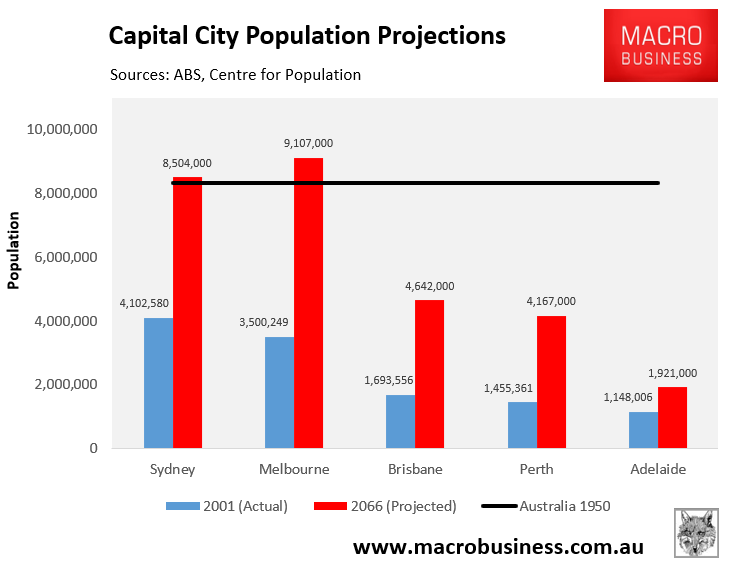
However, with Sydney’s population projected to expand by around 3 million people over the next 40 years to a megacity of 8.5 million, infrastructure supply will never keep up with demand.
The reality is that Sydney’s infrastructure woes are the direct result of decades of mass immigration. The federal government imported too many people, many of whom landed in Sydney, and infrastructure could not keep pace.
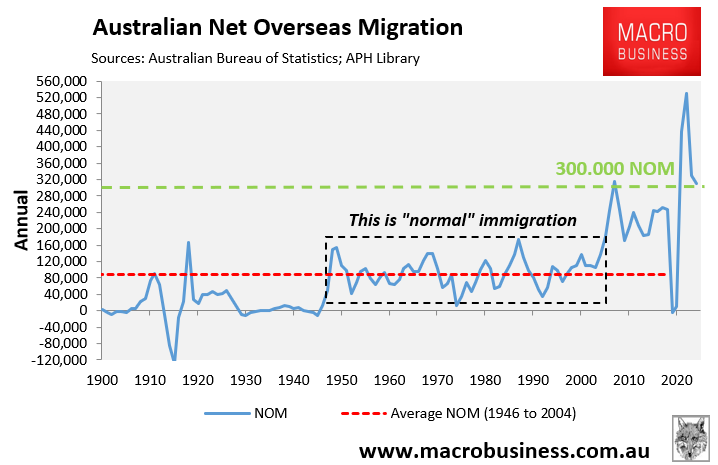
The situation will worsen so long as the federal government persists with the Big Australia mass migration policy.
