
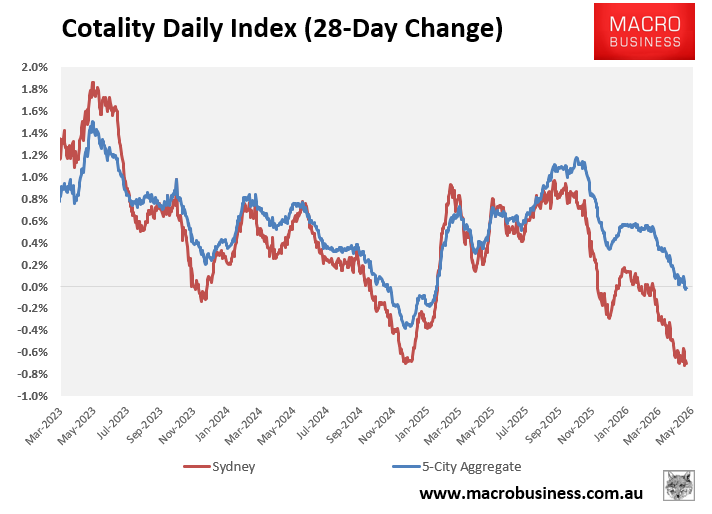
Sydney’s housing market is experiencing an accelerating downturn, with prices falling and auction clearance rates crashing, according to Cotality:
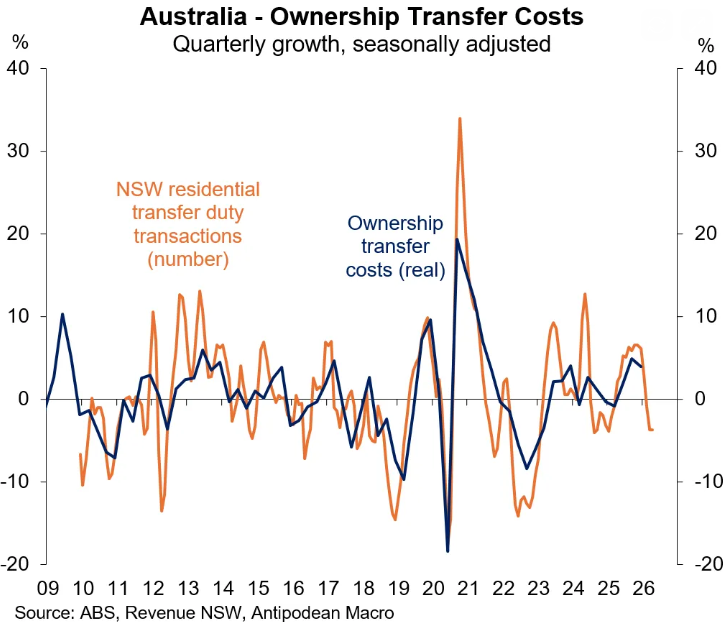
Justin Fabo from Antipodean Macro also reported that residential transfer duty transaction volumes have fallen sharply in NSW, consistent with the slowing property market:
NSW Treasurer Daniel Mookhey used a pre-budget address to the McKell Institute on Wednesday to state that Treasury is now forecasting a decline in stamp duty receipts of $5 billion over the forward estimates.
Revenue from land tax receipts are also tipped to fall by $3 billion over the same time period.
“Falling stamp duty and lower land taxes are by far the biggest reasons why we expect to collect less tax than previously projected”, Mookhey said. “Stamp duty collections are likely down by $5 billion over forward estimates. We expect land tax receipts to drop by around $3 billion during those years”.
Moohkey also revealed that the Treasury is also forecasting gross state product growth of just 1% in 2026-27, down from the 2.5% predicted in December, as well as being below the forecast of 1.5% growth for Victoria.
Mookhey suggested that NSW’s forecast of lower growth when compared to other states is due to the fact that its average mortgages are much higher than anywhere else.
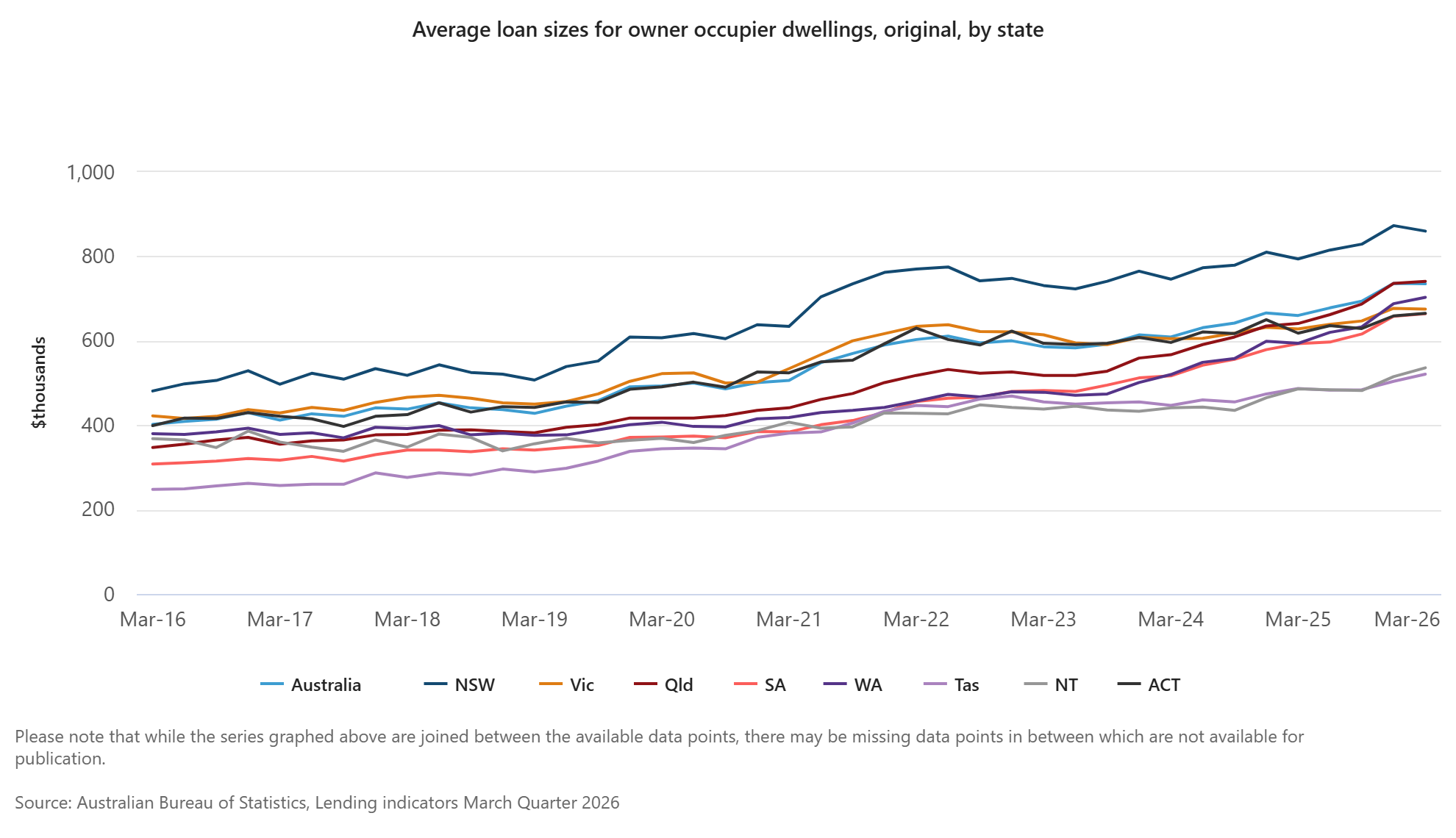
“Attentive budget watchers will notice a slowdown more pronounced in NSW than elsewhere in the federation”, Mookhey said. “The typical working family taking out a new mortgage today in NSW is likely to borrow $873,000″.
“But a family taking out a mortgage in Victoria – Australia’s next biggest state – will borrow about $677,000, 28% less”.
“That is why NSW fares better when interest rates fall. And fares worse when they rise”.
“That is why higher interest rates hit the disposable incomes of families in NSW harder than in the rest of the Commonwealth”.
“Their impact is also bigger on the state’s taxation revenues than elsewhere”.
“The reason is because our state taxation revenues correlate heavily with the property cycle. Which in turn is heavily correlated with interest rates”.
“Put simply – higher interest rates lead to lower state revenues”, Mookhey said.
Daniel Mookhey must surely be cursing the Commonwealth Grants Commission’s decision to strip GST revenue from NSW to give to Victoria:
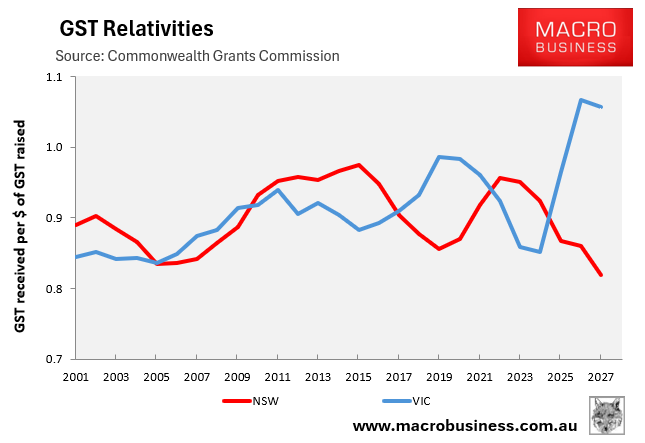
In 2026-27, NSW will only receive $28.2 billion of GST revenue, $1.4 billion less than Victoria’s $29.6 billion allocation.
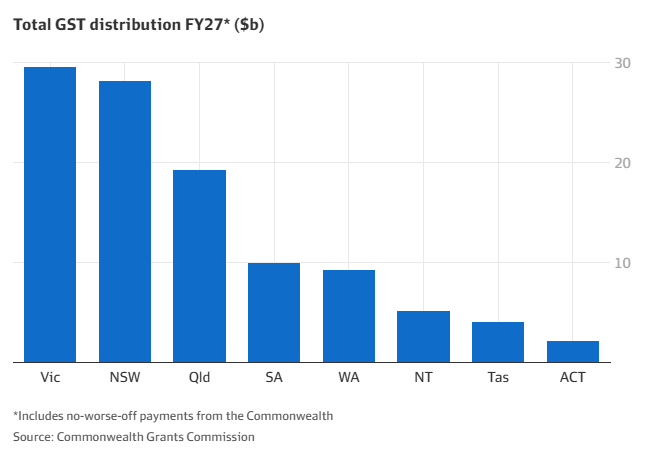
As a result, despite NSW having 1.5 million more people, it will receive $1.4 billion less in GST revenue than Victoria in 2026-27.
NSW will receive just 82¢ for every dollar notionally paid by its residents, down from 86¢ in the previous financial year. In contrast, Victoria will receive $1.06 for every $1 of GST estimated to be paid in the state based on its population, down from $1.07 last year.
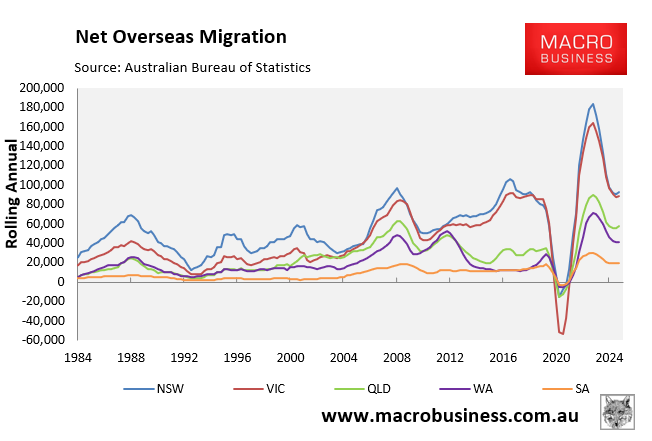
The reality is that NSW is the biggest loser from the GST system, given that it has received a diminishing share of the GST (0.82 cents per dollar raised in 2026-27), despite receiving the nation’s largest intake of migrants, who require new infrastructure and services.
The situation is grossly unfair.
