
Late last month, Productivity Commission (PC) chair Danielle Wood downplayed the impact of artificial intelligence (AI) on Australia’s job market, claiming only around 4% of jobs are at risk of elimination:
“They [Jobs and Skills Australia] found a reasonably small share of jobs, about 4% of jobs, can either be fully or mostly automated. So those are the jobs that you’d expect to be most at risk”, she said.
“There’s a much bigger share of jobs, 30%-plus, which are subject to augmentation. Some of the tasks can be done by AI, but you’d absolutely need a kind of human in the equation”.
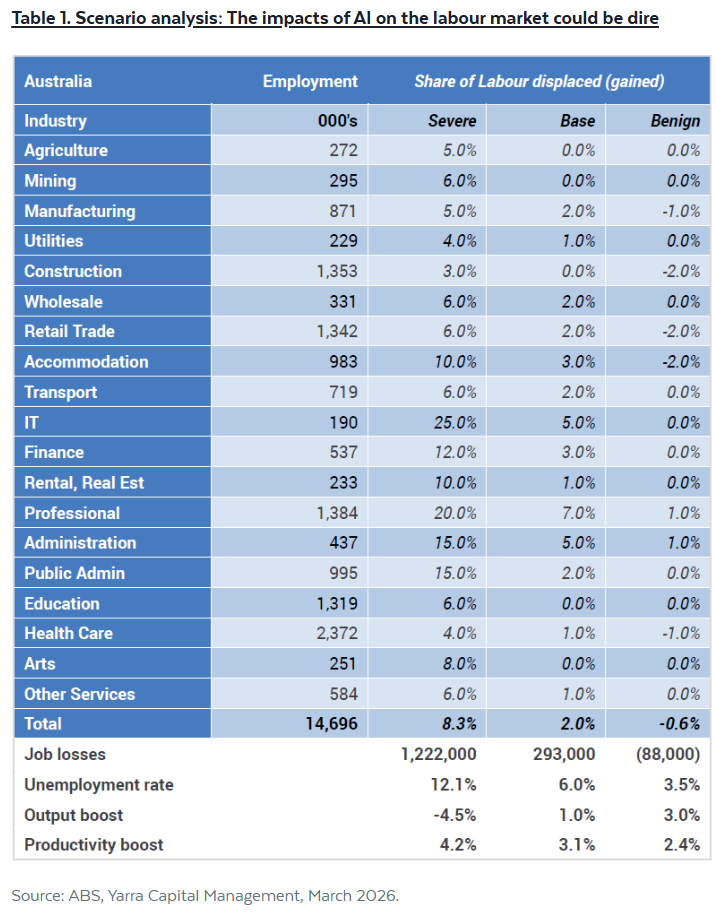
Last month, Tim Toohey from Yarra Capital gave a far more sobering assessment. He warned that if AI is “deployed at scale in Australia over the next two years”, which is his base case, then the nation’s unemployment rate could rise to above 6% from 4.3% currently, following 293,000 job losses:
Shortly afterwards, a Mercer survey of Australian senior executives, human resources personnel, and employees revealed that 100% of HR managers believed their company would reduce headcount due to AI within two years, with 60% believing that one in five jobs would be lost because of AI.
Danielle Wood argued that if AI proves more effective at replacing labour than merely augmenting it, then policymakers would need to be prepared to consider potential responses, such as a universal basic income.
“You would have to start thinking about those sorts of things and also how do you create meaning and structure in people’s lives, and these are very big, hard questions”, she said.
One can only wonder why Wood wouldn’t recommend reducing immigration to Australia to counterbalance the impacts of AI.
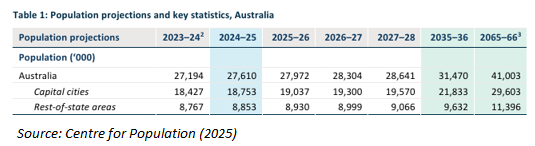
The Centre for Population projects that Australia will grow by 13.4 million people over the 41 years to 2065-66, equivalent to adding another Sydney, Melbourne, and Perth, on the back of permanently high net overseas migration of 235,000 annually:
In addition to crush-loading housing and infrastructure and diluting Australia’s resource base among more people, the notion of importing millions of people makes even less sense when automation via AI is expected to displace a significant share of jobs.
Recall BlackRock CEO Larry Fink’s testimony at Davos when he stated that nations with low or negative population growth will adapt better to AI:
“We always used to think shrinking population is a cause for negative growth. But in my conversations with the leadership of these large developed countries that have xenophobic immigration policies that don’t allow anybody to come in, these countries will rapidly develop robotics and tech and AI and technology”.
“If the promise of all that transforms productivity, which most of us think it will, we’ll be able to elevate the standard of living of countries and standard of living of individuals even with shrinking populations”.
“And so the paradigm of negative population growth is going to be changing and the social problems that one will have in substituting humans for machines are going to be far easier in those countries that have declining populations”.
With AI set to replace many jobs in Australia, why are policymakers persisting with running a high migration program? Surely, such a policy is a recipe for higher unemployment and civil unrest?
