
Migrants sent $21 billion out of Australia in 2024
A migrant remittance is simply money that a migrant worker earns in one country and sends to people in their home country.
Significant net migrant remittance outflows are an economic cost to the host country.
They are a net leakage from national income, domestic demand, and the tax base. As a result, they weaken the economic and fiscal return from immigration.
Australia is a major remittance-sending country because it has a large migrant workforce, many migrants support families overseas, and wages in Australia are high relative to origin countries.
According to the World Bank’s migrant remittance database, $US14.3 billion of net remittances were sent from Australia in 2024, up from only $US784 million in 2004.
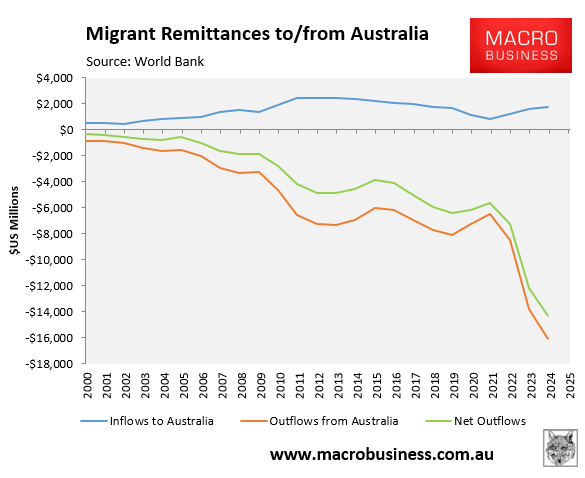
Net migrant remittance outflows from Australia have also more than doubled since 2019, when $US6.4 billion in remittances left Australia.
Based on the average AUD/USD exchange rate of 0.66 in 2024, this suggests that Australia lost around $A21.7 billion from net migrant remittance outflows in 2024 alone, roughly equal to around 0.84% of GDP. That is a large leakage by advanced‑economy standards.
Separate data from Money Transfer Australia, which drew on figures from the World Bank, ABS, KNOMAD, and DFAT, estimated that US$25 billion (A$37.9 billion) was sent abroad from Australia in 2024, with India (US$4.8 billion) the largest single recipient.
“The surge comes as Australia’s migrant population hits historic highs, fuelling unprecedented levels of money flowing back to families and communities across India”, noted Indian Link.
“These funds help families cover essentials such as education, healthcare, and housing, while also boosting local economies across India”.
The large volumes of remittances sent home by the Indian diaspora make sense, given that they are now Australia’s largest migrant source after expanding by 867,000 via net overseas migration over the 20 years to 2024-25:
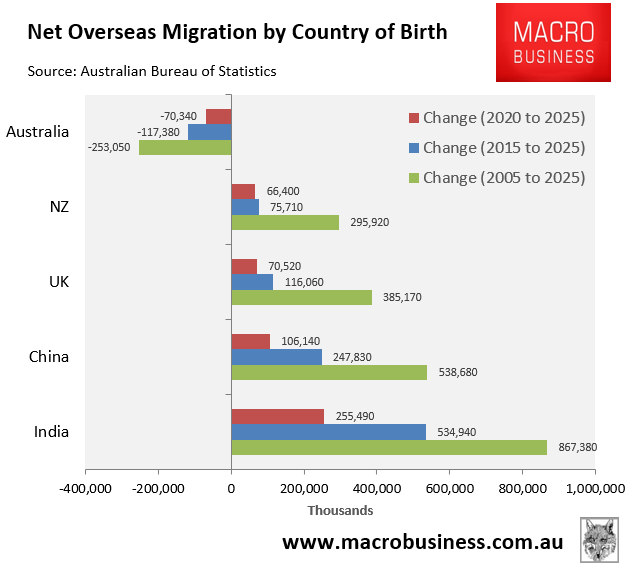
Indian Link projected that remittance outflows to India will continue to rise as the migrant population expands in Australia.
The heavy leakage of migrant remittances from Australia is another cost of immigration that policymakers choose to ignore.
