
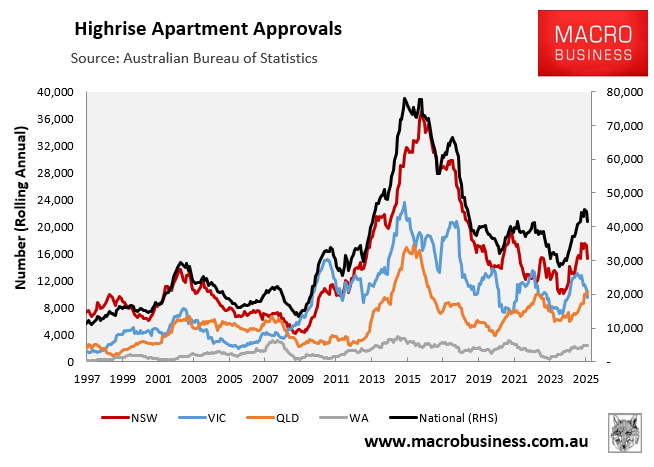
Small one and two-bedroom apartments served as the foundation for the high-rise construction boom of the previous decade.
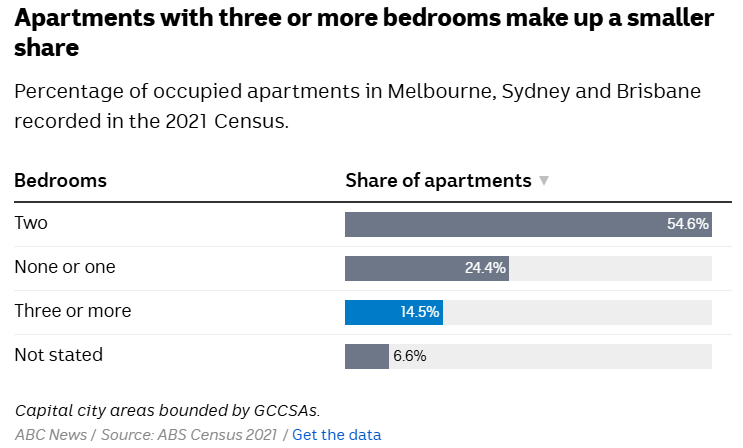
As shown below by the ABC, compact apartments with two or fewer bedrooms dominated apartment supply in the three main capital cities:
Unfortunately, many of these ‘shoebox’ apartments were poorly constructed. The most conspicuous examples were Sydney’s Opal and Mascot Towers, which required evacuation owing to widespread cracking.
The Four Corners Report “Cracking Up” highlighted these issues and exposed systemic flaws in the quality of high-rise apartment developments.
Engineer Leith Dawes warned that buying an off-the-plan apartment in Australia had become “Russian Roulette” due to numerous hidden structural faults.
With construction costs rising, developers are now focusing on the affluent end of the apartment market, targeting prestige buyers rather than entry‑level households.
Developers claim that affordable projects are no longer financially viable, leaving first‑home buyers locked out of the very stock meant to ease the supply crisis.
Developers are increasingly pursuing $1 million-plus price points with fatter margins.
As a result, apartments no longer serve as the conventional entry-level path to homeownership.
“We have an issue that has been brewing for a long time, and that is that low-income households are really struggling to find affordable housing”, said AHURI head of development Tom Alves.
“But the other bit that’s unrelated, really, is that we have an issue now where it’s difficult for property developers to be able to deliver housing affordably, and that’s impacting production. But the flip side of that is – and it seems counterintuitive – the market has disappeared”.
“The impact of this is a large number of households in significant stress and a large list of people looking to access social housing and finding themselves priced out”, he says.
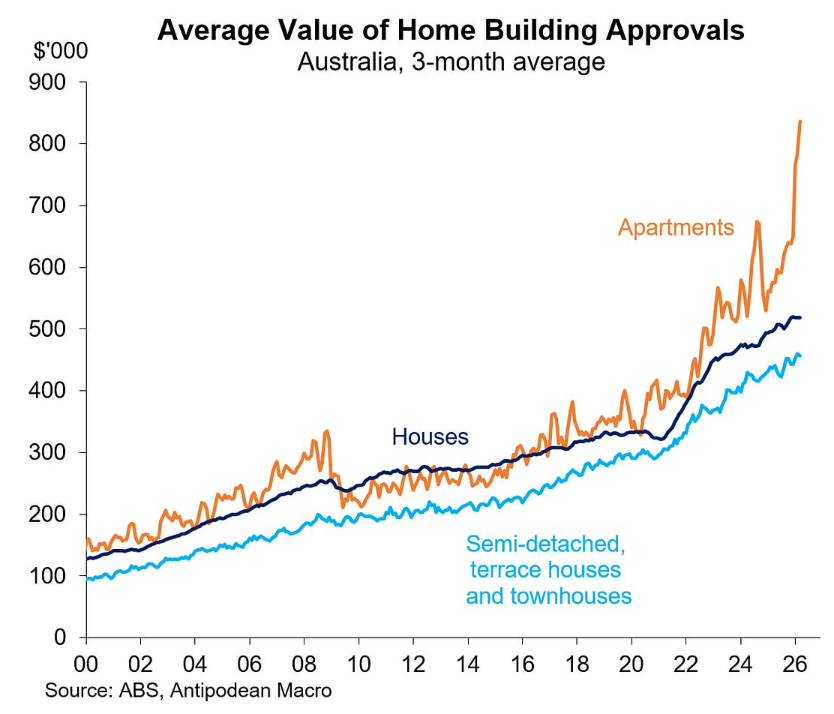
The following charts from Justin Fabo at Antipodean Macro summarise the situation based on the latest dwelling approvals data for March from the Australian Bureau of Statistics.
The average value of approvals to build apartments in Australia has risen sharply over the past 12-18 months to around $850,000:
The increase has been concentrated in high-rise apartments of 4 storeys or more:
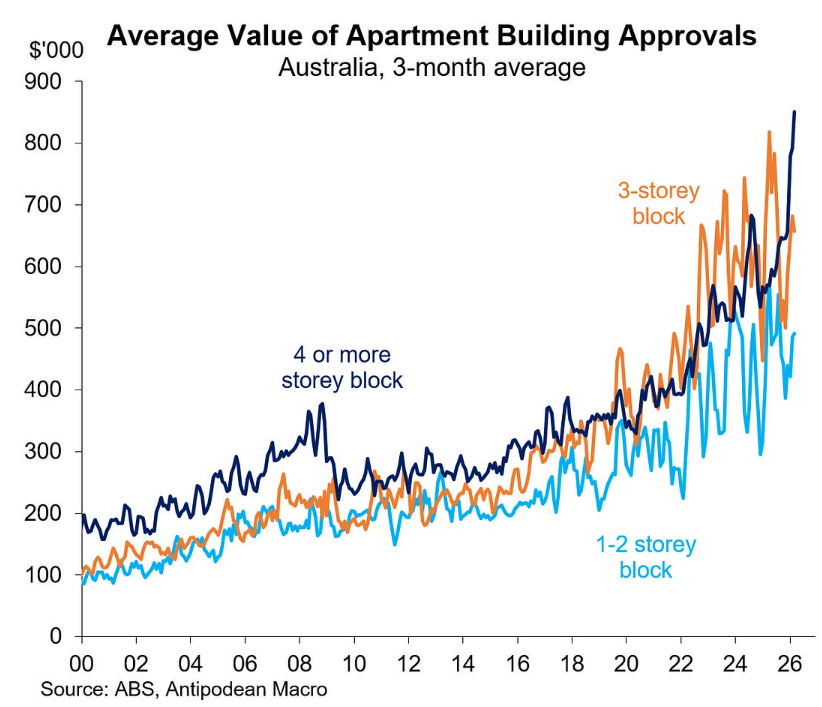
“This likely partly reflects shifts in the composition of approved apartments towards higher-end offerings”, noted Fabo.
Developers are clearly shunning the entry-level apartment market. As a result, the government’s plans to ease the housing affordability crisis via high-rise shoeboxes look like another failure.
