
Last year, the Albanese government increased its 2026 international student planning level by 25,000, bringing it to 295,000.
However, it was a flexible cap, with Ministerial Direction (MD) 115 permitting universities to exceed their caps by 15% before the Department of Home Affairs deprioritised visa processing for new applicants associated with that institution.
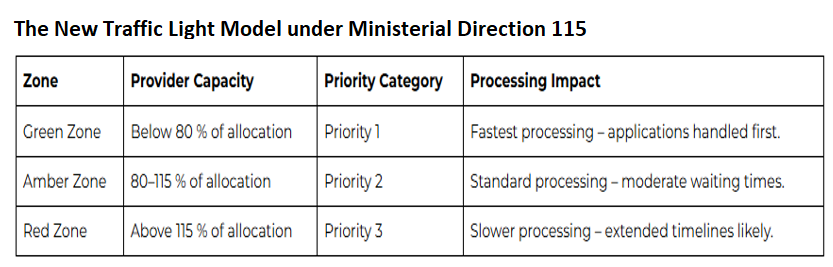
For example, if a university’s allotment is 10,000 spots, it may admit up to 11,500 students without penalty. If universities reach 11,500, the Department of Home Affairs will slow visa applications for their students.
As a result, the 115% cap under MD 115 served solely as a compliance tool, as it did not prohibit universities from enrolling additional students. The 295,000 planning level for 2026 was also a “soft cap,” meaning providers could exceed it without consequences.
Last year, the Albanese government relaxed other regulations, making it simpler for universities to accept international students.
Students from South Asia were given lower risk weights. This meant that applicants from countries such as India, Nepal, Bangladesh, and Sri Lanka were deemed lower risk, resulting in speedier processing and fewer evidential requirements (for example, less financial documentation or fewer English-language test results) when applying for a student visa.
The lower risk weights for South Asian students also led to stronger recruitment opportunities for Australian universities.
Finally, under MD 115, over a dozen Australian universities received lower risk weightings for international student recruiting.
As a result, students applying to these universities experienced faster, easier visa approvals with fewer evidentiary requirements (for example, less financial evidence and fewer English-language test results).
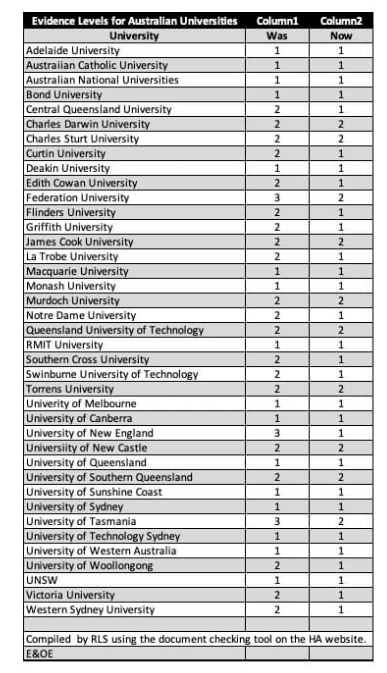
University Risk Weightings
Overall, it appeared last year that the Albanese government was determined to accelerate international student recruitment in Australia, thereby increasing overall student numbers and net overseas migration.
A policy U-turn in 2026:
The Albanese government looks to be altering course, seeking to halt the influx of international students and thereby net overseas migration.
Following concerns about integrity, particularly a dramatic increase in false financial documents and unverifiable academic records, the Albanese government tightened risk weightings, placing nations such as India, Bhutan, Vietnam, and Nepal in the highest-risk Evidence Level 3 category.
Visa consultants in Bengaluru observed a significant increase in the submission of fraudulent or unverified financial papers for student visa applications.
Officers apparently had difficulty verifying marksheets and certificates provided by certain universities, raising doubts about their credibility.
According to multiple reports, a significant number of non‑genuine applicants were using the student visa pathway for work migration rather than for study.
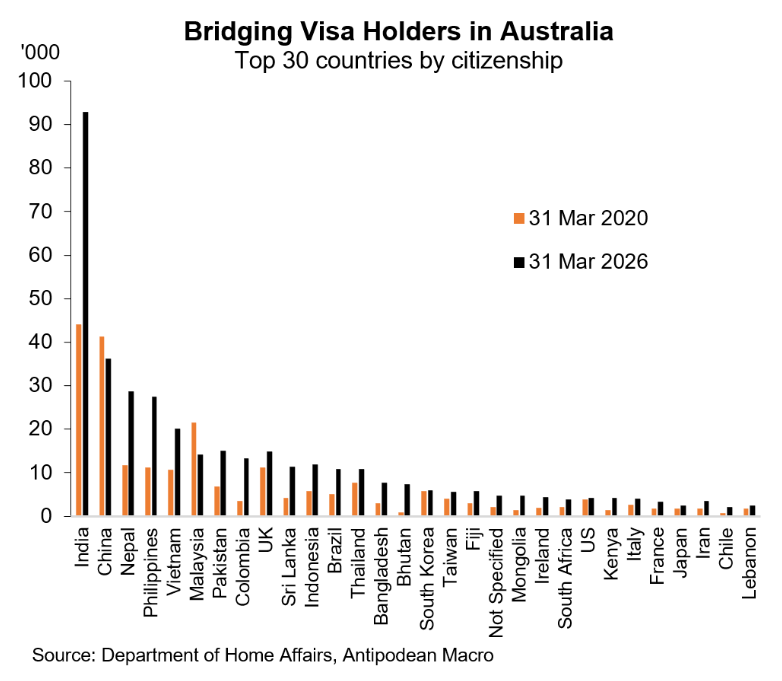
The policy U-turn from the Albanese government was also likely in response to fake degree busts in India, as well as the ballooning numbers of Indians on bridging visas, many of whom are former international students who refuse to return home.
Graduate visas are a key drawcard for students from the Indian subcontinent, as confirmed by recent research from Jobs & Skills Australia (JSA):
“Nearly 70% of international higher education students reported that the possibility to migrate was a reason for choosing to study in Australia, rising to 77% of Indian and 79% of Nepali higher education students”.
Furthermore, JSA reported that over 90% of Indian and nearly 96% of Nepali higher-education students chose Australia for the opportunity to work while studying. “80% of students from South and Central Asia (including India and Nepal) were working during study”.
The Albanese government has also increased the application fee for the Temporary Graduate visa (subclass 485) from $2,300 to $4,600, making it the world’s most expensive post-study employment visa.
The change took effect immediately, with no transition period, and applied to most applicants, except for eligible Pacific Island and Timor-Leste citizens and students studying in regional areas.
The application fee increase was nonrefundable, implemented without prior notice, and the third since early last year.
New data from the Department of Home Affairs (DHA) showed that Australia’s approval rates for student visas for higher-education applicants have fallen to their lowest level in more than 20 years, with only 59% of offshore university visa applications approved in March. This means over 40% of applicants were refused — the highest refusal rate since records began.
Two of Australia’s largest student markets were hit hardest. Only 49% of applications from India were approved, whereas only 27% of Nepalese applicants were approved.
According to sector leaders, the DHA has begun applying MD 106 much more strictly. This includes:
- “Holistic financial assessments” of whether students can afford their entire degree, not just the first year (which is all the law requires).
- Tighter scrutiny of whether applicants have “genuine access to funds”, especially when relying on large loans with unclear repayment capacity.
Migration experts say this change represents a major shift in how financial evidence is interpreted.
Melbourne-based migration agent Navjot Kailey says such outcomes are becoming increasingly difficult to explain to applicants.
“In recent months, we’ve seen more blanket refusals from the subcontinent, partly due to concerns about fraudulent applications, but also rising political pressure on the government to cut migration intake”, Kailey told SBS News.
Kailey said the spike in refusals across some of these countries is linked to concerns about document integrity—for example, falsified qualifications, questionable financial statements, fabricated employment histories, and misleading claims about work experience—and argued that a significant proportion of applications are affected by fraudulent practices overseas.
“Unethical practices are carried out overseas to bridge the document gap, leaving the department with no choice but to give blanket refusals”, he says.
A spokesperson for DHA confirmed that they had tightened integrity measures.
“Higher refusal rates have been seen following an increased focus on integrity and quality in markets that have shown a very high level of growth”, a department spokesperson told SBS News in a statement.
“The government’s focus is on ensuring the student visa program supports genuine study and skills development, protects students from exploitation, and remains sustainable”.
Rather than lifting the refusal rate by stealth to reduce inflows, policymakers should instead explicitly aim to recruit a significantly smaller pool of excellent (genuine) students via the following reforms:
- Significantly raising English-language standards and mandating entrance examinations for prospective students to study in Australia.
- Significantly increasing financial requirements and mandating the payment of funds into an escrow account before arrival in Australia.
- Reducing the number of hours that international students can work and severing the direct link between studying, working, and permanent residency.
- Allowing only top-of-class graduates to receive graduate visas.
- Because Australian universities are non-profit enterprises that do not pay taxes, the government should impose a levy on international students to ensure that Australians receive a financial return from the trade.
Australia must prioritise quality over quantity when it comes to international student and graduate visas. Policy should be explicitly targeted to meet this goal.
