
The federal government has introduced a suite of structural, legislative and administrative reforms to slow the rapid growth in National Disability Insurance Scheme (NDIS) costs.
The changes fall into five broad categories: tightening eligibility, reducing plan inflation, cracking down on fraud and non‑compliance, shifting some demand outside the NDIS, and workforce restructuring.
Stricter access and eligibility rules
- Tougher “permanence” test — Participants must now exhaust all other treatment options before being deemed to have a permanent disability. This applies even to groups that previously received automatic access.
- Clearer eligibility requirements — Part of the government’s “Securing the NDIS for Future Generations” reforms, aimed at ensuring the scheme is reserved for people with significant and permanent disability.
- Reduced participant numbers — The government aims to remove roughly 160,000 participants over four years, largely by diverting people with lower needs to other systems.
Reducing plan inflation and tightening supports
- Ministerial powers to cut funding — New legislation allows the minister to reduce supports below what is currently deemed “reasonable and necessary” in some cases.
- Limiting unscheduled reassessments — These have been a major driver of cost blowouts; reforms will restrict how often plans can be reopened.
- New planning framework (delayed to 2027) — A redesigned assessment and budgeting model will deliver more consistent, needs‑based plans and reduce plan inflation.
Major fraud, compliance and integrity crackdown
- Expanded Crack Down on Fraud program — An extra $151 million over four years to strengthen NDIA systems and fraud detection, plus ongoing funding from 2029–30.
- Increased compliance workforce — Additional funding to maintain and expand the NDIA’s payment integrity team.
- Civil penalties and automated decision‑making powers — New penalties for non‑compliant providers and limited automation to reduce rorting (with safeguards to avoid Robodebt‑style failures).
- Wider provider registration requirements — More providers will be required to register, improving oversight and quality control.
Shifting demand outside the NDIS
- Rebuilding state disability services — The federal government expects states to recreate non‑NDIS disability supports, which were dismantled after the scheme launched.
- Early childhood reforms — Acknowledging that children (especially with autism or developmental delay) are driving much of the growth, the government is developing alternative pathways outside the NDIS.
Workforce and agency restructuring
- NDIA staffing cuts — Nearly 700 positions will be removed to streamline operations.
- Quality & Safeguards Commission expansion — Almost 200 new staff to strengthen provider oversight.
The government expects the proposed changes to reduce the NDIS’s annual cost to $55 billion in 2030, down from previous forecasts of $70 billion.
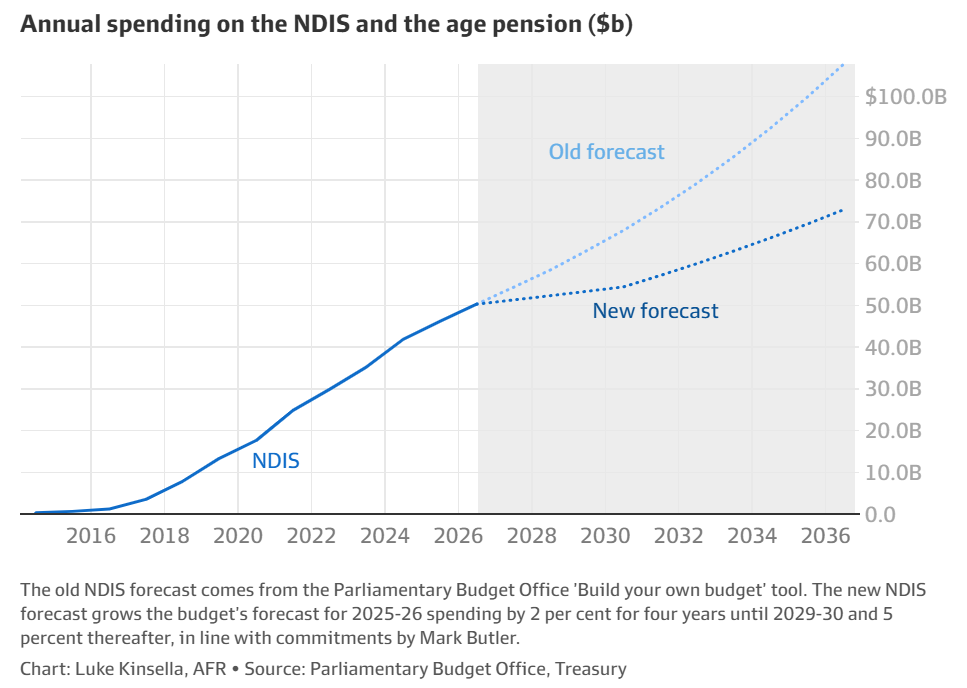
Source: Australian Financial Review
The federal government aims to reduce annual growth in NDIS spending to an average of 2% over the next four years, compared with more than 10% currently.
However, as illustrated below by Justin Fabo from Antipodean Macro, the 2% spending growth over four years, followed by 5% from 2030, would represent a massive unwind from the current level of around 10.3% in the three months to April:
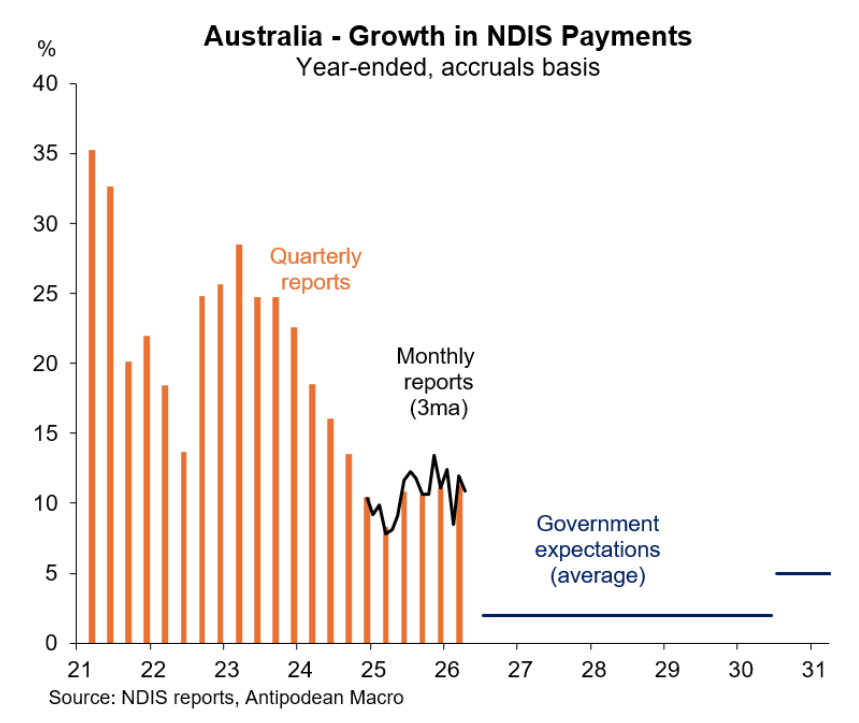
I’ll believe it when I see it. The planned cuts to the NDIS’ growth look highly optimistic and would be achieved in part by cost shifting onto other programs outside the NDIS.
Even so, I appreciate the government’s efforts to slow the growth of the NDIS to a sustainable level. For all of our sakes, I sincerely hope that it succeeds.
