
Why endless population growth makes Australians poorer
I noted on Thursday how in 2000-01, Australia’s regions accounted for 35% of the population. As of 2024-25, the latest available data from the ABS shows that the regions’ share of Australia’s population has declined to 32%.
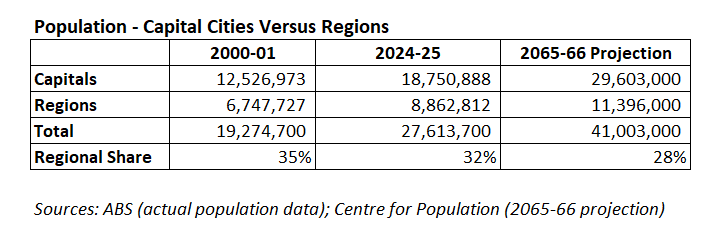
The Centre for Population’s 2025 Population Statement projects that Australia’s population will grow by 13.4 million people over the 41 years to 2065–66.
Most of this 13.4 million growth (81%) is projected to occur in the capital cities, which are expected to swell by 10,850,000 over the next 41 years. Australia’s regions are projected to only grow by 2.5 million.
Australia’s population growth is expected to come from ongoing high net overseas migration (NOM), which is projected to average 235,000 over the 41-year forecast horizon.
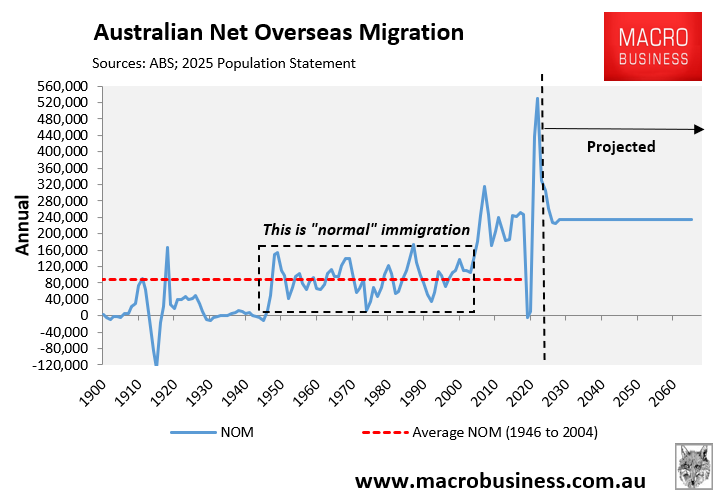
The Centre for Population projects that the overwhelming majority (84%) of this NOM will flow to capital cities rather than to Australia’s regions.
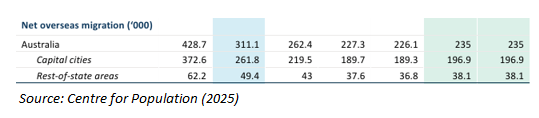
The capital cities are projected to receive 196,900 net migrants per year, whereas the regions are expected to receive only 38,100 per year.
Consequently, by 2065-66, the regions are projected to comprise only 28% of Australia’s population, a decrease of 7 percentage points from 2000-01.
High migration makes Australians poorer:
Last year, the “Stats Guy” Simon Kuestenmacher made the following observation about Australia’s economy:
“For a living we export mining products, agricultural produce, and entertain a few tourists and educate a few foreigners in our universities – that’s the only four export sectors that matter”.
Kuestenmacher was largely correct, although the Australian Bureau of Statistics (ABS) massively overstates education exports.
The economic reality is that Australia primarily finances its global presence through the sale of its fixed mineral endowment and agricultural goods. Australia’s exports ultimately pay for its imports.
According to the Department of Foreign Affairs and Trade (DFAT), 79% of Australia’s top 25 exports in 2024 were mining, commodity, or agricultural products produced in Australia’s regions:
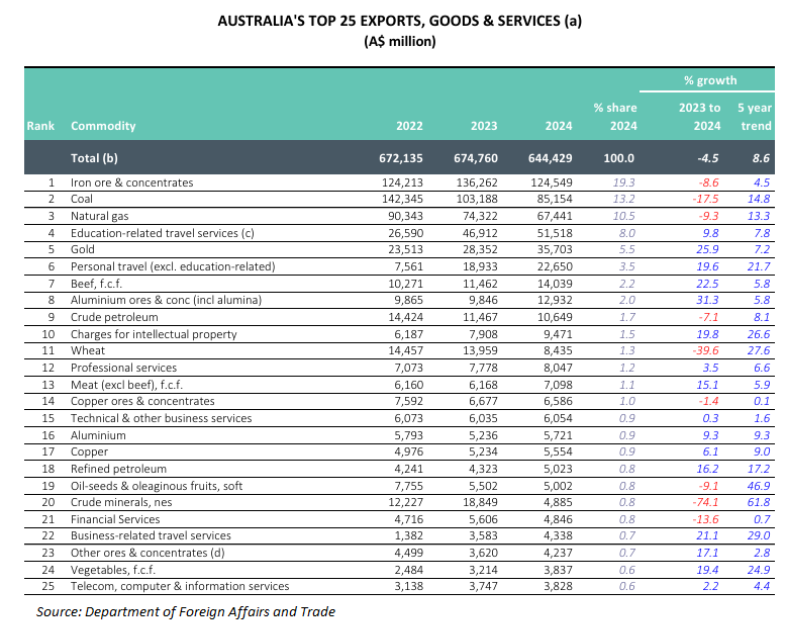
Demand for these products is exogenous, whereas their supply is highly capital-intensive and not dependent on high population growth from immigration.
Therefore, aggressively growing Australia’s population through immigration necessarily spreads its mineral and agricultural exports among more people, reducing per-person exports.
Put another way, high migration leads to a greater influx of imports than exports.
Victoria and New South Wales encapsulate the economic downside of aggressively expanding Sydney and Melbourne through immigration. Both states combined have received around two-thirds of the nation’s net overseas migration over the past 20 years, mostly into Sydney and Melbourne.
This extreme level of immigration to Sydney and Melbourne has expanded New South Wales’ and Victoria’s imports without materially increasing their exports (which are mostly generated in the regions).
As a result, Victoria and New South Wales have recorded large and growing trade deficits:
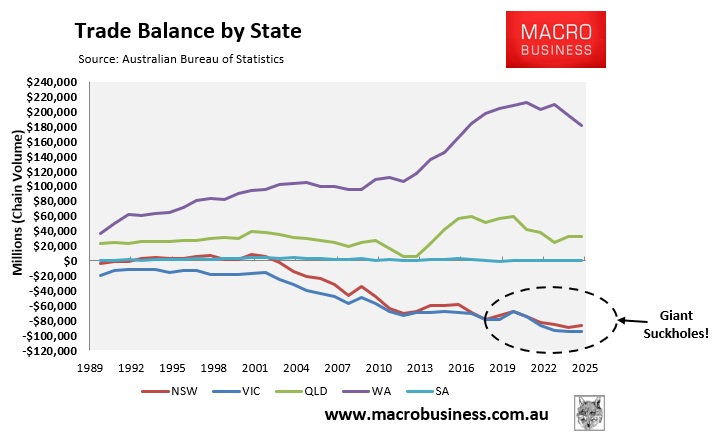
By pursuing large-scale immigration, Australia’s policymakers have chosen to dilute the nation’s mineral and agricultural wealth, worsening the nation’s trade balance, and ultimately making Australians poorer.
This brings us to the second component of Australia’s “business model,” which is based on funnelling people into low-productivity people-serving industries such as hospitality and retail, while directing the country’s productive effort towards infrastructure and housing to keep up with rapacious population growth.
Australia’s population has grown by around 9 million (more than 47%) this century due to high immigration.
However, investment in business, infrastructure, and housing has not kept pace.
As a result, the capital stock per worker has fallen, resulting in “capital shallowing” and lower productivity.
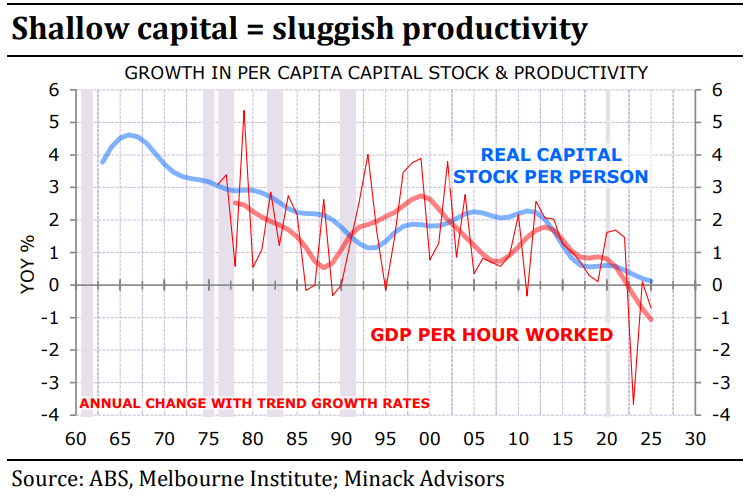
Congestion costs have also risen as infrastructure has been overburdened, further restricting productivity and output.
As explained by economist Gerard Minack:
Australia’s economic performance in the decade before the pandemic was, on many measures, the worst in 60 years.
Per capita GDP growth was low, productivity growth tepid, real wages were stagnant, and housing increasingly unaffordable. There were many reasons for the mess, but the most important was a giant capital-to-labour switch: Australia relied on increasing labour supply, rather than increasing investment, to drive growth.
Australia’s population-led growth model was a demonstrable failure in the 15 years before the pandemic. Remarkably, the country now seems to be doubling down on the same strategy. The result, unsurprisingly, is likely to be more of the same.
Even Kuestenmacher previously admitted that the ballooning populations of Sydney and Melbourne above their efficient size have wrecked living standards:
“For decades, we ran a migration nation without linking our national housing and migration policies. A rather ridiculous oversight if you ask me”…
“Melbourne and Sydney both stopped functioning seamlessly in their current set-up (one main CBD, low population density, huge urban sprawl) at around 4 million residents”.
In other words, the ‘Big Australia’ business model worsened living standards and made Australians poorer.
With the population projected to expand by more than 13 million over the next 40 years, Australia’s mineral and agricultural wealth will be diluted further, capital shallowing will persist, and living standards will erode.
