
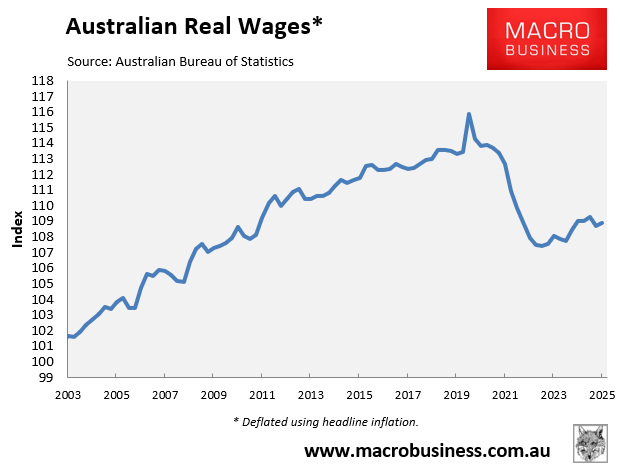
The Australian Bureau of Statistics (ABS) wage price index for the December quarter revealed that real inflation-adjusted wages declined by 0.3% in 2025 and were tracking 6% below their Covid-19 ‘bubble’ peak of around late 2011 levels:
The Reserve Bank of Australia’s (RBA) forecasts laid out in its February Statement of Monetary Policy (SoMP) suggested that real wages would not recover over the forward estimates.
By the June quarter of 2028, the RBA forecast that Australia’s real wages would be 6.4% lower than their mid-2020 peak, at roughly the same level as the March quarter of 2011:
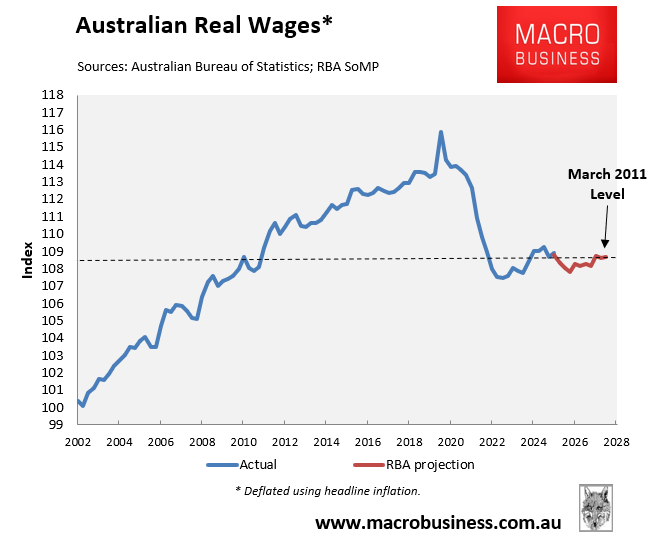
These forecasts will likely prove to be highly optimistic.
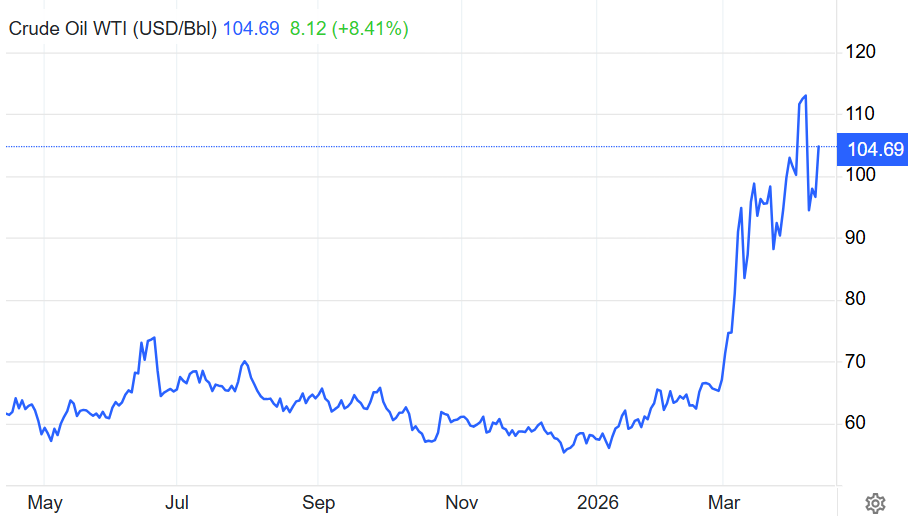
The war in the Middle East is forecast to send Australia’s CPI inflation well above 5% in the period ahead, even if the war were to end today.
In fact, Deloitte Access Economics warned that if the oil price hit $US150 a barrel, versus just over $US100 currently, CPI inflation could reach over 6.5%.
If the crude oil price hits $US175 per barrel, Deloitte forecasts CPI inflation would reach 7.5%.
Meanwhile, Australian nominal wage growth remains stuck in the low growth zone.
According to CBA’s latest Wage Insights, which are based on wages paid into CBA customer accounts, nominal wages grew by only 0.8% over the quarter and by 3.1% annually, significantly below the latest ABS headline CPI inflation reading of 3.8% in the year to January 2026 and obviously far below the CPI inflation forecasts outlined above.
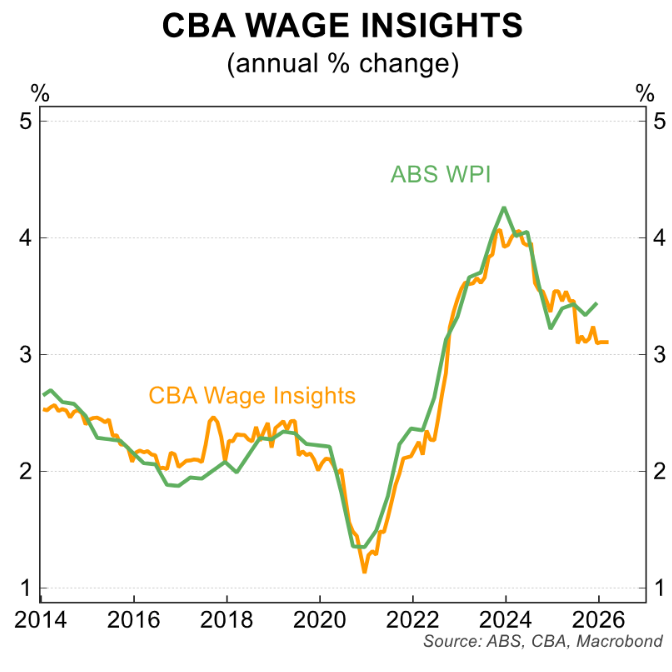
Thus, Australian real wages are set to fall sharply in the period ahead amid sluggish nominal wage growth and soaring CPI inflation driven by the global energy shock.
As a result, real per capita household disposable income will also fall sharply, further exacerbated by rising mortgage payments driven by higher interest rates.
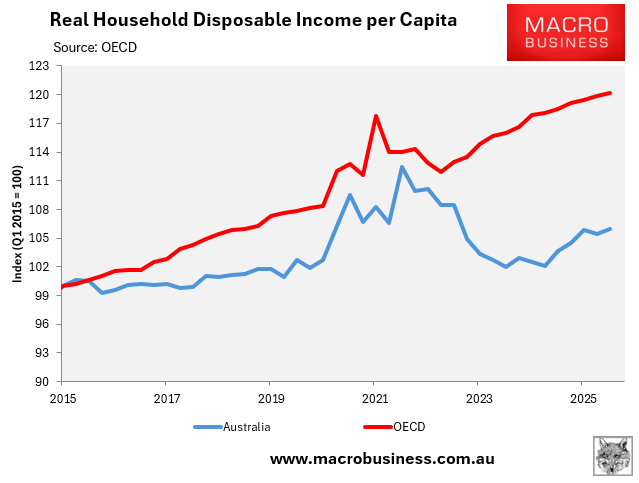
The 2020s are shaping up as a decade of despair for Australian households.
