
Aussie energy regulator tackles the death spiral
The electricity “death spiral” arises when demand for power declines, due in part to customers taking up solar PV, leading to higher prices to cover fixed network costs. That is, the more people that take up solar power, the faster the decline in electricity demand, and the more fixed costs must be spread over a smaller volume of electricity, raising costs for everyone else.
Already, Australia has the highest levels of rooftop solar power (PV) in the world, thanks in part to generous government subsidies that have typically flowed to higher-income, home-owning households:
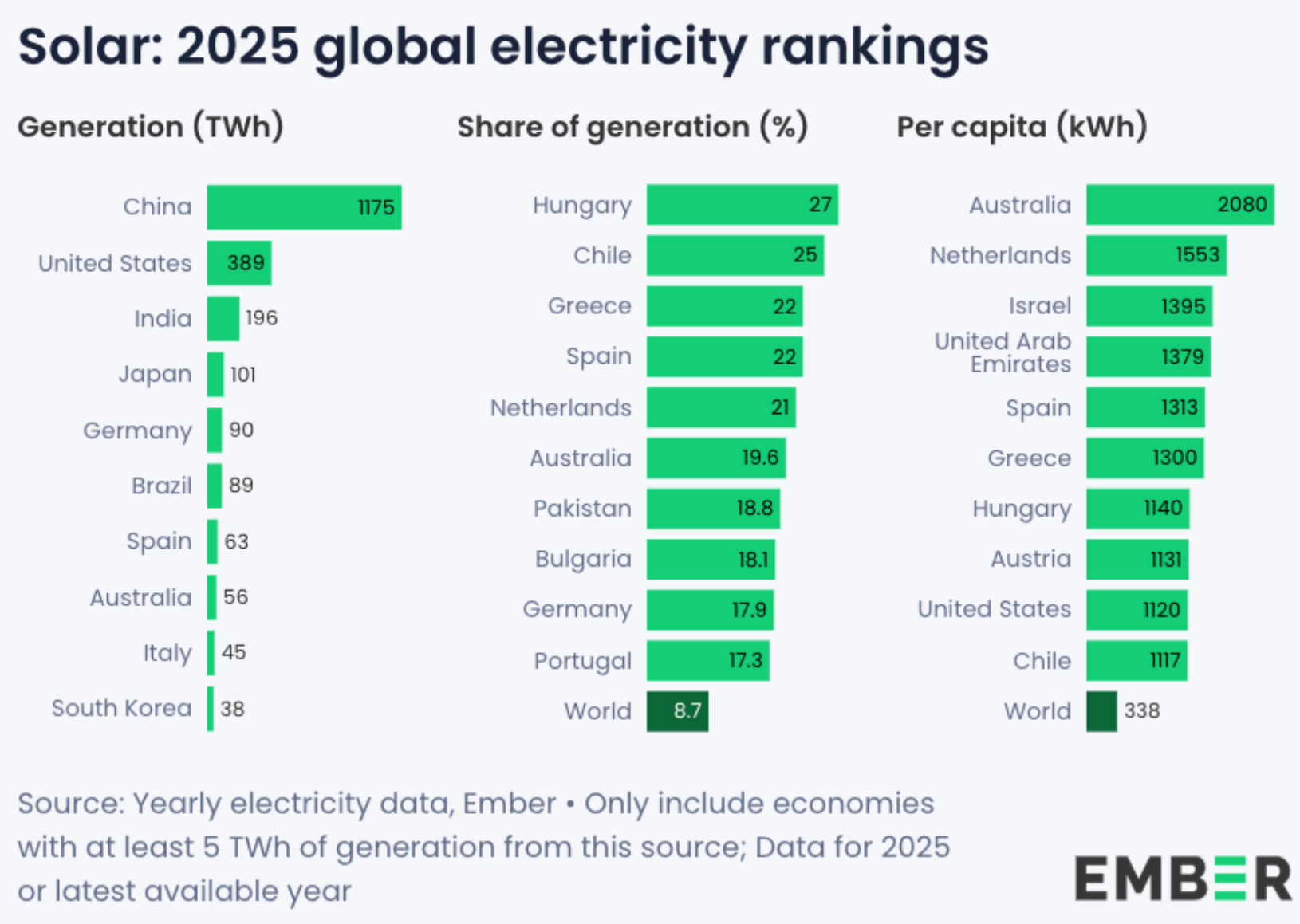
The wealthy are most likely to install solar and battery storage because they can afford the high upfront costs. This leaves poorer households and renters facing large rises in their power bills as fixed network costs are spread across a diminishing pool of customers.
The problem of solar PV owners being subsidised by the working poor was first highlighted in 2012 by Paul Simshauser and Tim Nelson in their classic paper “The Energy Market Death Spiral – Rethinking Customer Hardship”.
For a paper now 14 years old, it was remarkably prescient in its discussion of what would happen.
Simshauser and Nelson showed that, back in 2012, the typical working poor customer who could not afford to install solar PV was subsidising those who had the financial means to do so.
Various green energy schemes have been regressive wealth transfers, leaving those unable to afford upfront solar investments to bear the escalating costs of the grid.
The Australian Energy Market Commission (AEMC) has proposed fixing the inequities through a fundamental reset of how electricity network charges are structured — a shift it says could cut system‑wide costs by up to $6 billion over 15 years, but with uneven impacts across households.
Network charges, which comprise around 40% of a household’s bill, would be redesigned to become:
- More fixed — to recover the underlying cost of poles and wires.
- More dynamic — with variable charges that rise during peak demand and fall when the grid has spare capacity.
This is a move away from today’s mostly usage‑based tariffs, which the AEMC argues do not reflect the real cost of supplying electricity at different times of day.
The AEMC aims to have sharper price signals that encourage households to shift consumption away from peak periods, reducing the need for expensive network upgrades, which are one of the biggest drivers of electricity bills.
The AEMC’s modelling (based on 400+ million data points) shows most households would benefit, but not all.
The likely winners would be high‑usage households, electrified homes (those replacing gas with electric appliances), renters, and households without solar or batteries.
These groups would benefit because lower variable charges outweigh higher fixed charges, they currently pay more during peak periods, and they have fewer ways to avoid network costs under the current system.
Typical savings for these groups are likely to range from $40 to $80 per year by 2040.
By comparison, the losers from the reforms would likely include low‑usage households, some small businesses, and owners of solar and battery systems.
These groups would lose because higher fixed charges reduce the value of self-generation, and low-usage households would lose the ability to minimise bills due to low consumption.
The AEMC will release final recommendations in June. More than 2,700 stakeholder submissions are still being reviewed.
In my view, a shift to high fixed charges and dynamic peak pricing is a sensible move. Fixed network costs must be recovered efficiently and fairly.
