
Victorian government outsources jobs interstate, overseas
Of Australia’s main capital cities, Melbourne is the most economically challenged.
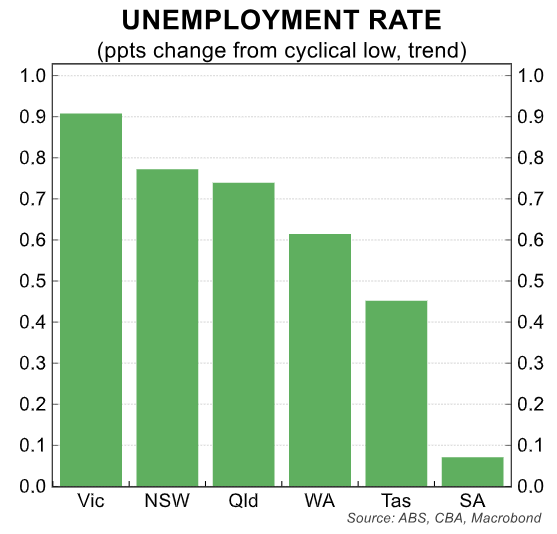
The latest labour force data from the Australian Bureau of Statistics (ABS), presented below by CBA, shows that Victoria has recorded the steepest rise in unemployment in the nation:
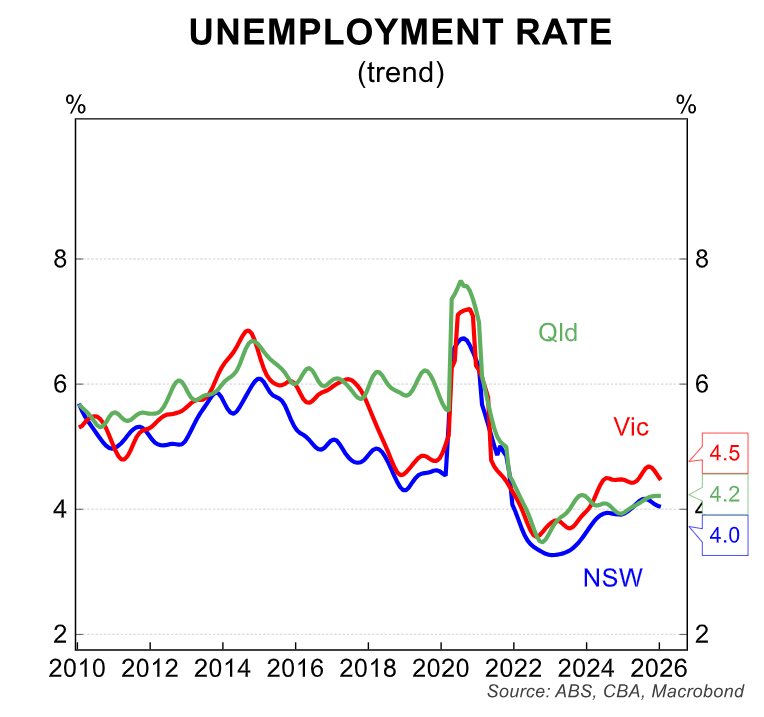
Victoria’s unemployment rate of 4.5% is also the highest in the nation, tracking 0.4% above the national average in January 2026:
The Property Council of Australia’s latest office market report showed that the vacancy rate in Melbourne’s CBD had risen to 19% in January 2026, compared with 17.9% in July 2025. Melbourne’s CBD’s office vacancy rate was tracking at its highest level since 1997 and is also the highest in the nation.
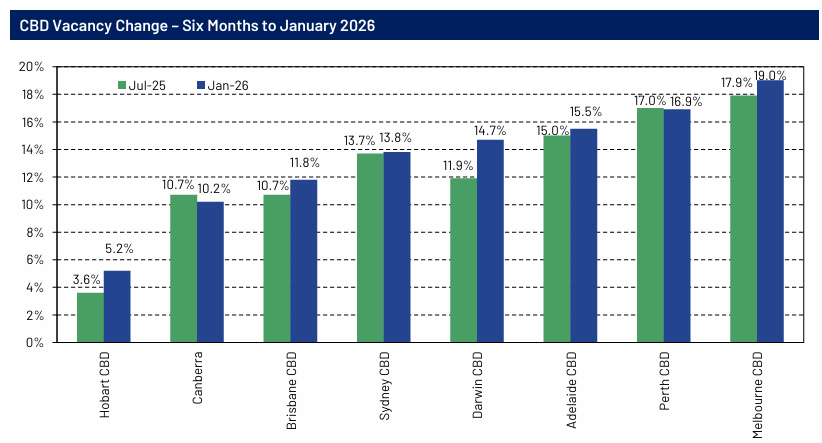
Source: Property Council of Australia
By comparison, the average office vacancy rate nationally was 15.9% in January 2026.
Recent data from Roy Morgan also showed that Melbourne is the only CBD to have fewer workers than before the pandemic:
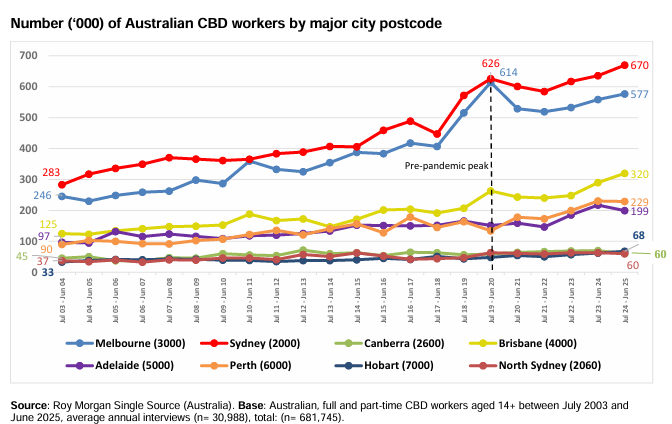
Roy Morgan estimated that Melbourne’s CBD workforce was 37,000 below the pre-pandemic peak as of mid-2025.
The Victorian government this week confirmed that it will introduce laws giving employees the right to work from home two days per week, provided their job can reasonably be performed remotely. This applies across:
- Public and private sectors
- Large corporations and micro‑businesses
- All industries where remote work is feasible
Premier Jacinta Allan has confirmed the policy will be blanket, rejecting earlier suggestions that small businesses might be carved out.
The Allan government argues the reform is about fairness and modernising work:
- Many large employers already offer hybrid work; smaller businesses often do not.
- Extending the right universally is framed as a way to boost workforce participation, especially for women.
- The government says workers want their remote‑work arrangements protected.
Small business groups and owners are worried about:
- Operational strain — many small workplaces rely on in‑person roles or have limited capacity to manage hybrid arrangements.
- A “two‑tier” workforce — employees who can work from home gaining flexibility while others cannot.
- Added compliance and red tape — concerns that the law will impose obligations that small firms are not equipped to handle.
Business groups have also warned that the policy will worsen Victoria’s reputation as anti‑enterprise and deter investment.
The Committee for Melbourne says it is hearing “anywhere but Victoria” from investors.
“I’m having a lot of conversations with people saying ‘anywhere but Melbourne or Victoria’, and we know that states like Queensland and South Australia are doing incredibly well at the moment”, Committee for Melbourne chief executive Scott Veenker said. “We don’t need to give business another reason to look across the border.”
The Business Council of Australia argues the policy will lead to fewer jobs, less flexibility for employers, and more caution in hiring.
“At a time when business conditions in Victoria are at a low and alleged union corruption is rife, the government should be attracting investment, not chasing it away”, Business Council of Australia CEO Bran Black said.
Black had previously warned that the policy would incentivise employers to shift investment capital and jobs interstate.
“Businesses, especially those operating across multiple jurisdictions, may find alternative locations more appealing if Victoria imposes rigid workplace mandates”, he said.
“The Victorian economy Victoria’s economy is currently facing significant headwinds”.
“It is imperative, therefore, that Victoria does more to create jobs and generate investment in the state”, Black said.
While I enjoy working from home and have done so for 14 years, the Victorian government has no right to mandate private enterprises to allow employees to work from home two days each week. Employers and employees should negotiate such terms in a mutually beneficial way.
Mandating work-from-home will encourage firms to relocate their offices interstate. Moreover, many roles that can be done remotely from home in Victoria could also be performed interstate or overseas. So expect roles to be outsourced following the implementation of these rules.
Rather than micromanaging businesses, the Victorian government should focus on its core tasks of maintaining law and order and properly managing its expenditures and debt levels.
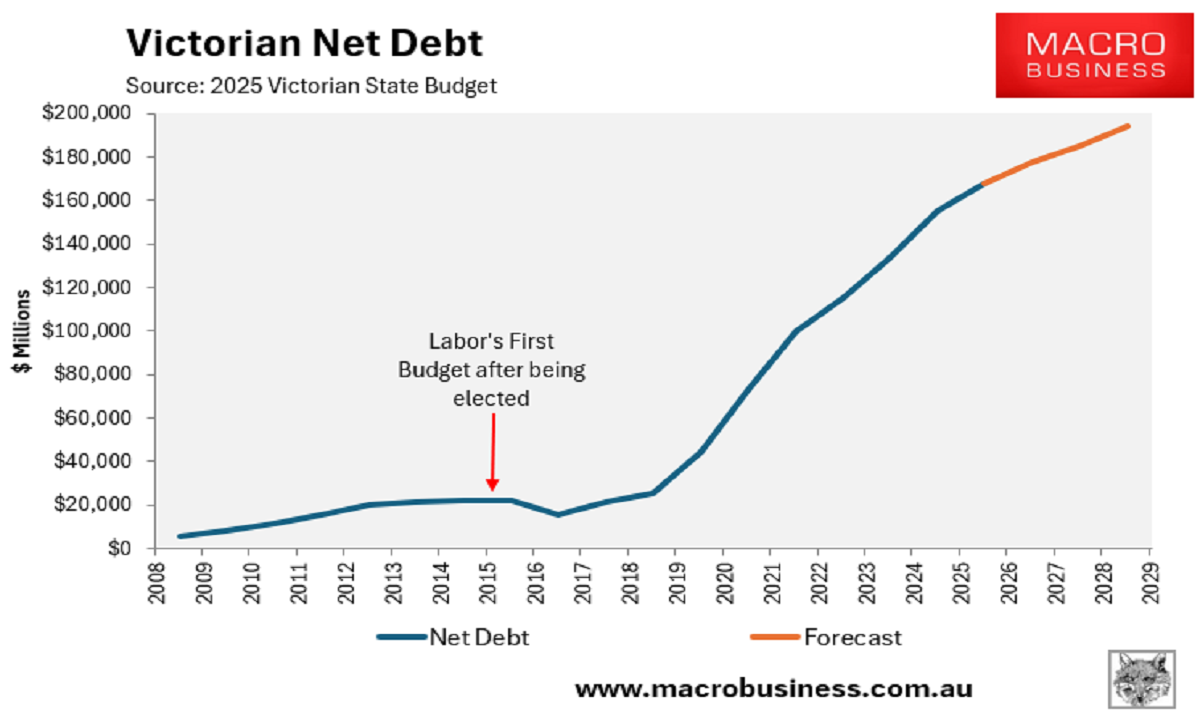
Currently, the Victorian government is failing badly.
