
Over the past 20 years, Australian universities have completely transformed into revenue-driven corporations.
In a nutshell, the federal government and Australian universities created a framework to attract huge volumes of full-fee-paying overseas students by:
- The federal government provided generous student and graduate visa work rights, as well as the opportunity for permanent residency.
- Australian higher education institutions lowered admission and teaching standards.
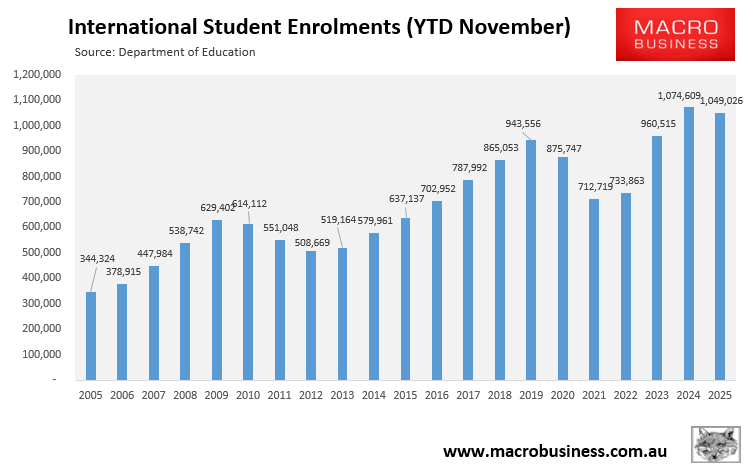
As a result, the number of international enrolments at Australian universities has tripled since 2005:
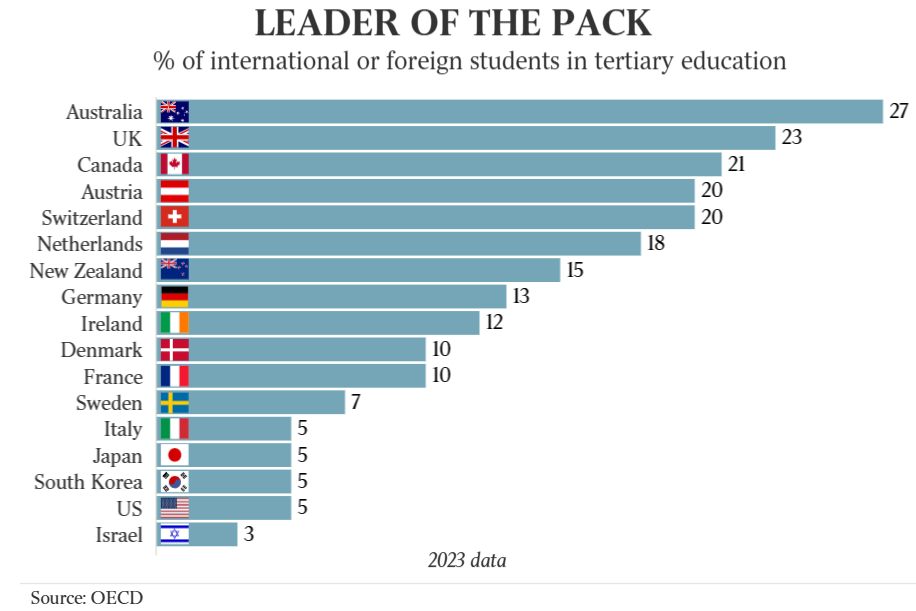
Australia has the second-highest share of international enrolments in the world, behind Luxembourg:
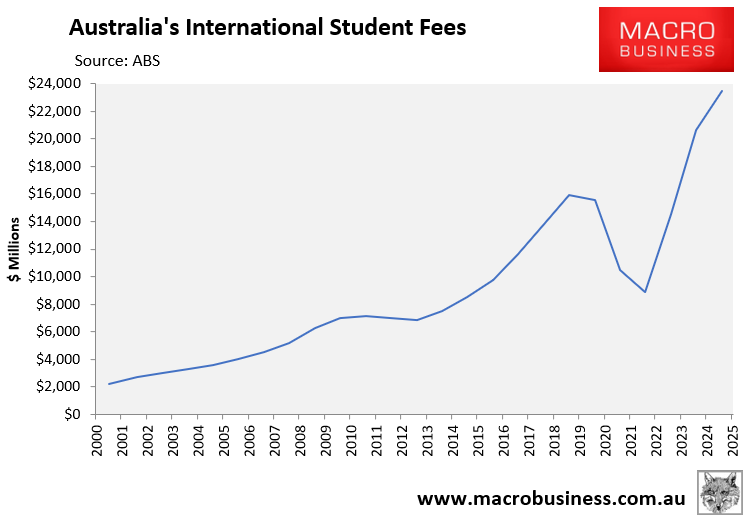
Fee revenue from international students has skyrocketed:
The cash bonanza from increased international student numbers was primarily spent on flashy buildings and research aimed at boosting Australian institutions’ global rankings, rather than on areas that promote educational quality and productivity.
A higher global rating improves a university’s reputation and indicates its quality. As a result, Australian institutions use these rankings as a marketing tool to attract more international students and to justify higher tuition rates.
This feedback loop serves as an incredible Ponzi scheme for Australian universities. 1) Import planeloads of full-fee-paying international students. 2) Direct fee revenue into research. 3) Improve the global ranking. 4) Sell more courses to international students. 5. Rinse and repeat.
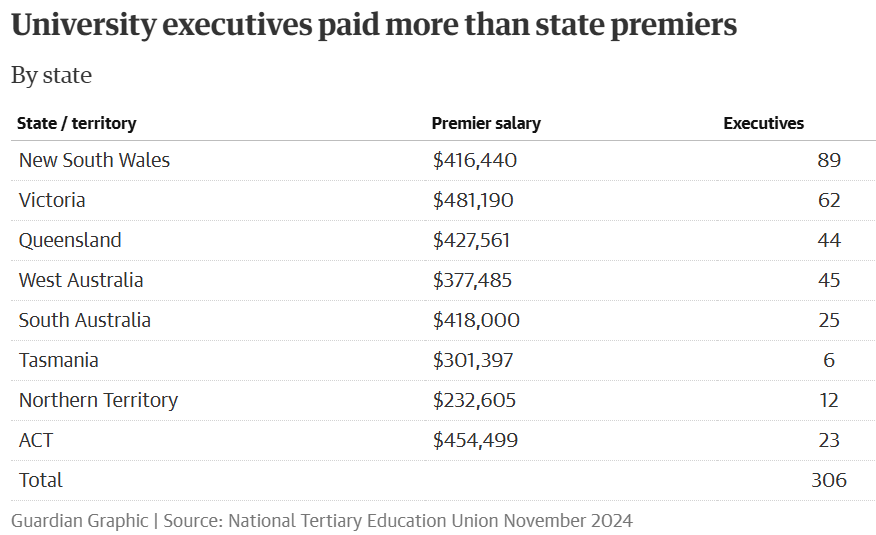
Vice-chancellors and senior executives were awarded the highest salaries in the world, dwarfing those of other educational professionals.
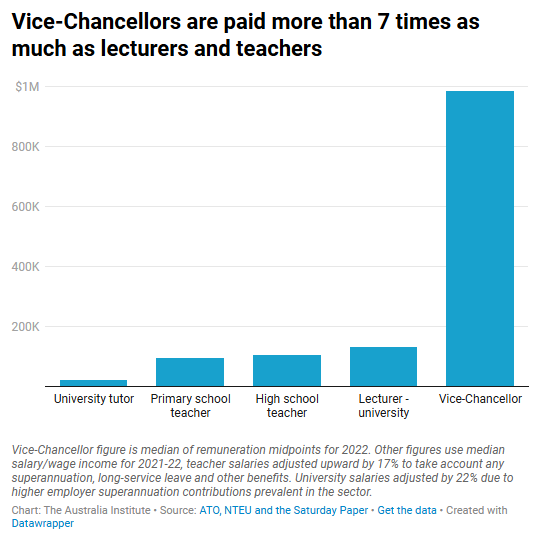
Over 300 Australian university executives earn more than state premiers.
Meanwhile, students have been treated as if they are cattle, crammed into generic, cookie-cutter classes.
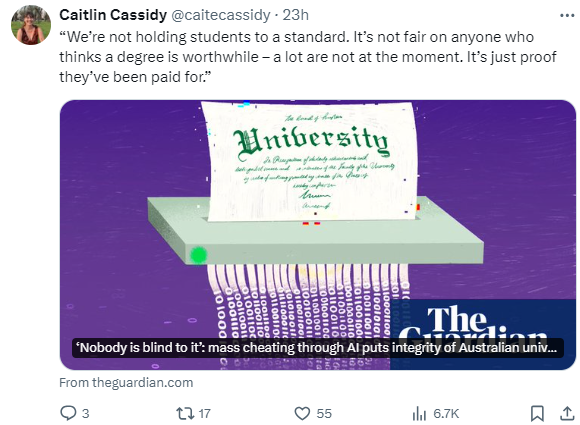
Pedagogical standards have been eroded, and academics are forbidden from failing international students since it would threaten their high-volume business model.
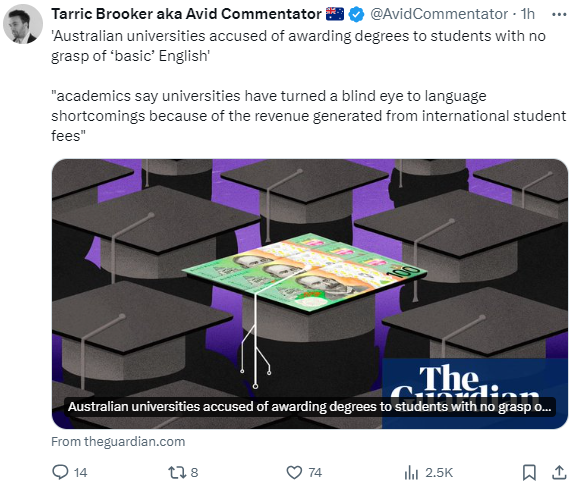
Local students have been obliged to carry international students through their courses via group tasks, and cheating by international students is common.
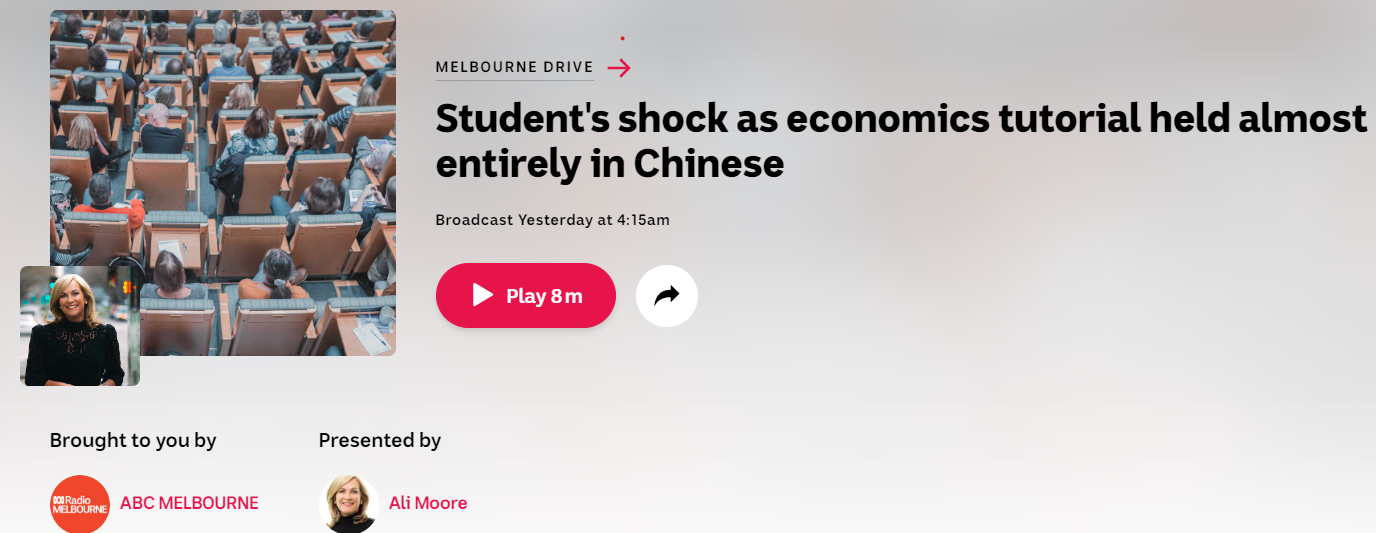
Some Australian universities have even conducted tutorials in foreign languages, wrecking the experience for local students:
Many phony private ‘ghost colleges’ have also been established as fronts for migration.
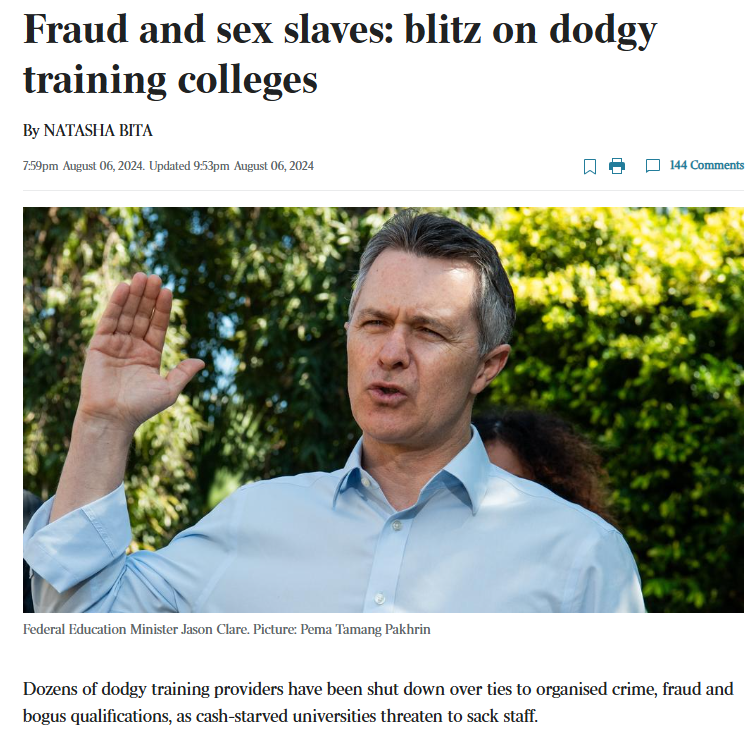
Crispin Hull encapsulated the situation nicely with the following statement in his latest article:
“Universities have become more like big corporations and their Vice-Chancellors more like highly paid CEOs”.
“The international students are attracted by the possibility of permanent residency as much as the education. That in turn has led to more pressure on housing and infrastructure generally”.
Author Hannah Forsyth’s latest article in The Guardian similarly argues that Australia’s universities have been degraded through decades of bipartisan marketisation, chronic underfunding, and the transformation of universities from public institutions into quasi‑corporate revenue‑seeking businesses.
Forsyth argues that successive governments (both Labor and Coalition) have reshaped universities to behave like competitive businesses rather than a public institution via:
- Treating education as an export industry
- Pushing universities to chase revenue, rankings, and growth
- Encouraging managerialism and corporate governance structures
- Prioritising branding, marketing, and property development over teaching
These priorities have hollowed out the traditional mission of universities. They have prioritised revenue over academic standards. As a result, teaching quality has declined as student numbers have ballooned, workloads have increased, and staff numbers have fallen.
A managerial class has become increasingly disconnected from academic work. As a result, rank-and-file staff have suffered from widespread insecure employment and underpayment scandals, and there is a heavy reliance on casual academics who do the bulk of teaching.
Teaching standards have suffered because universities now offer larger classes and fewer contact hours, use pre‑recorded lectures and minimal face‑to‑face teaching, prioritise enrolment growth over learning outcomes, and treat students as “customers” rather than learners.
The concerns raised above are valid. Higher education in Australia has become corporatised and corrupted.
Rather than continually lowering standards to lure more international students of doubtful quality to Australia, policymakers should instead aim to recruit a significantly smaller number of excellent (genuine) students via:
- Significantly increasing English-language standards and requiring prospective international students to complete entrance examinations before being permitted to study in Australia.
- Significantly increasing financial requirements, including requiring funds to be paid into an escrow account before they arrive in Australia.
- Reducing the number of hours that international students are allowed to work and severing the direct link between study, work, and permanent residency.
- Only top-of-class graduates should be eligible to receive graduate visas.
Universities should also be required to provide on-campus housing for international students in proportion to their enrolments to reduce pressure on the private rental market.
In other words, universities must get back to their core function of teaching, not acting as revenue-maximising migration conduits.
