
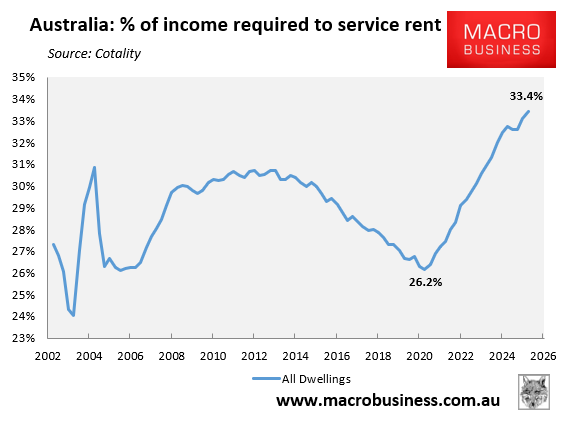
Late last year, Cotality released its housing affordability report, which recorded the poorest rental affordability on record, with the median tenant household required to pay a record 33.4% of their incomes to service rent:
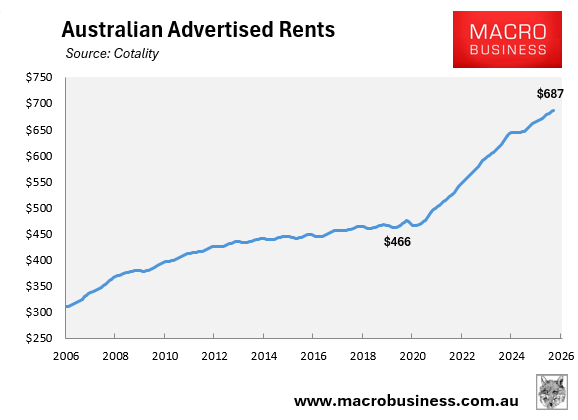
The decline in rental affordability was driven by the 47% increase in advertised rents since the end of 2019, which has added around $11,500 to the annual cost of renting the median Australian home:
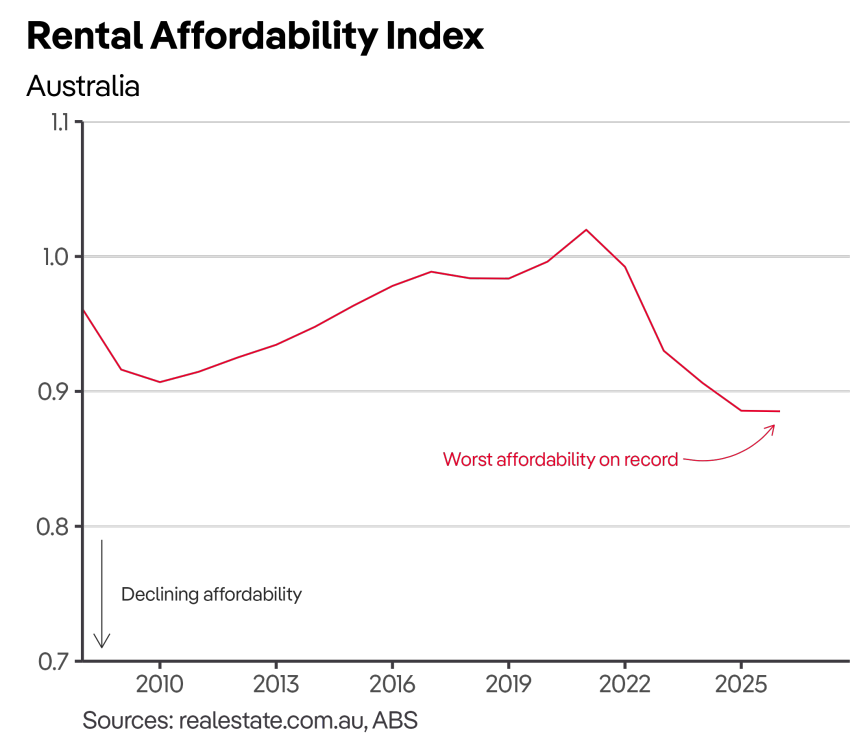
REA Group has released the latest realestate.com.au Rental Affordability Report, which also revealed that rental affordability declined over the past year to reach its lowest level since at least 2008, when records began.
Rental prices rose a further 5% in the December quarter of 2025, bringing them to 55% higher than at the start of 2020.
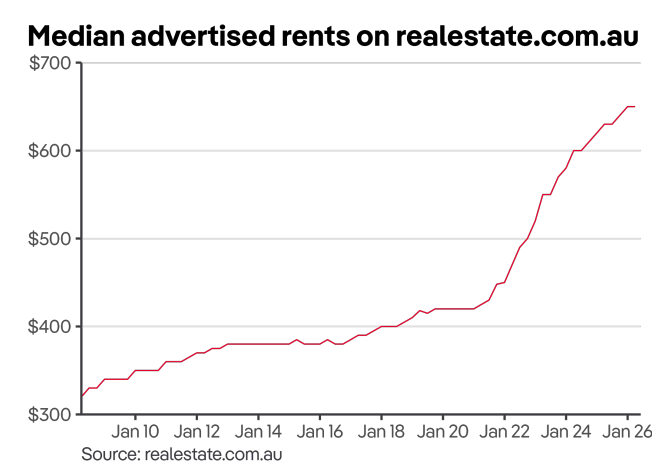
REA Group estimates that the national median advertised rent has increased since the pandemic, from $420 at the start of 2020 to $650 today. This has added $11,960 to the annual cost of renting the median home.
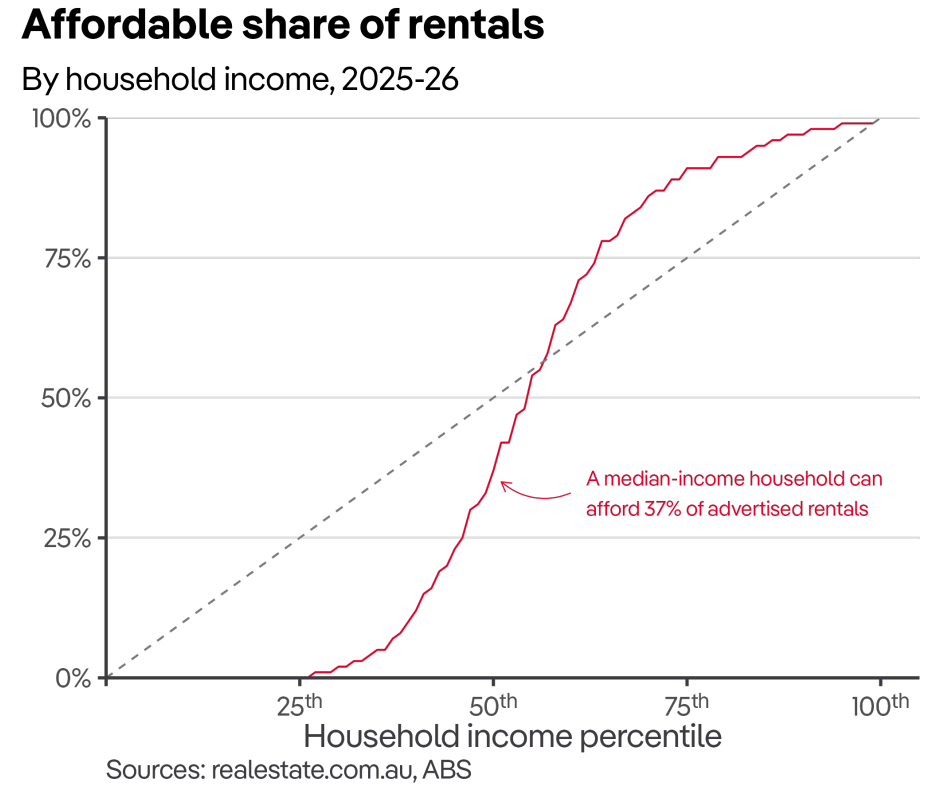
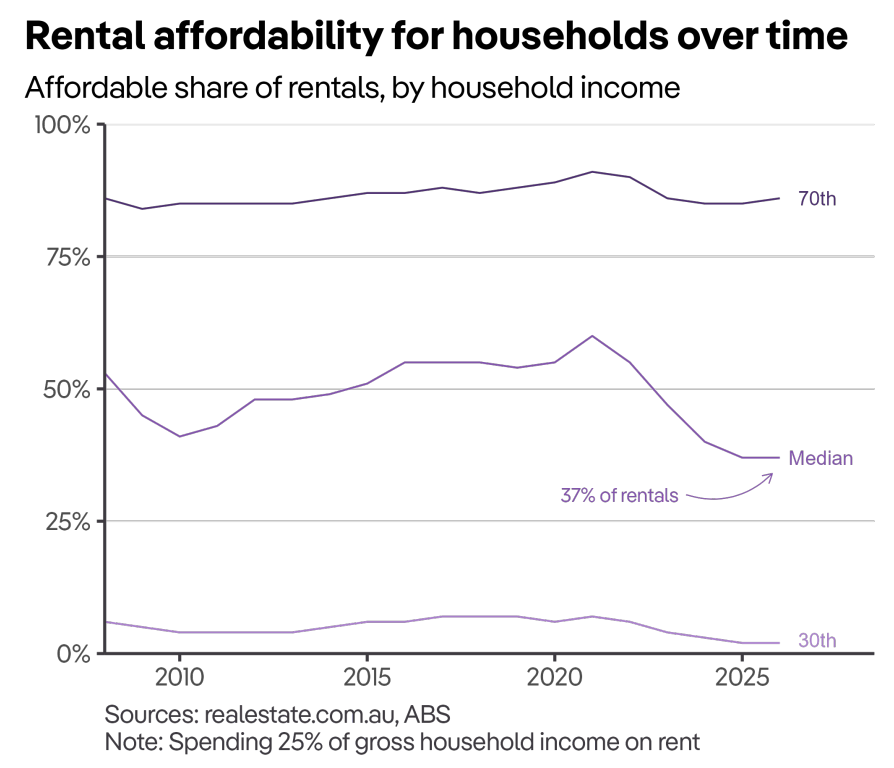
Australian households earning the median income of $124,000 could afford just 37% of rentals advertised from July to December 2025, a new low. REA Group’s affordability benchmark is based on a household spending 25% of its pre-tax income on rent.
For lower-income households earning just under $75,000 per year, only 2% of rentals advertised from July to December 2025 would have been affordable.
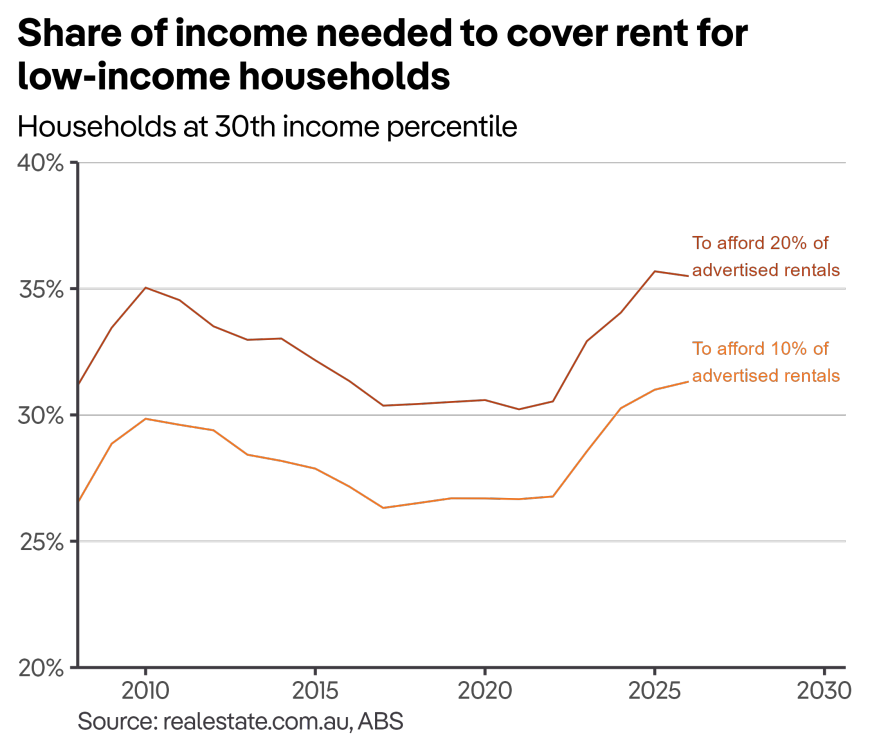
Put another way, for these lower-income households to afford even one in five rentals advertised across Australia, they would need to spend 35.5% of their pre-tax income.
Focusing just on existing renter households, the situation is likely even worse. Because renter households are typically lower-income than the overall population, 30% of renter households earn less than $68,000 per year, meaning they would need to spend close to 39% of their pre-tax income to afford one in five rentals.
REA Group Senior Economist and report author, Angus Moore, said: “Rental affordability has fallen to a record low, with Australian renters facing the toughest conditions since at least 2008″.
“A median income household in Australia could afford to rent just 37% of the advertised rentals on realestate.com.au between July and December 2025″.
“This is a significant decline from the conditions recorded at the end of the 2010s into the early 2020s. Since the onset of the pandemic, national rent prices have grown 55%, and income growth has failed to keep pace, lifting just 25% over the same period”.
“This imbalance has worsened rental affordability”.
“On top of that, rent prices have grown faster for more affordable properties, making it particularly challenging for low-income renters, who can afford essentially no rentals at just 2%”, Moore said.
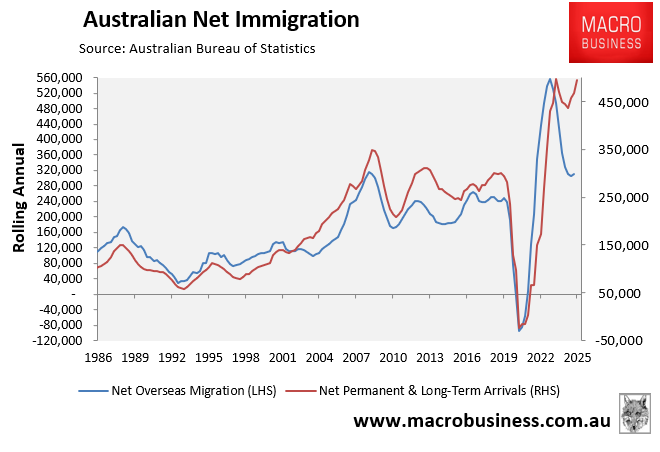
With immigration rising again and tracking at historically high levels, rental affordability will inevitably worsen:
The single best solution to Australia’s rental crisis is to slow the importation of people who require housing.
Just under 500,000 net permanent and long-term arrivals landed in Australia in the year to January, while 311,000 net overseas migrants landed in the year to September 2025.
Such massive migration inflows have placed undue strain on the rental market, driving vacancy rates to record lows and rents to record highs.
