
The housing finance commitments for the December quarter from the Australian Bureau of Statistics (ABS) showed that the number of investor mortgages issued over the quarter hit a record after jumping by 5.5% over the quarter to 60,445:
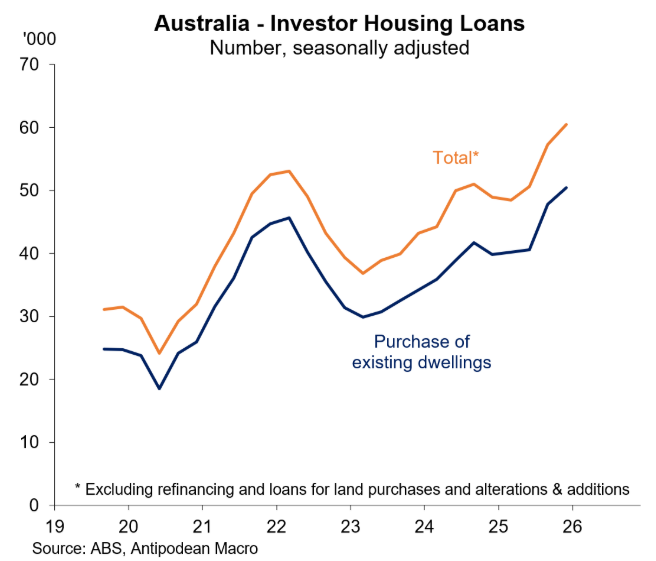
Chart from Justin Fabo at Antipodean Macro
The value of investor lending also surged by 7.9% over the quarter and 31.8% over the year, with investor loans accounting for 39% of new mortgage lending in 2025, the highest share since 2017.
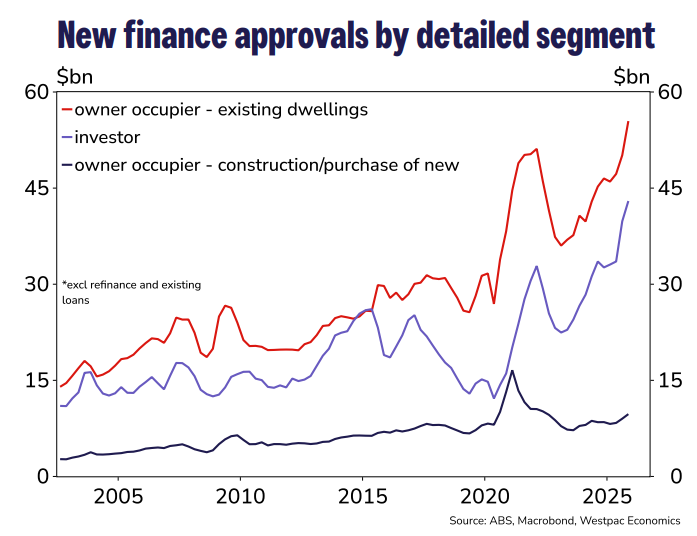
Chart from Westpac Economics
The bullish investor data continued in January, with the Reserve Bank of Australia (RBA) on Friday reporting that the stock of investor mortgages on issue rose by 0.8% over the month, by 2.6% over the quarter, and by 8.9% year-on-year:
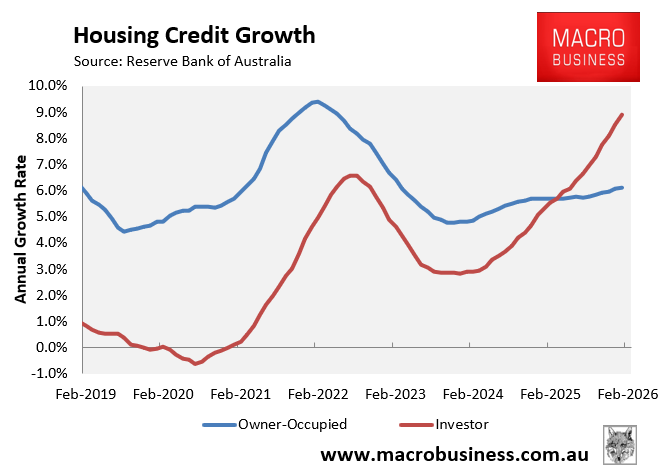
It was the strongest annual growth in the stock of investor mortgages since October 2015 and easily eclipsed the 6.10% growth in the stock of owner-occupier mortgages.
Investor appetite for Australian property remains strong, with Google searches for “investment property” tracking at historically high levels, commensurate with the explosive growth in mortgage commitments:
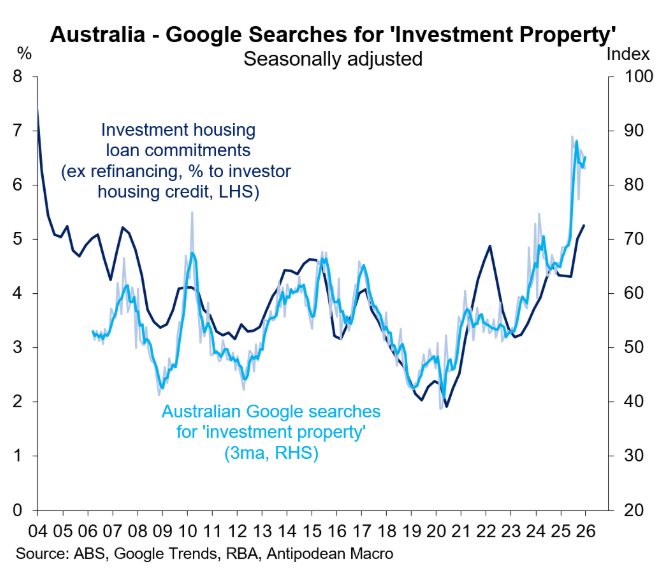
Chart from Justin Fabo at Antipodean Macro
The latest Westpac-Melbourne Institute survey on consumer sentiment also revealed that house price expectations were tracking at their highest level in 15 years, despite widespread expectations of further interest rate hikes:
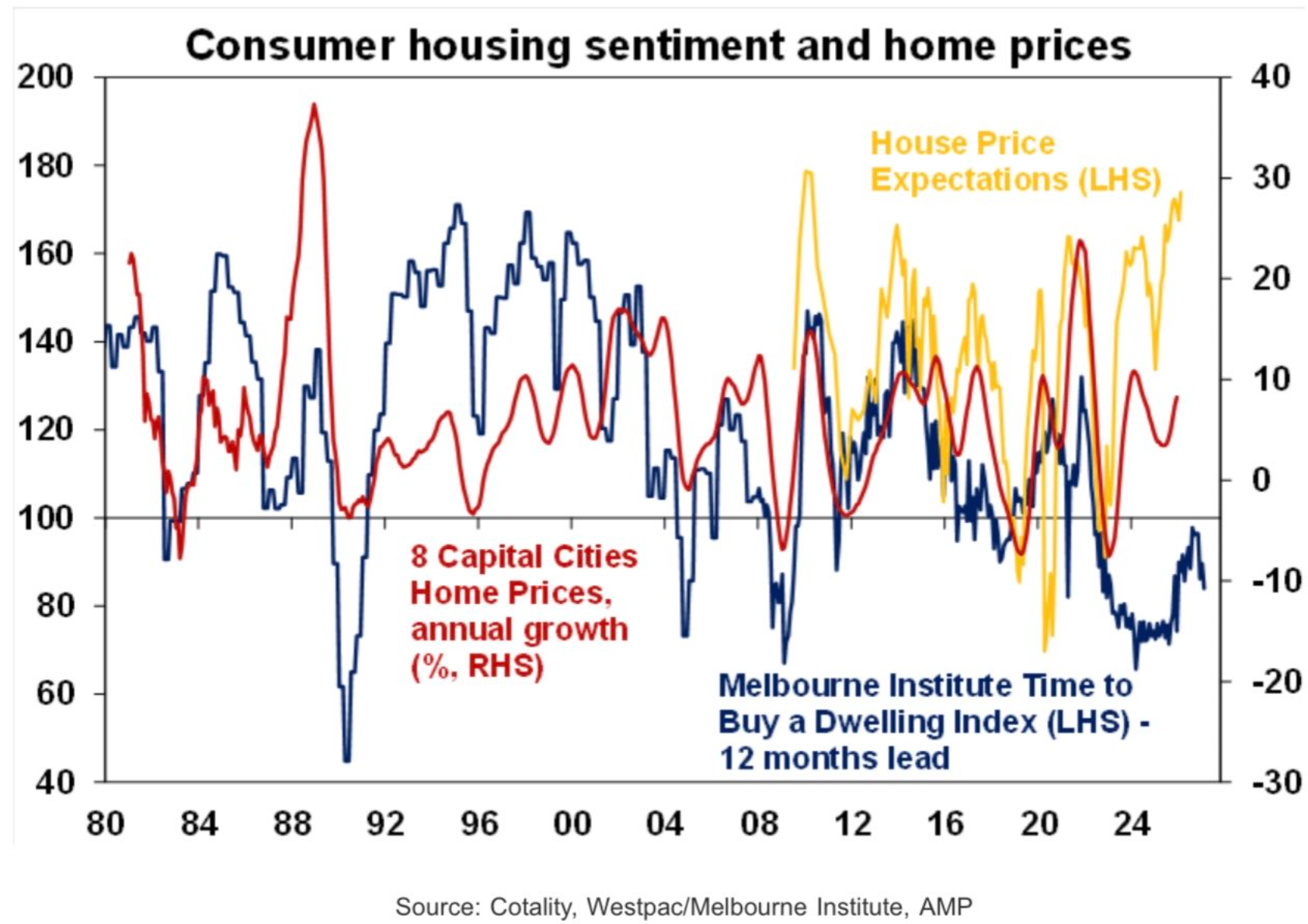
Chart by Shane Oliver (AMP)
The surge in investor mortgage demand comes amid growing expectations that the Albanese government will make changes to investment property tax concessions in the upcoming May Budget.
Government discussions and media reports indicate active consideration of reducing the discount on investment property gains from 50% to 33% or even 25%.
Economists, unions, the Greens, and some crossbench MPs have expressed support for reductions. There is also uncertainty over whether the changes would be grandfathered for existing investors or phased in over an extended period.
The Australian Treasury has confirmed that it is actively modelling changes to the CGT discount ahead of the May 2026 Budget.
The Albanese government is also rumoured to be examining a cap on the number of properties that can be negatively geared.
Media reports suggest that the government is considering a cap of two investment properties per individual that could still be negatively geared. At the same time, the Australian Council of Trade Unions (ACTU) has proposed restricting both negative gearing and the CGT discount to one investment property per person, with a transition period to protect existing holdings.
A cap on negative gearing would limit the ability of large-scale “professional landlords” to deduct rental losses from wage income, while protecting “mum and dad” investors with small investment property holdings.
Judging by the high volume of Google searches for “investment property”, the rumoured tax changes have yet to impact demand.
Investors may be attempting to buy before the rules take effect, expecting to be grandfathered in.
Should the May Budget tighten concessions around negative gearing and the CGT discount, expect investor demand to fall, similar to what happened in Victoria after land taxes were increased:
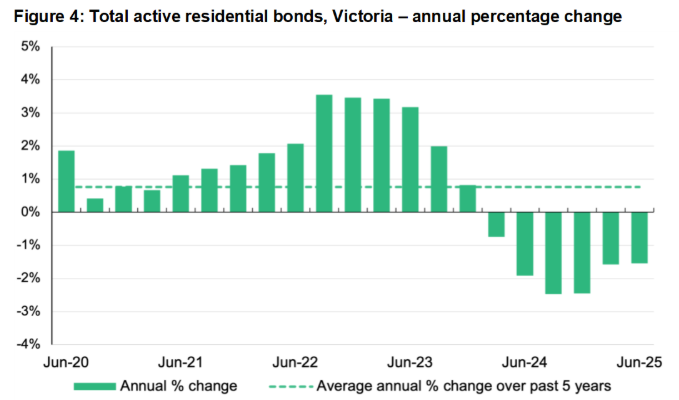
Source: Homes Victoria Q3 2025 Rental Report
The increase in land taxes on investment properties drove an exodus of investors from the Victorian market.
