
Former Home Affairs Minister-turned-Housing Minister, Clare O’Neil, regularly lamented that Australia’s migration system was too temporary and held the nation back.
“Today, really for the first time in our modern history, our uncapped, unplanned temporary program is the centrepiece and driver of our migration system. This simple fact is the source of huge problems”, O’Neil bemoaned in February 2023.
“In 2007, we had about one million temporary migrants in Australia, excluding visitor and transit visas. Today that number is 1.9 million”.
O’Neil repeatedly blamed the former Coalition government for the growth in temporary visas.
“It happened not through thoughtful planning and strategy, but by negligence and continental drift. And, this reliance on temporary migration is having enormous economic and social consequences”, O’Neil claimed.
“This focus on temporariness means that migrants cannot truly flourish”.
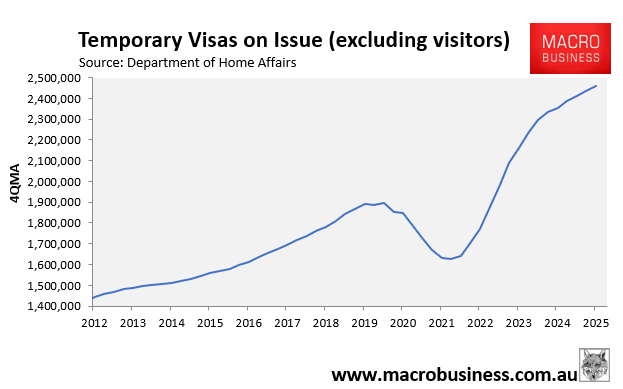
The Department of Home Affairs (DHA) released temporary visa data for the December quarter, presented below on a calendar-year basis to remove seasonality.

DHA revealed that the number of temporary visa holders in Australia, excluding visitors, hit a record high of 2,322,800 in the 2025 calendar year, up 89,800 on the prior year’s record.
Temporary visa numbers were tracking nearly 460,000 above the pre-pandemic peak. Therefore, by Clare O’Neil’s own admission, Labor has failed dismally on immigration by letting the number of temporary migrants in Australia soar nearly half a million above the Coalition’s peak.
The following chart by Justin Fabo from Antipodean Macro shows that the growth in temporary visa numbers has been driven overwhelmingly by Indians:

The following time series chart plots the change in temporary visa numbers by major category:

The next chart shows the change in temporary visa numbers by category between Q4 2019, just prior to the pandemic, and Q4 2025:

As you can see, bridging visas (195,917) and graduate visas (136,577) have driven the growth in temporary visa numbers.
Once again, Justin Fabo’s chart below shows that Indians have driven the explosive growth in bridging visas:

Former senior immigration department bureaucrat Abul Rizvi argued that bridging visas are “the most important barometer of the health of the visa system”.
Rizvi regularly criticised the former Coalition government for allowing the number of bridging visas to balloon past 100,000 before the pandemic.
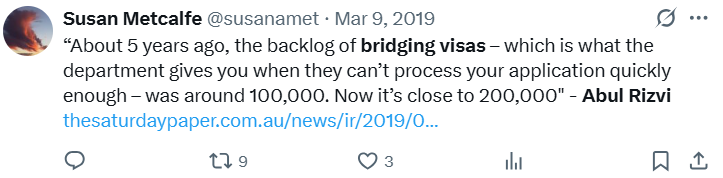
Rizvi argued that the growth in bridging visas was evidence of “administrative incompetence”.
The number of bridging visas on issue rose dramatically when borders were closed during the Covid-19 pandemic, as temporary migrants on expired visas were unable to leave.
However, with borders now fully open, the Albanese Labor government has presided over the largest bridging visa numbers in history, with 387,572 on issue as of 31 December 2025:

If bridging visas are “the most important barometer of the health of the visa system”, then the Albanese government must be the most incompetent immigration manager in the nation’s history.
Abul Rizvi also argued in December that Australia’s visa system was “unable to cope with the volume”:
“Just about everything is up — there’s nothing that’s fallen over the last decade,” said Dr Abul Rizvi, former deputy secretary of the Immigration Department. “The only one that hasn’t really gone up is visitors. We’re not getting the tourism numbers we did pre-Covid”.
Dr Rizvi, who served at the Immigration Department from 1991 to 2007, said Australia’s visa system was more overloaded than ever and “unable to cope with the volume”, particularly of bridging visas…
Rizvi said the government must urgently “slow the rate at which temporary visa holders in Australia are growing”…
Rizvi criticised the Albanese government for walking back on its commitment to cut temporary visa numbers:
Dr Rizvi said Labor appeared to have walked away from its promise rein in the flood of temporary visas.
“The Labor government promised prior to the 2019 election that it would significantly reduce reliance on temporary entry visas,” he said.
“The Migration Strategy it issued in 2023 said it would reduce reliance on temporary entry visas. I think it’s a reasonable question to ask, what happened to the promise?”
Leading up to the 2022 and 2025 federal elections, Anthony Albanese stated that Labor would run a smaller and less temporary migration program.
Instead, Labor has delivered a larger, lower-quality, and more temporary migration program than ever.
