
If a nation drives up energy costs, it deindustrialises
The evidence from around the world shows that when you raise energy costs, your economy deindustrialises.
Consider the following examples.
Germany:
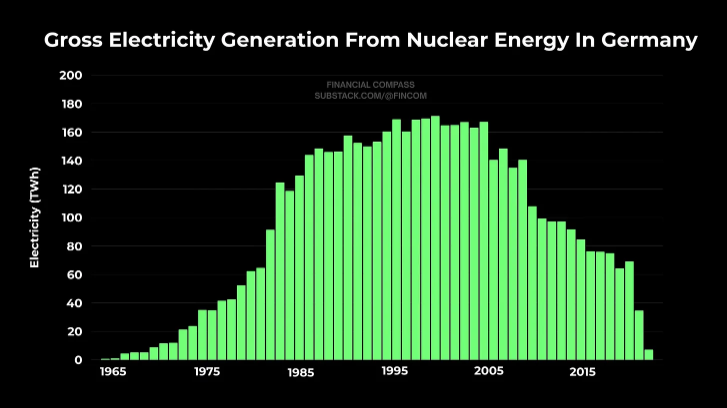
Germany once had about 22 GW of nuclear power, producing over 160 TWh annually at a reasonable cost and with no emissions.
Following the Fukushima accident in 2011, Berlin shut down 8 GW of nuclear generation immediately and completed the phase-out by 2023.
Source: Financial Compass
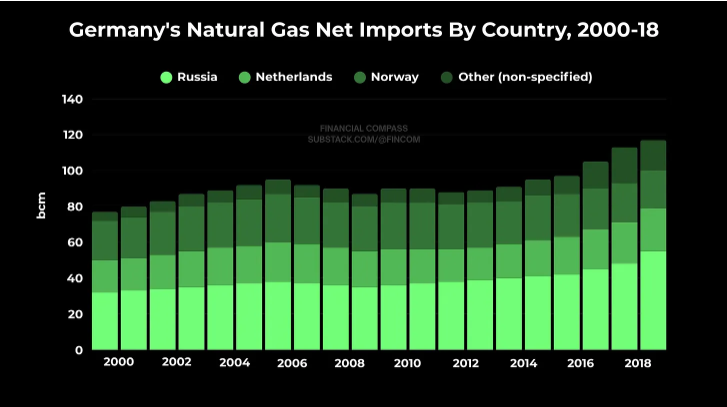
However, renewables were unable to deliver reliable baseload power. As a result, natural gas imports, particularly from Russia, were used to fill the gap.
Source: Financial Compass
By 2018, Russia supplied more than half of Germany’s imported gas, thereby concentrating risk.
The Russian invasion of Ukraine highlighted Germany’s energy vulnerability.
With nuclear power gone, gas limited, and renewables insufficient, coal—the fuel Germany promised to eliminate—returned as an emergency remedy. Coal plants were restarted to keep the grid stable.
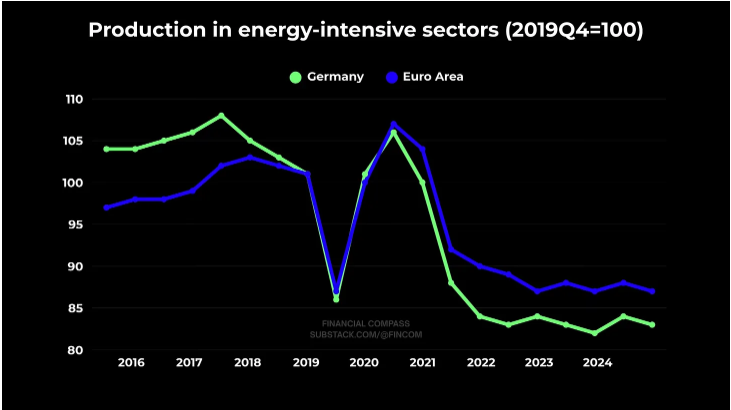
Industrial behemoths such as BASF suffered, reducing operations owing to rising energy costs.Energy-intensive sectors shrank, with investment shifting elsewhere.
Source: Financial Compass
As explained by Financial Compass:
Germany was hit harder than the rest of Europe. Its energy-intensive industries contracted sharply in 2022, and output has lagged ever since.
Even today, German production sits below the euro-area average, a gap that has not closed. Industrial activity remains subdued, energy-heavy sectors are still cautious, and investment continues to drift abroad…
Some analyses suggest that if Germany had kept its nuclear fleet running from 2002 to 2022, it could have cut its carbon emissions by roughly 70% and avoided hundreds of billions of euros in energy-transition costs.
Nuclear power offered Germany exactly the kind of steady, clean support that could have carried the country through the hardest year of its energy crisis…
Germany shut down its final nuclear power facility on April 15, 2023. Pro-nuclear supporters online expressed indignation and disgust at photographs of demonstrators celebrating the end of their 50-year war on nuclear energy.
It’s difficult to understand why protesters would celebrate a move that clearly contradicts Germany’s renewable energy and energy security goals.
Shutting down Germany’s nuclear facilities has made it far more reliant on fossil fuels than its nuclear rival France, while also raising energy bills.
Germany emits 440 grammes of CO2 every kilowatt hour it generates, compared to 30-40 grammes in nuclear-heavy France.
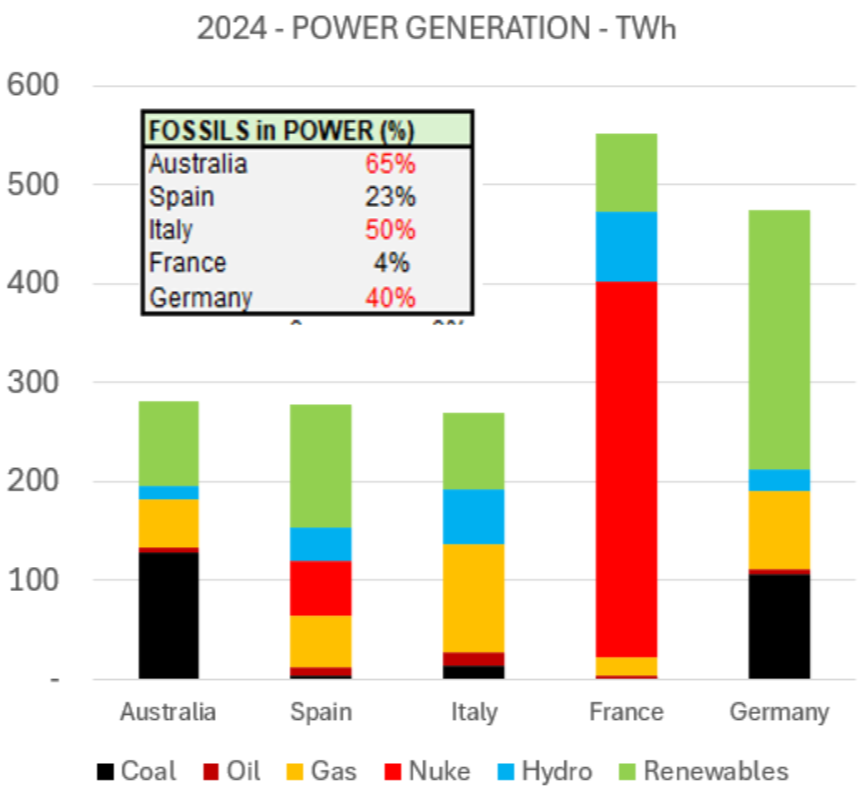
Germany now has the highest electricity prices in Europe and the fifth most expensive electricity prices in the world.
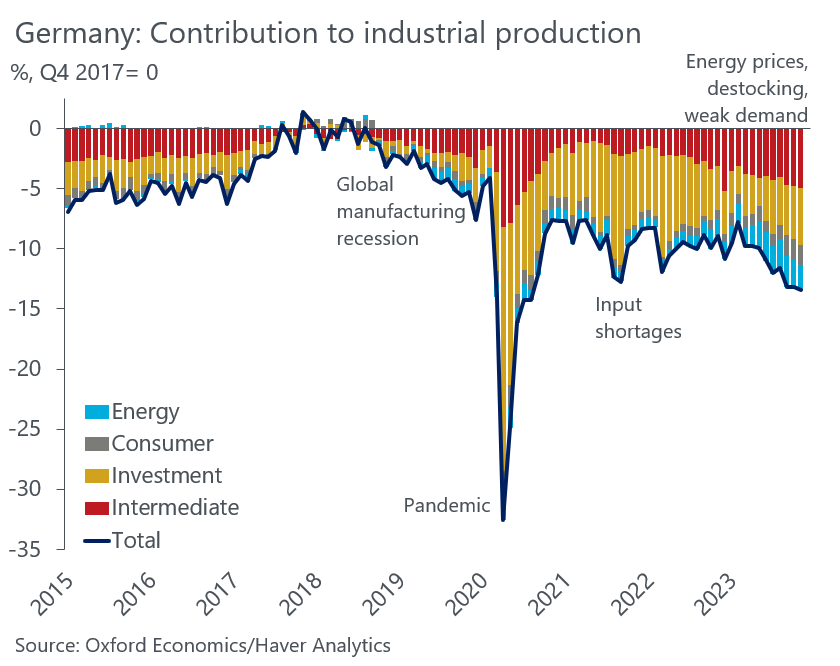
The impact on German industry has been catastrophic, with industrial production contracting at an alarming rate.
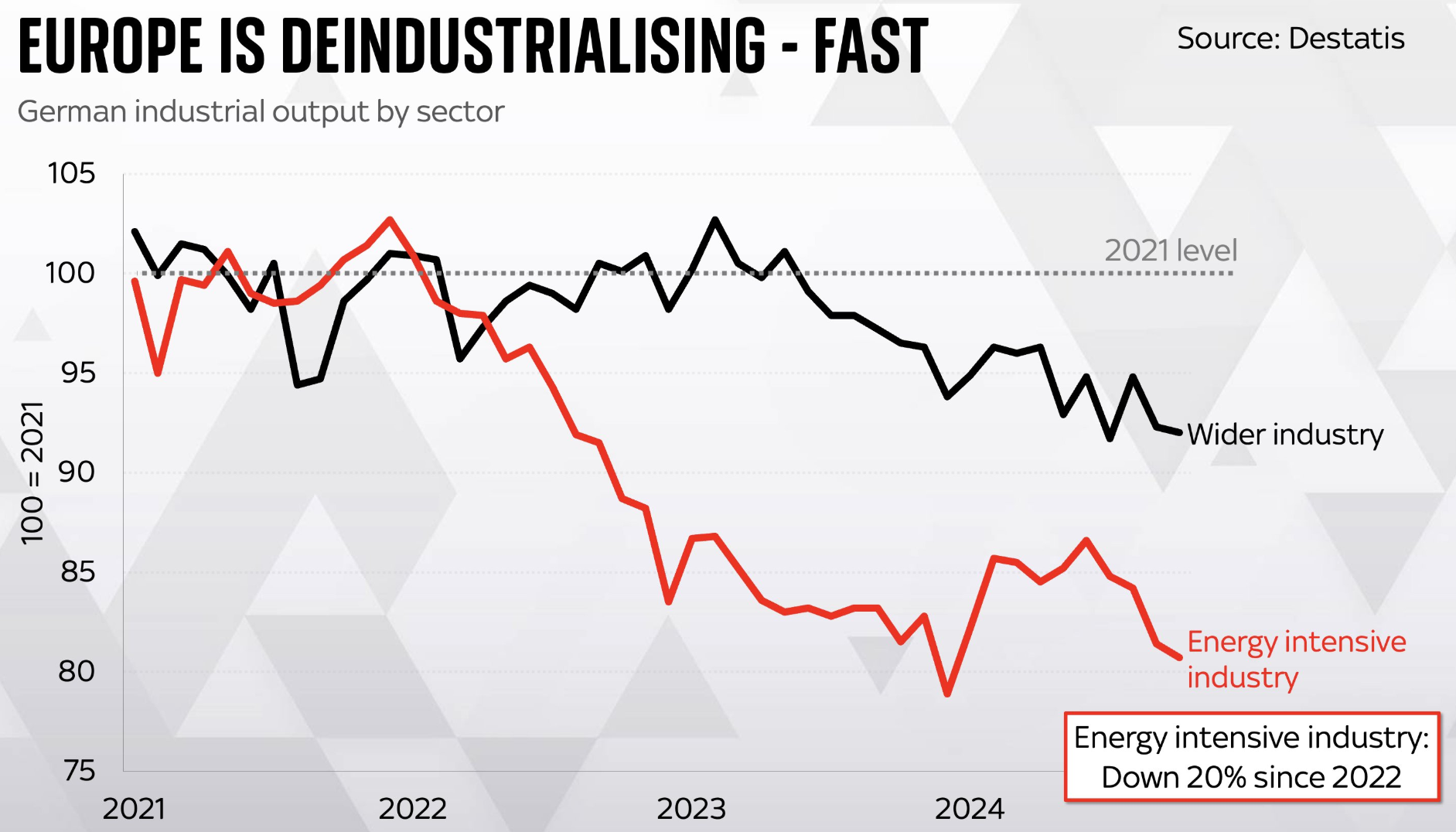
Germany’s deindustrialisation has been concentrated in energy-intensive industries, which have declined by 20% since 2022:
The United Kingdom:
The UK has positioned itself as a global climate leader, especially around COP26 in Glasgow.
Like Australia, the UK has committed to net zero by 2050 and has strong 2030 emissions reduction targets.
The UK’s energy transition—especially the phase‑out of coal—is already well advanced with legally binding carbon budgets.
The UK government’s stated targets in the Clean Power 2030 plan, include:
- 45–47 GW of installed solar capacity by 2030.
- 50 GW of offshore wind by 2030.
- 23 GW of battery storage by 2030.
Recent testimony from energy company bosses in the UK parliament warned that even if wholesale power costs fell by 50%, electricity bills would rise by around 20% over five years due to increased network and other costs associated with renewables:
UK electricity prices have been on a steady upward trajectory since the early 2000s, with particularly sharp increases in recent years.
These increases have been driven by wholesale market volatility, infrastructure costs, and policy changes.
The UK’s regulated energy price cap rose to £1,758 per year in 2025, which is nearly 70% higher than in 2021.
The rise in energy costs is deindustrialising the UK.
A new report from CBI and Energy UK warns of widespread deindustrialisation because energy prices remain far higher than in competitor economies. Their joint report argues that high costs are undermining investment, competitiveness, and the country’s status as a major manufacturing centre.
The UK has some of the highest industrial energy prices in the developed world—almost two‑thirds above the IEA median and the highest in the G7. As a result, sectors like chemicals are already seeing closures and Make UK and other industry groups warn that without major intervention, the industrial base will shrink.
UK business electricity costs are 70% higher than before Russia’s invasion of Ukraine. Gas prices are 60% higher. Nearly 90% of companies have seen energy bills rise over the past five years.
The report warns of rising risks of job losses, production cuts, plant closures, and offshoring. 40% of businesses have reduced investment due to high energy costs.
The report calls for a comprehensive review of the UK’s energy needs and regulatory framework.
Indoor food growers in the UK are also suffering from rising energy prices.
From 1 April, UK electricity standing charges will rise sharply. Thanet Earth—the UK’s largest glasshouse complex—expects:
- £900,000 extra per year immediately
- Rising to £1.6 million extra by 2028
- This alone adds ~5% to tomato production costs.
Growers say these increases are impossible to absorb and will push up food prices.
Growers also warn that some producers may stop production while others will be forced to raise prices, fuelling food inflation.
As a result, investment in new facilities is being frozen.
Lessons for Australia:
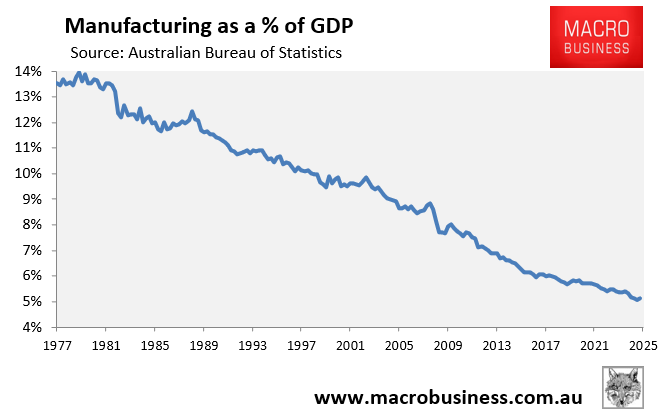
Australia is experiencing similar energy price pressures and rapid deindustrialisation.
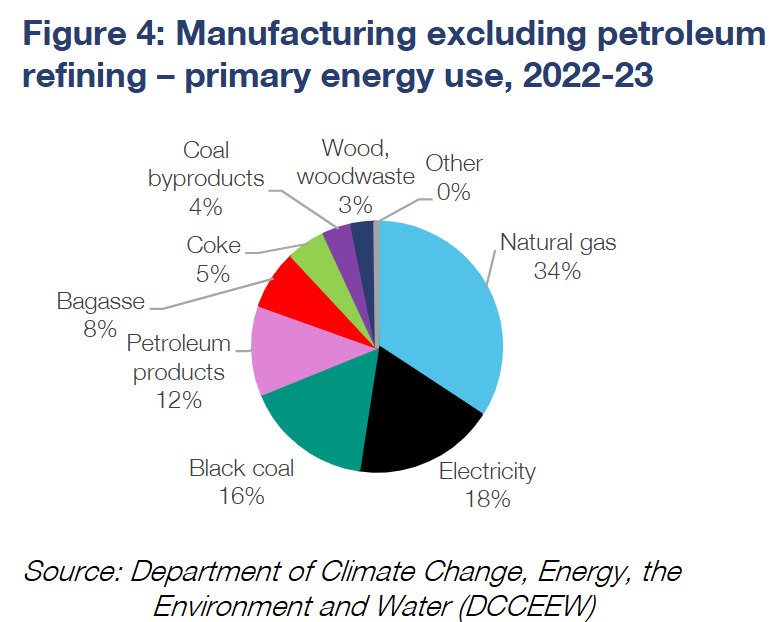
Gas and electricity are key inputs to Australian manufacturing:
Alex Joiner, chief economist at IFM Investors, illustrated the manufacturing sector’s energy conundrum with the following chart:
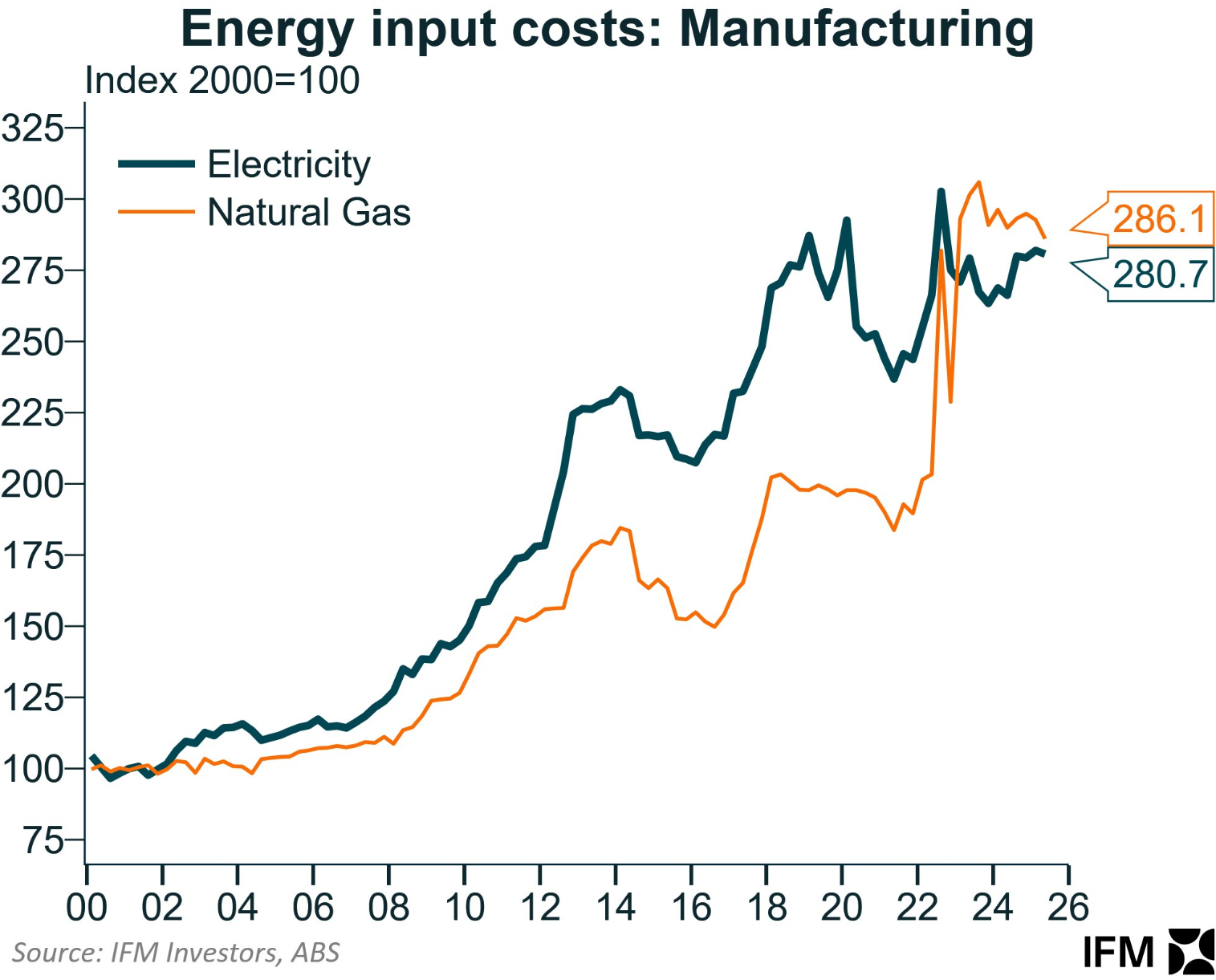
Natural gas input costs in industry have risen by 186% since 2000, while electricity prices have risen by 181%.
The rise in natural gas costs has been especially dramatic since 2022, when Russia invaded Ukraine.
As a result, ASIC insolvency figures last year showed that over 1400 manufacturers nationwide had failed since 2022-23.
Among these, Incitec Pivot, a large fertiliser company, closed most of its Australian operations due to rising energy costs.
Qenos, Australia’s last major plastics plant, shut down in 2024 due to high gas prices, leaving the country entirely reliant on polymers supplied from China.
Oceania Glass, Australia’s lone architectural glass manufacturer, closed in February 2025 after 169 years of business due to rising energy costs and Chinese dumping.
Orica, the world’s largest producer of mining explosives, chemicals, and agricultural fertilisers, and BlueScope Steel have threatened to downsize their Australian operations and relocate to the United States in response to rising energy prices.
Without inexpensive and reliable gas and electricity, Australia’s manufacturing sector will continue to shrink, the country will deindustrialise, its economy will become less diverse and productive, and living standards will decline.
This is why Australia needs a genuine domestic gas reservation policy, alongside a technology-neutral energy policy aimed squarely at providing stable and reliable power at the lowest possible cost.
There is no point in Australia becoming a ‘net zero hero’ if our industry is simply offshored to locations with cheaper energy and poorer pollution control.
