“Economically illiterate” airport boss spins migration fairy tales

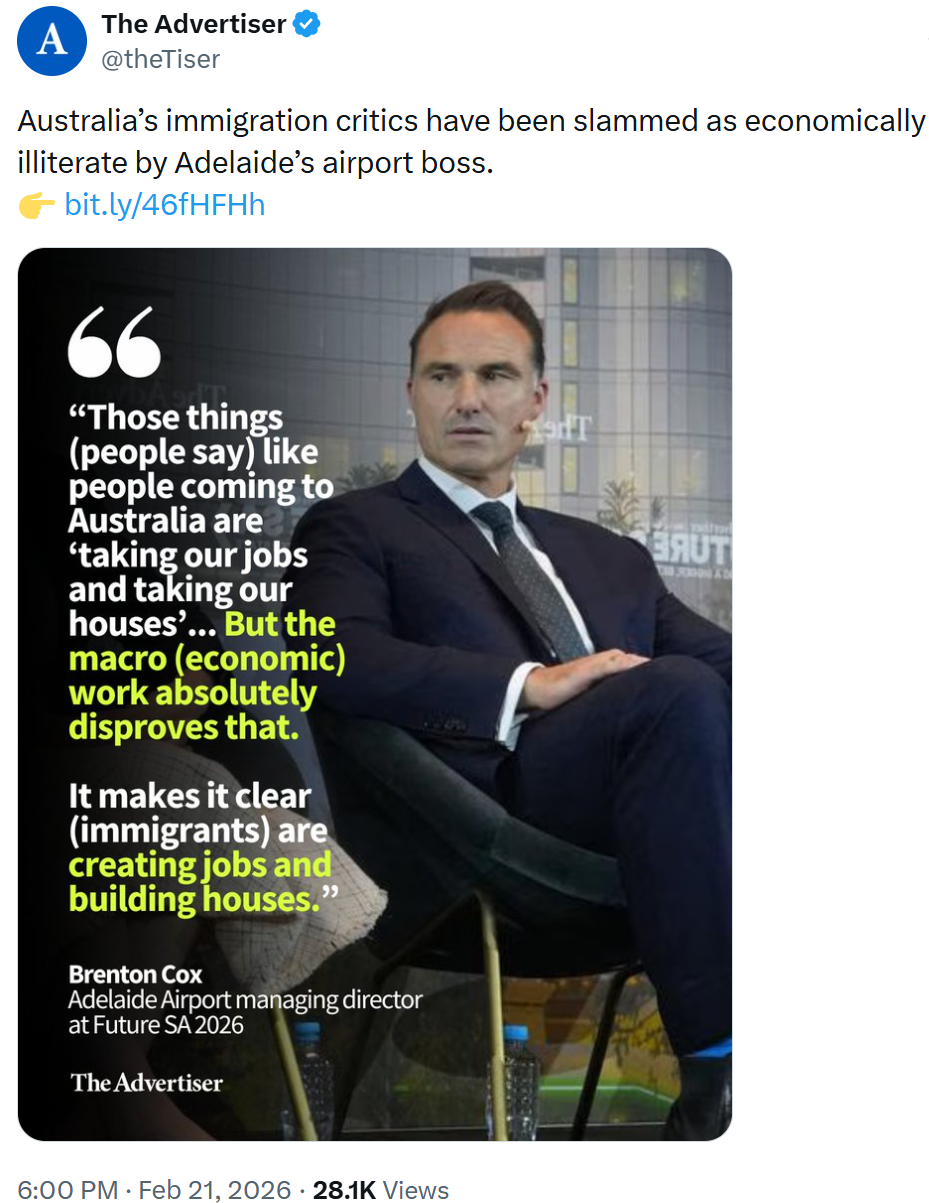
Adelaide Airport managing director Brenton Cox has labelled immigration critics “economically illiterate”, arguing that lower immigration levels would hinder growth and hinder housing supply.
“Those things (people say) like people coming to Australia are ‘taking jobs and taking our houses’… But the macro (economic) work absolutely disproves that”.
“It makes clear (immigrants) are creating jobs and building houses”, Cox was reported as saying at the Future SA 2026 summit.
Cox should make sure that he has his facts in order before labelling those wanting lower, sustainable immigration “economically illiterate”. Otherwise, he will look like a goose.
The available data clearly shows that migrants are heavily underrepresented in the construction sector. But don’t just take my word for it.
Build Skills Australia’s recent report explicitly stated that immigration’s “demand impact is particularly significant in residential construction, where every new migrant requires additional housing and associated services, creating an immediate need for more labour to deliver these essentials”.
However, it noted that “only 3.2% of recent immigrants—those who arrived in the last decade—are employed in the residential construction sector”, below the “4.0% and 5.0% of the working-age population in Australia” that are employed in construction.
“This indicates that immigration’s contribution to population growth has not been matched by its contribution to the workforce needed to construct housing for these additional residents”, Build Skills Australia said.
The Grattan Institute also warned that few migrants work in the construction sector.
“Migrants who arrived in Australia less than five years ago account for just 2.8% of the construction workforce, but account for 4.4% of all workers in Australia”, Grattan reported.
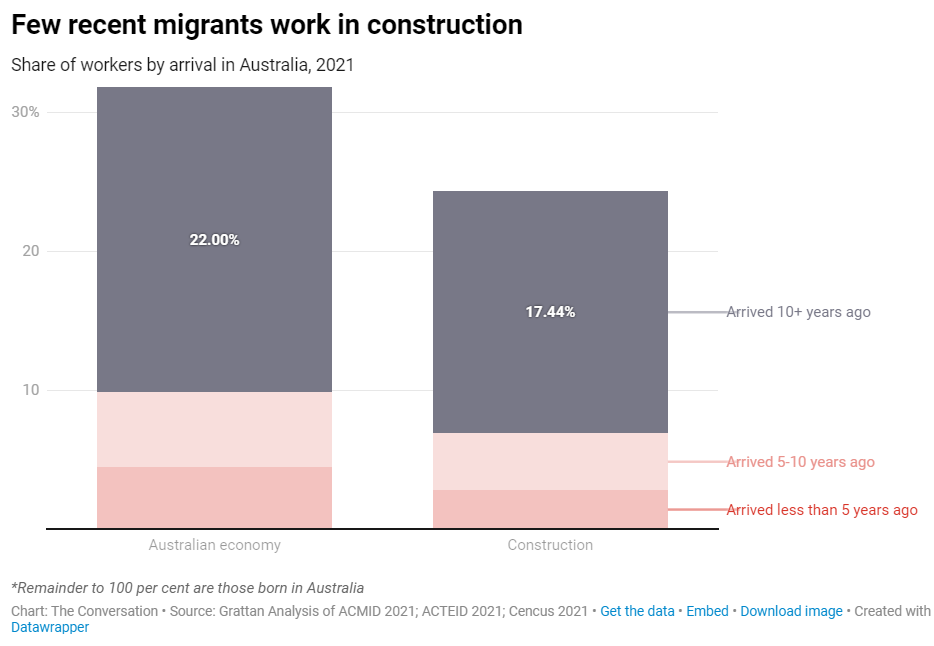
Therefore, contrary to Cox’s claim, Australia’s immigration system adds far more to housing and infrastructure demand than it adds to supply, causing shortages of both.
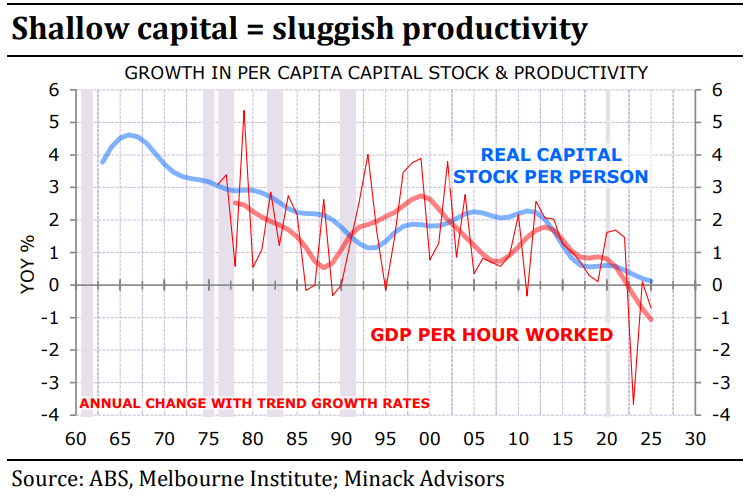
This “capital shallowing” from excessive levels of immigration, whereby the population has grown faster than business, infrastructure, and housing investment, is also contributing to Australia’s poor productivity growth:
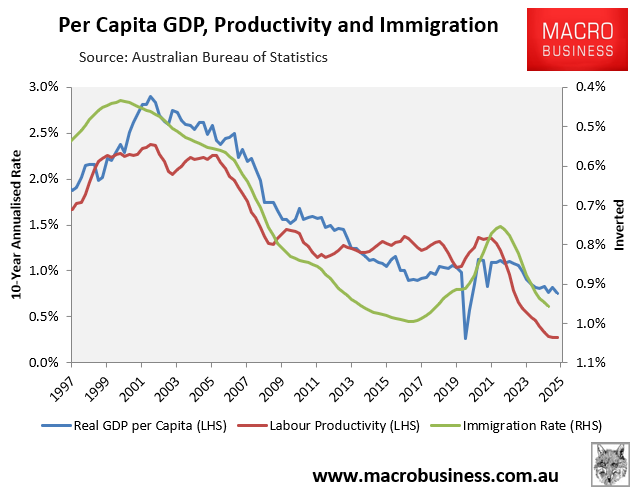
As a result, Australia’s productivity and per capita GDP growth performance have fallen as the immigration rate increased:
The obvious solution is to run a significantly smaller migration program that is focused on the skills the nation actually needs, rather than more Uber drivers.
Australia should aim for migration quality over quantity.
Sadly, rent-seekers like Brenton Cox, who profit from more people churning through Adelaide Airport, will never tell the truth on immigration.