
Australia’s education exports are massively overstated
Universities Australia (UA) has published its pre-budget submission, which repeats the lie that international education is “a $52 billion export engine” and “one of Australia’s biggest money-makers”.
This fantastical $52 billion education export figure comes from the Australian Bureau of Statistics (ABS) and is wildly exaggerated because it does not subtract money earned and then spent in Australia, remittances sent home, or commissions paid by universities to overseas agents.
The ABS counts all spending in Australia by international students as an export, regardless of where the money comes from.
This is explicitly confirmed by the ABS:
“All expenditure by international students studying in Australia is recorded as an export… This includes expenditure on tuition fees, food, accommodation, local transport, health services, etc.”
Under the Balance of Payments framework, the ABS treats international students as non‑residents consuming Australian goods and services.
Under this framework:
- If a non‑resident spends money in Australia, it is automatically considered an export.
- It does not matter whether the money was earned here.
- It does not matter whether some of it is later sent overseas via remittances.
- It does not matter whether Australian institutions pay commissions to foreign agents.
The ABS treats total spending in Australia by student visa holders as if it were all foreign money.
This is a methodological choice by the ABS, not an economic assessment of net exports or net benefit.
Three education export leakages that the ABS does not net out.
The largest ‘leakage’ from the “$52 billion” education export figure derived by the ABS relates to the domestic earnings of international students.
All money earned in Australia by students is counted as an export when they spend it even though:
- It is not foreign income.
- It is not paid by overseas households.
- It is not a net inflow to Australia.
After years of criticism, the ABS finally acknowledged that “around a third of the expenditure is funded by international students working in Australia for Australian employers”.
As a result, UA’s fantastical $52 billion education export figure is already marked down to $34.7 billion.
However, we know that a significant proportion of international students work off-the-books for cash, meaning the true amount of income earned by students in Australia would likely be higher and exports would be lower.
The second largest leakage of education exports comes from remittances sent home by international students or former students.
Remittances are an import in the balance of payments, but the ABS does not subtract them from the education exports figure:
“Personal transfers of cash or in-kind (sometimes referred to as workers remittances) between residents and non-residents are recorded under secondary income. However, if an international student receives funds from their non-resident parents who live overseas, or if the student transfers funds back to their home economy, both of these transactions would be out of scope of Australia’s balance of payments as they are transactions between non-residents”.
Students and former students remit large amounts to India, Nepal, China, Pakistan, Bangladesh, etc.
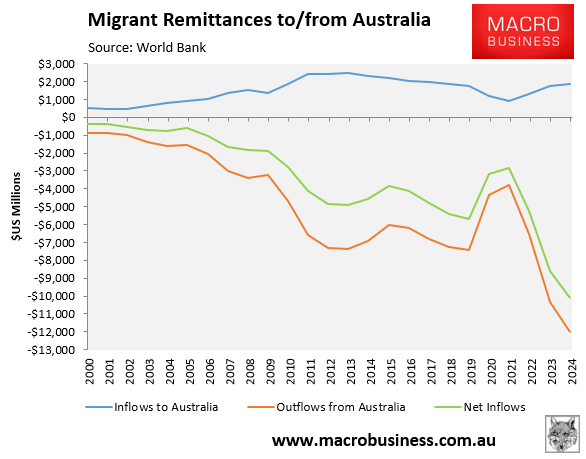
According to the World Bank’s most recent data on migrant remittances, net remittance outflows from Australia totalled $US10.1 billion in 2024, or around $A15 billion:
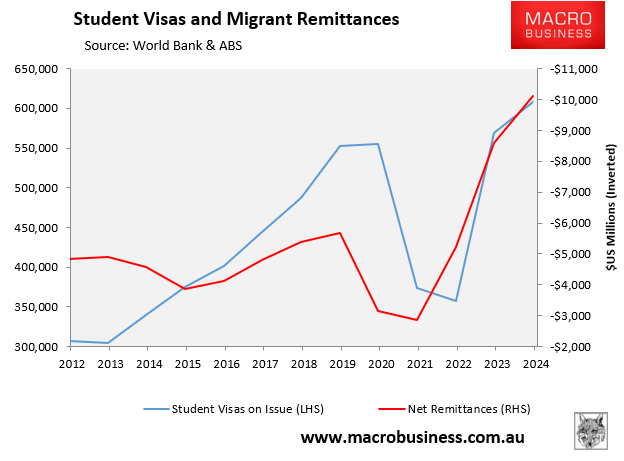
The volume of net remittance outflows has also tracked the number of international students studying in Australia.
Indeed, Jobs & Skills Australia’s (JSA) latest report on the international education system stated that over 90% of Indian and nearly 96% of Nepali higher education students cited the ability to work while studying as one of the reasons they chose Australia. “80% of students from South and Central Asia (including India and Nepal) were working during study”, JSA said.
JSA also noted that many Indian students send money back to their home countries via remittances.
A recent report from Money Transfer Australia, which drew on data from the World Bank, ABS, KNOMAD, and DFAT, estimated that US$4.8 billion worth of remittances were sent to India from Australia in 2024.
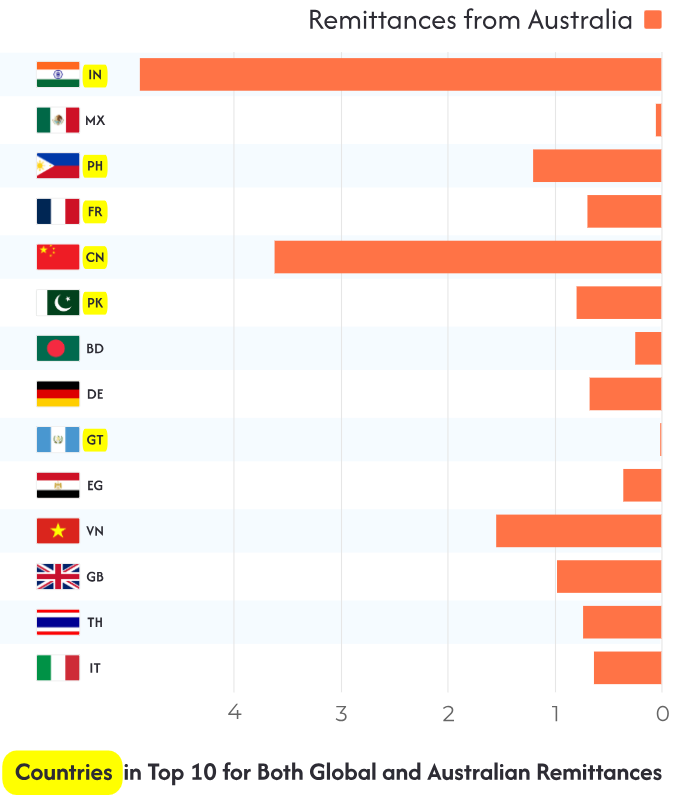
Source: Money Transfer Australia
“Money Transfer Australia’s report highlights that migrants from India are among the most active senders of money, despite the diversity of Australia’s overseas-born population”.
Indian Link projected that remittance outflows to India will continue to rise as the migrant population expands in Australia, driven by international education.
The third leakage from the education export figure released by the ABS relates to commissions paid by Australian education providers to foreign agents.
The Australian reported on Monday that universities are spending over $1 billion a year on recruitment and marketing aimed at international students.
More than $530 million was paid in agent commissions alone in 2024, although the true figure is likely much higher, because several major universities refuse to disclose their payments.
High spenders on agent commissions in 2024 included:
- UNSW: $133.3 million
- University of Sydney: $71 million
- Curtin University: $52.4 million
- James Cook University: $39.4 million
- QUT: $24.6 million (despite nearly half of recruited students dropping out in first year)
- Deakin: $30.6 million
- La Trobe: $11 million
Universities refusing to disclose commissions included Monash University, the University of Melbourne, and the University of Queensland.
Around 70–80% of international students in Australia are recruited through agents (though it varies by country).
Commission rates often range from 10% to 20% of first‑year tuition, sometimes higher for pathway colleges.
The government is now collecting commission data from providers for the first time. Providers must report education agent commission payments under new ESOS Act rules. However, this information will not be made public.
Presumably, the Department of Education wishes to keep the commissions data secret because if the public saw the true numbers, it would confirm:
- how heavily universities rely on middlemen to fill classrooms;
- how fragile their business model is; and
- how much of the “$52 billion export engine” is actually leaking offshore.
Universities prefer the narrative that international students choose them for “quality”, not because agents are paid aggressively to funnel students into specific institutions.
Disclosing commissions would make the public realise how much the sector’s finances hinge on volume recruitment, not academic excellence.
Such data could embarrass universities and raise questions about quality, integrity, and visa risk.
It would undermine the idea that they are elite academic institutions rather than high‑volume international businesses.
The Takeaway:
The fantastical “$52 billion export” figure for international education, quoted by UA, is wildly exaggerated.
If the ABS were to properly deduct leakages, including domestically earned income, remittances sent offshore, and commissions paid to foreign agents, the true figure would likely be half as high.
Moreover, around one quarter of education exports comes from vocational providers, not universities.
