Australia has experienced the strongest population growth in the developed world this century.
According to the ABS’ Population clock, the nation’s population has expanded by 8.9 million people this century, a 47% increase.
Australia has also experienced the biggest immigration boom in the nation’s history under the Albanese government, which has fueled the nation’s rental crisis.
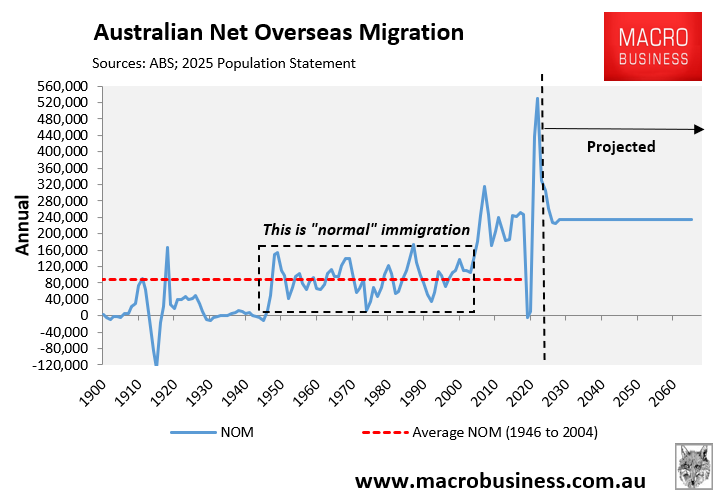
Since the Albanese government was elected in mid-2022, net overseas migration (NOM) has averaged 424,400 per year, amounting to 1,162 net migrants landing every day over Labor’s first three years and 1,273,200 net migrants overall:
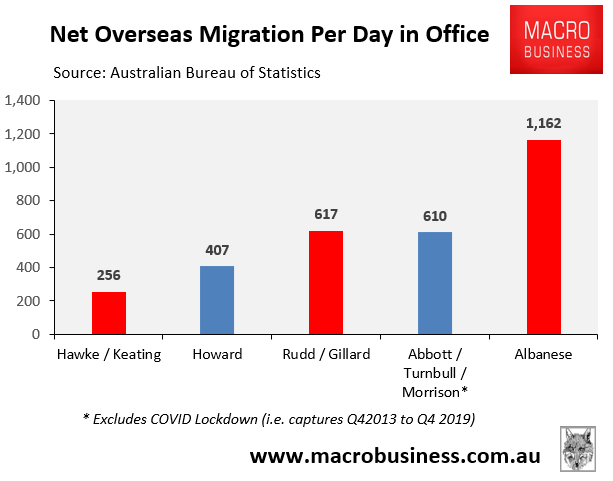
The level of NOM under Labor is nearly double the daily average reported by the previous Coalition government prior to the pandemic (i.e., between Q4 2013 to Q4 2019). It is also significantly higher than any other prior government.
The notion that Australia is ‘catching up’ on migration lost during the pandemic is also categorically false.
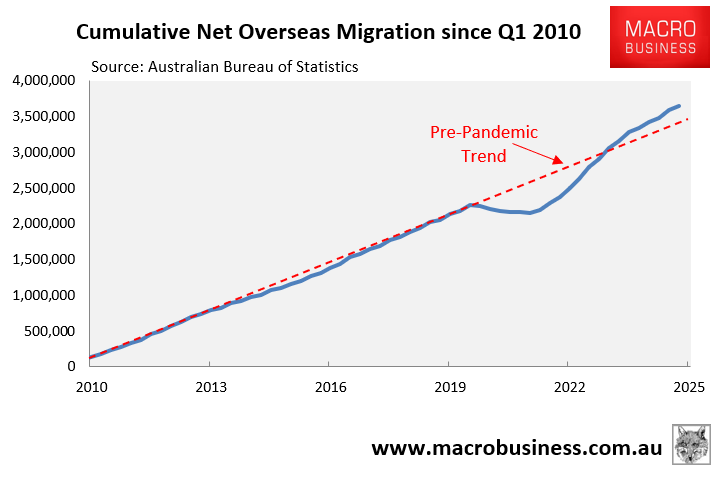
Since the end of 2019, NOM has averaged 266,000 per year. This is significantly above the average NOM of 226,000 during the 15 years of “Big Australia” before the pandemic.
IFM Investors’ chief economist, Alex Joiner, published a chart on Twitter (X) illustrating the extremeness of Australia’s recent population growth.
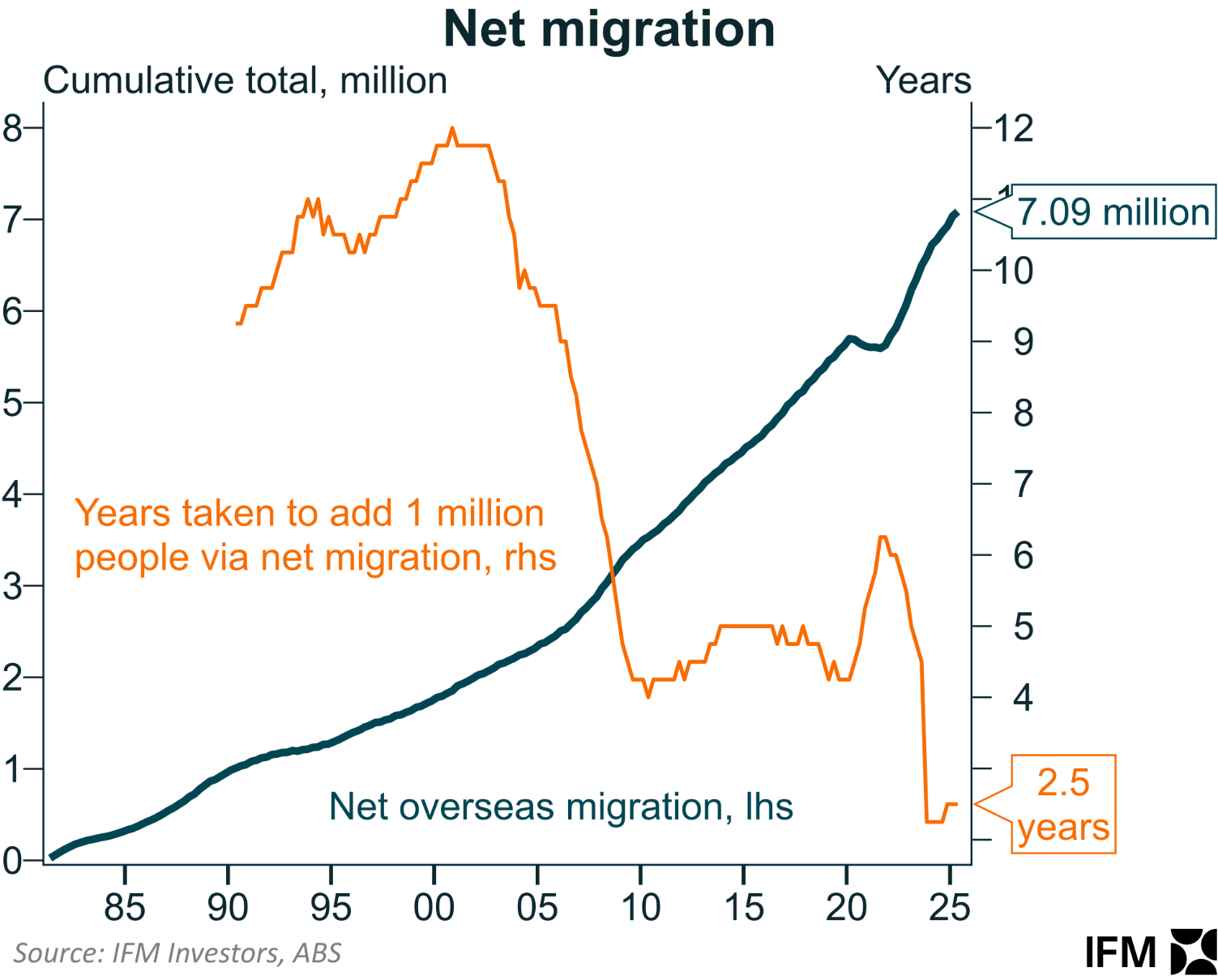
Joiner’s chart shows that it took 12 years to add one million people to Australia’s population via NOM in 2000 (i.e., around the time of the Sydney Olympics). As of mid-2025, it had taken just 2.5 years to add one million people to Australia’s population via NOM.
Thus, Australia in 2025 grew more than four times faster due to immigration than it did in 2000.
The end result of two decades of extreme immigration-driven population growth has been felt most acutely across Australia’s major capital cities, which have suffered from chronic shortages of housing, infrastructure, water supplies, hospitals, and schools, and worsening traffic congestion and overall quality of life.
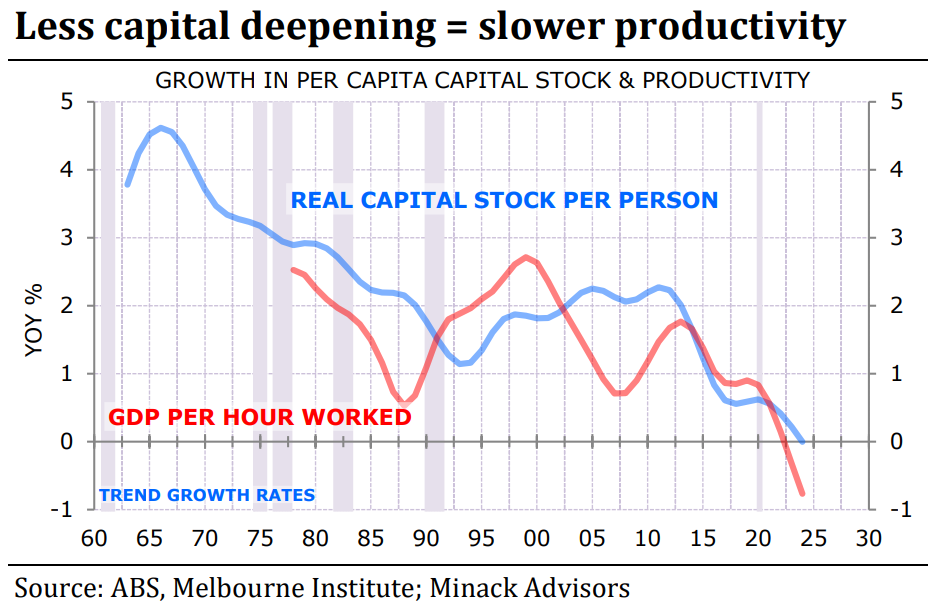
The nation’s productivity growth has also suffered because infrastructure and business investment have not kept pace with the nearly 9 million extra residents that have landed in Australia since the turn of the century, diluting the nation’s capital stock.
Given the deleterious impacts on the economy and living standards, common sense would dictate that the Australian Treasury and policymakers would change track and opt for a significantly smaller immigration program that prioritises quality over quantity. Sadly, Treasury via the centre for Population has doubled down on mass immigration and a Big Australia.
Last weekend’s Treasury of Common Sense with Luke Grant on Radio 2GB/4BC unpacked the Centre for Population’s 2025 Population Statement, which projects that Australia’s population will continue to grow aggressively over the next 40 years.
The Centre for Population projects that the nation’s population will balloon by 3,860,000 over the 11 years to 2035–36, with most (80%) of this growth occurring in the capital cities, which are projected to swell by 3,080,000 over the 11 years.
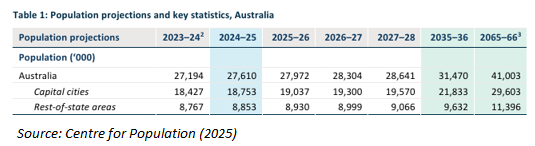
The hyper-population growth will continue indefinitely, with the nation’s population projected to balloon by an insane 13.4 million over the next 41 years to 2065–66, with most (81%) of this growth occurring in the capital cities, which are projected to swell by 10,850,000 over the next 41 years.
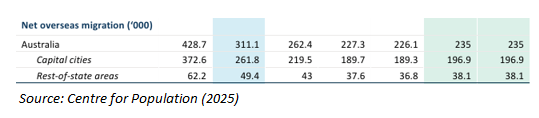
This extreme projected population growth is projected to come from high NOM, which is forecast to average 235,000 over the 41-year forecast horizon—i.e., 9,000 higher than the 226,000 average NOM recorded during the 15 years of ‘Big Australia’ before the pandemic.
To exacerbate the situation, it is projected that the capital cities will receive the overwhelming majority (84%) of this NOM, rather than the regions of Australia where immigration is actually needed:
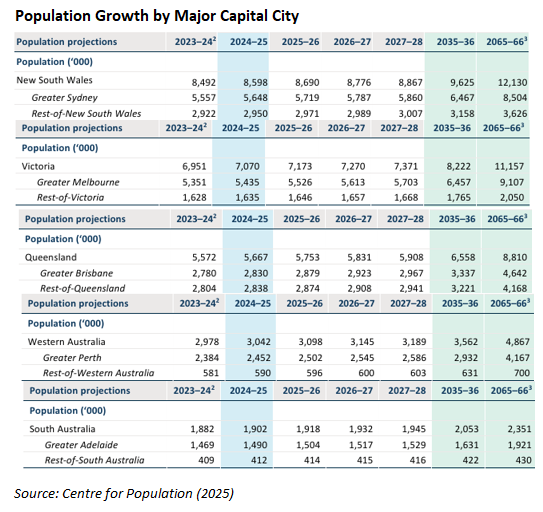
This rate of population growth is comparable to adding another Sydney, Melbourne, and Perth to the nation’s current population in just 41 years. All of the housing and infrastructure in these three major cities would need to be replicated, and water and energy supplies greatly expanded. Otherwise, housing shortages, productivity, and living standards will decline.
All major Australian capital cities will experience strong population growth over the 41-year period. Melbourne (9.1 million) and Sydney (8.5 million) are projected to become mega-cities by the mid-2060s, whereas Brisbane is tipped to grow by around 1.8 million to 4.6 million and Perth is projected to expand by 1.7 million to 4.2 million.
The bottom line is that the Australian Treasury’s fixation with mass migration will lead to permanent housing, infrastructure, water, and energy shortages, as well as environmental damage.
The Centre for Population’s projections are a blueprint for economic and social catastrophe.