I reported last week how Chief Executive and Principal Registrar at the Administrative Review Tribunal (ART), Michael Hawkins, informed Senate Estimates that the ART was being overwhelmed by an “explosion” of international students appealing their visa rejections.
Senate Estimates was told that the ART is struggling to process a whopping 46,590 student visa decisions as of October 31, 2025, with student visa cases representing 38% of the ART’s total caseload, with more than 13,000 one to two years old.
Hawkins warned that the ART “simply don’t have the resources” to process the claims. And when asked whether staff were triaging student visa cases, Hawkins was blunt.
“Well, there’s not a lot of triaging going on because we simply don’t have the resources to attack the study visa cohort”, he said.
Abul Rizvi was quoted in the Daily Mail as saying the spike in appeals was driven “almost entirely” by students failing to meet the required standards for student visas.
“The bulk of the onshore student refusals would have been due to applicants being found to not meet the “genuine student” requirement”, he said.
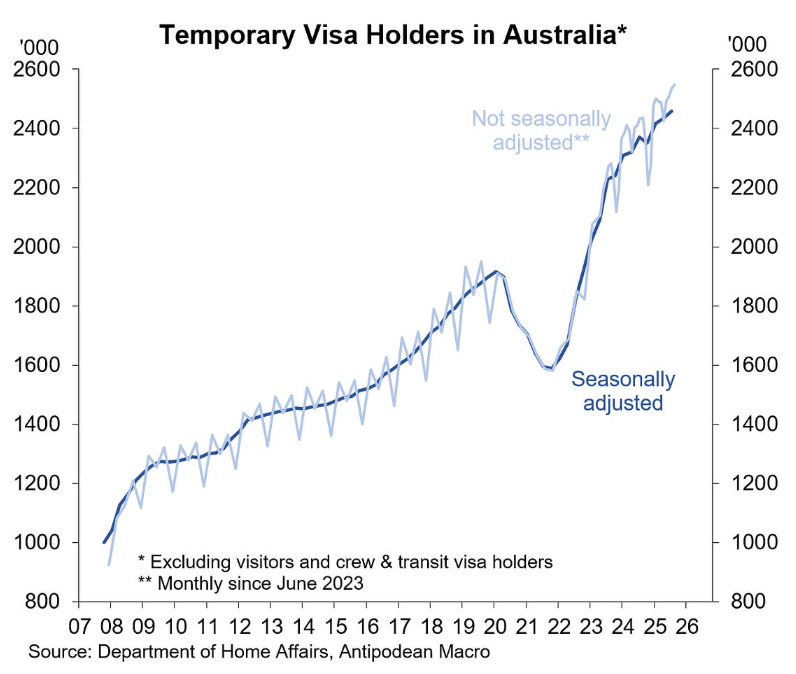
The latest temporary visa data from the Department of Home Affairs (DHA) revealed that a record 2,925,600 million temporary visa holders were in Australia as of end-October, up by around 500,000 from the pre-pandemic peak.
As illustrated below by Justin Fabo from Antipodean Macro, excluding visitors, there were a record 2,565,400 temporary visa holders in Australia:
The following chart, which tracks changes on a quarterly basis to Q3 2025 shows the categories that have driven the surge in temporary visa holders:
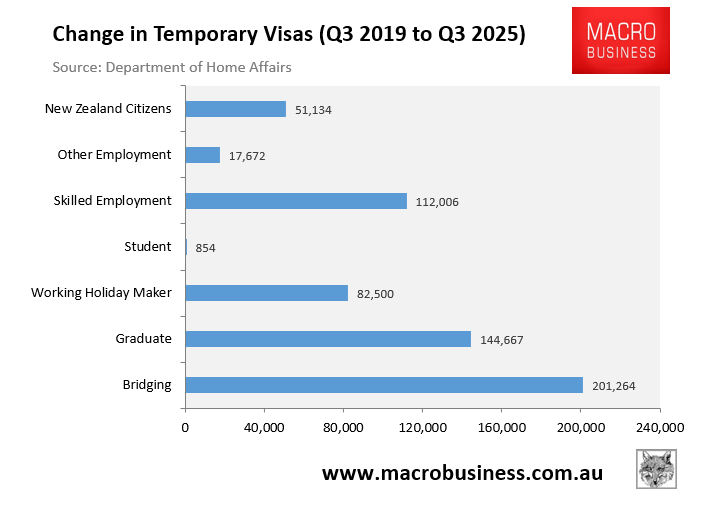
As you can see, the two biggest drivers of the temporary migrant surge are bridging and graduate visas.
Abul Rizvi has been a vigorous and outspoken defender of ‘Big Australia’ immigration, regularly attacking MB and others for advocating for a sensible and sustainable migration intake.
But it seems even Rizvi has had enough of the blowout of temporary visas, and bridging visas in particular. Check out what Rizvi told News.com.au’s Frank Chung following the release of the DHA’s data showing record temporary visa numbers:
“Just about everything is up — there’s nothing that’s fallen over the last decade,” said Dr Abul Rizvi, former deputy secretary of the Immigration Department. “The only one that hasn’t really gone up is visitors. We’re not getting the tourism numbers we did pre-Covid”.
Dr Rizvi, who served at the Immigration Department from 1991 to 2007, said Australia’s visa system was more overloaded than ever and “unable to cope with the volume”, particularly of bridging visas.
When the bridging visa system was brought in three decades ago, it was never intended to be for “more than a few thousand” people, according to Dr Rizvi…
“We were all in agreement large numbers of bridging visas is a really, really bad thing. We didn’t think the system [would get] so incredibly out of control. We just never anticipated that”…
Dr Rizvi said the government must urgently “slow the rate at which temporary visa holders in Australia are growing”…
Rizvi also attacked the Albanese government for walking back on its commitment to cut temporary visa numbers:
Dr Rizvi said Labor appeared to have walked away from its promise rein in the flood of temporary visas.
“The Labor government promised prior to the 2019 election that it would significantly reduce reliance on temporary entry visas,” he said.
“The Migration Strategy it issued in 2023 said it would reduce reliance on temporary entry visas. I think it’s a reasonable question to ask, what happened to the promise?”
Recall that Rizvi in October forecast that net overseas migration would average an insane 300,000 going forward under current migration settings—a level that was only ever reached once in Australia’s history (i.e., 2008-29) before the pandemic.
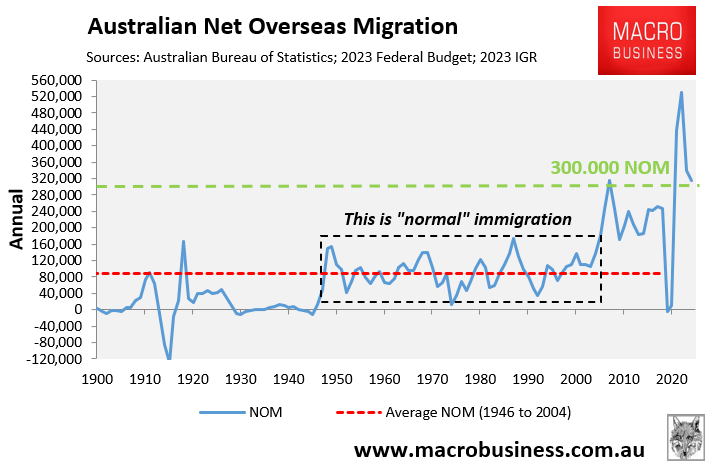
As reported in The AFR on 17 October:
Rizvi expects that net migration will be 15% higher than Treasury’s forecast, equivalent to an additional 40,000 migrants.
“Going forward, net overseas migration will be probably around 300,000 under current policy settings. The government’s processing of student visas is set to ramp up again, and the huge backlog in permanent visa applications will have to be accommodated eventually,” he said…
The government quietly sped up the processing of international student visas by lowering the risk ratings of 13 universities…
A Home Affairs spokesperson confirmed that students applying to universities with lower risk ratings can satisfy financial capacity and English-language proficiency requirements “by declaration”…
Rizvi said lower risk ratings drive higher approval rates, and higher approval rates drive higher application rates.
The government has also increased the number of international students given “priority” visa processing status…
Let’s be realistic: Labor has no intention of reducing immigration to sensible and sustainable levels.
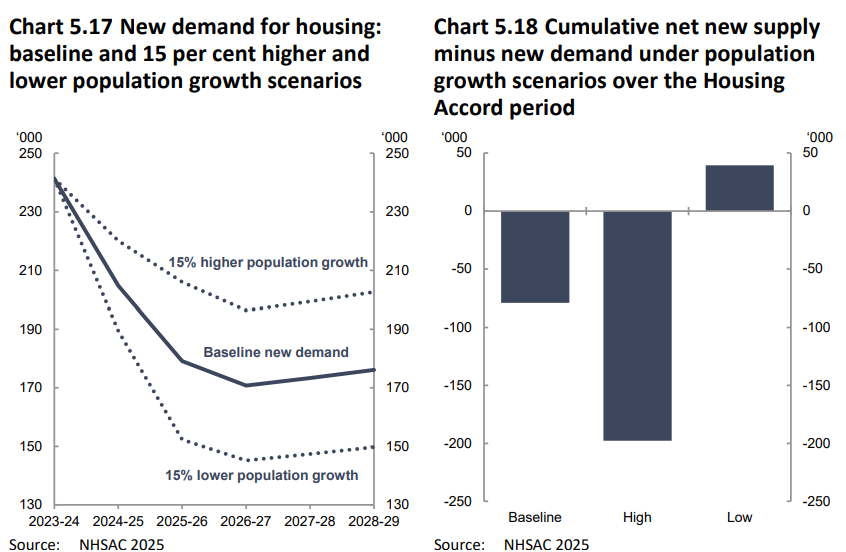
Instead, it has left the floodgates wide open, which, according to the government’s own National Housing Supply and Affordability Council, means the housing shortage will become even more intense.