
Assistant Governor (Economic), Sarah Hunter, gave an informative speech this week about whether the central bank sees AI as macroeconomic phenomenon.
So far, there is little evidence that AI has had large effects on aggregate employment in advanced economies, although there are emerging signs of weaker hiring, particularly among younger workers in highly AI-exposed occupations.15 In Australia, contacts in the RBA’s liaison program indicate that AI has not yet impacted most firms’ headcount (Graph 8) and is not expected to over the next year.
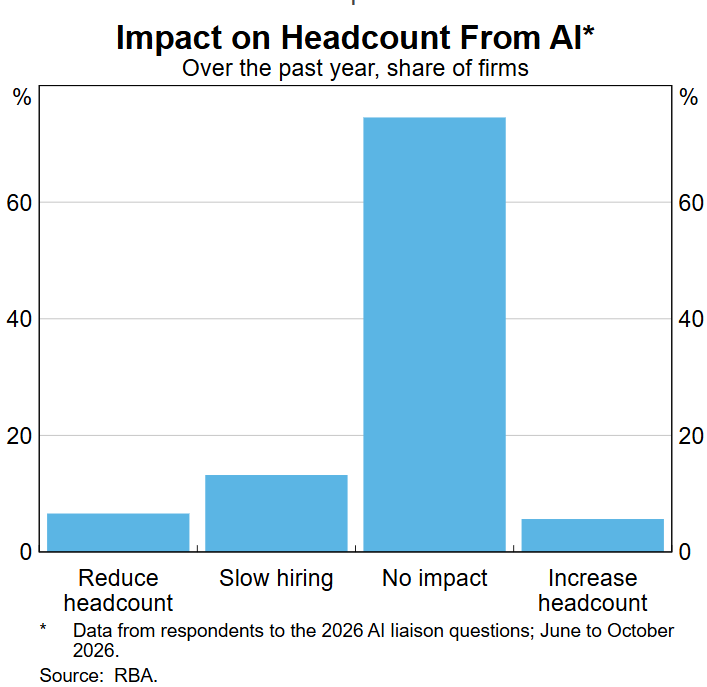
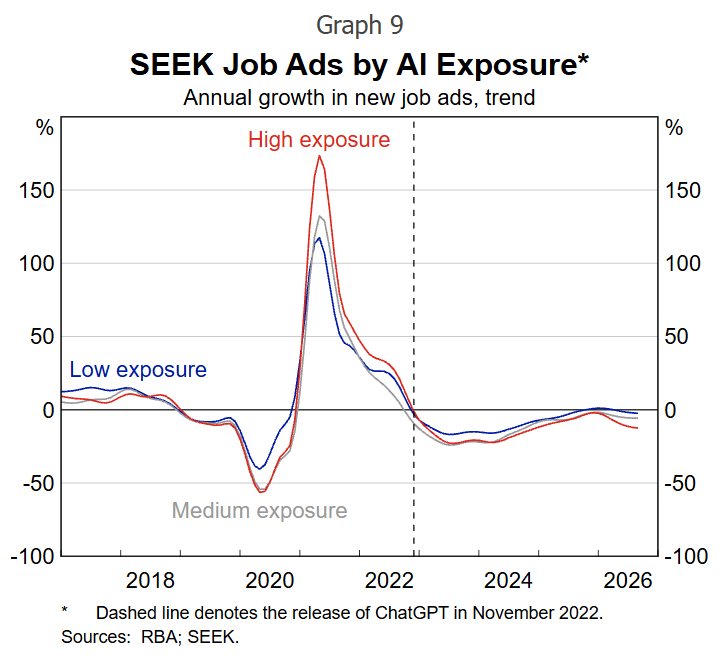
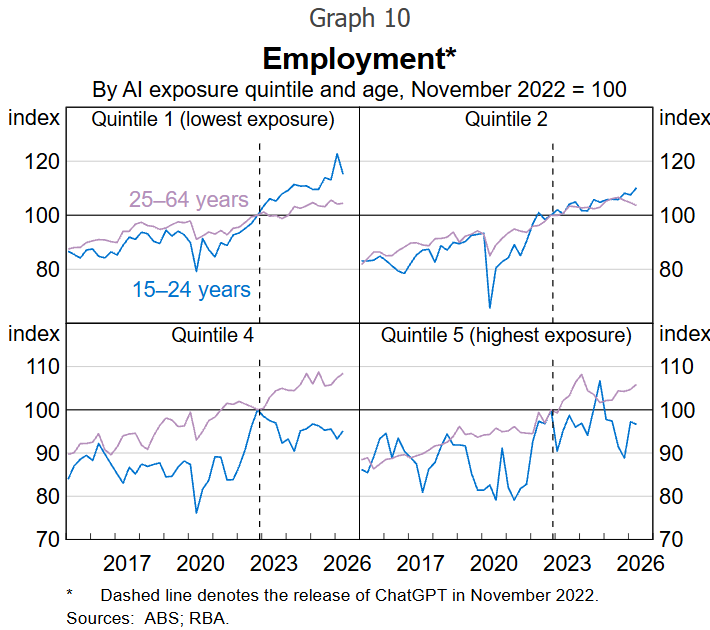
This is consistent with occupation-level analysis showing little sign to date that AI has materially disrupted the labour market.16 However, there are tentative signs of adjustment, through weaker job ad posting (Graph 9) and employment outcomes in more AI-exposed occupations, and stronger growth in areas where the technology has had less of an impact, particularly for younger workers (Graph 10). But these differences are modest, and it’s too early to tell whether they reflect AI adoption or other factors.
The full text of this article is available to MacroBusiness subscribers
