
Shortly after the end of each month Cotality releases their revised house price index data, revealing how much the market has improved or worsened after previous data was adjusted for lagged inputs.
This month again saw prices revised down significantly, continuing a trend that has now continued for months and potentially set to persist for months to come.
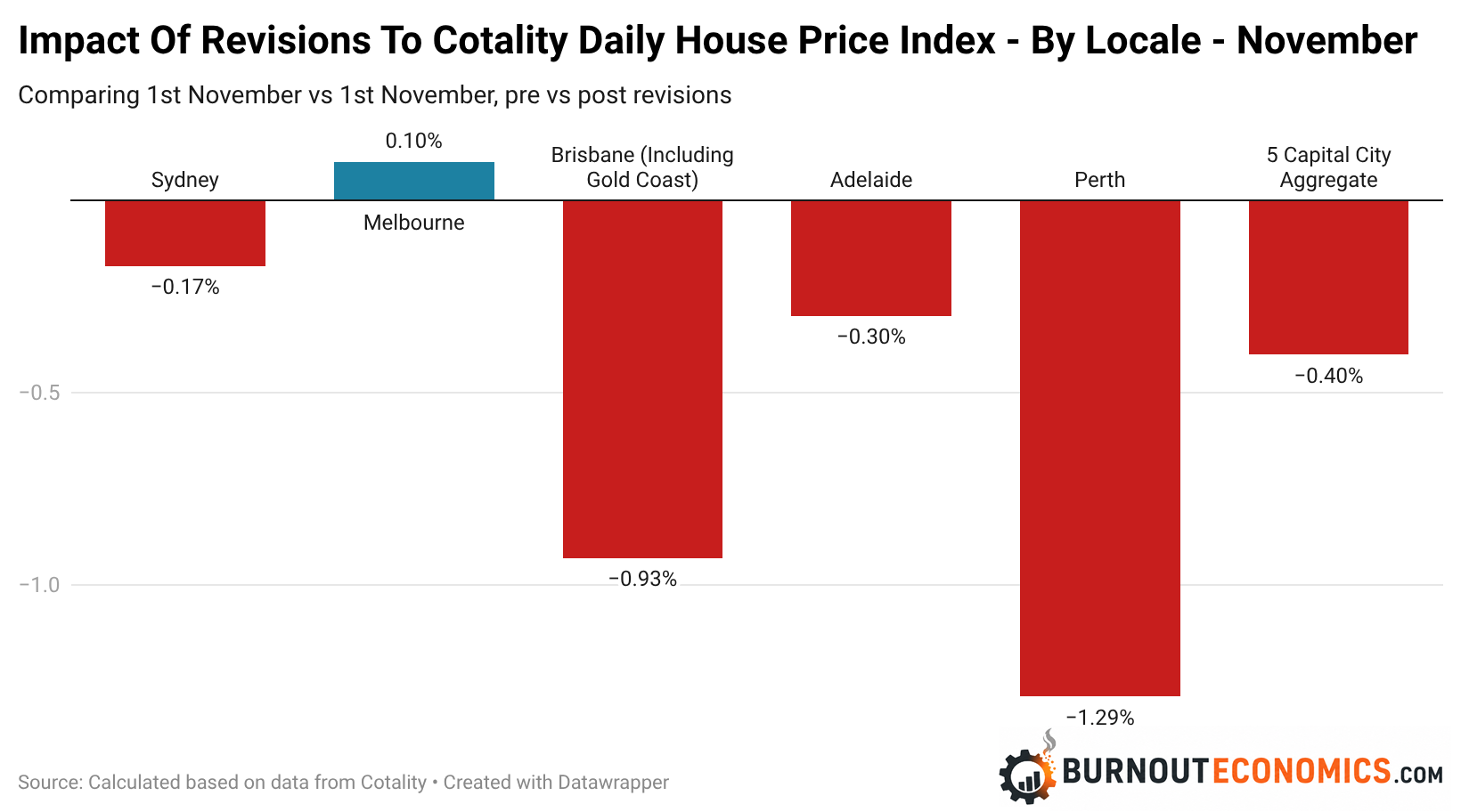
It is for this reason that Australia’s house price data needs to be approached with caution, as it could easily be revised down later to a significantly larger fall, making accurate up to date comparisons with past domestic housing price cycles or price falls overseas challenging.
If you would like to read more into the latest revisions and see how the current price fall cycle compares with the data we currently available, that can be viewed here.
In order to gain some perspective on how Australia’s price falls compare with its international peers, we instead need to look back about a little under two months.
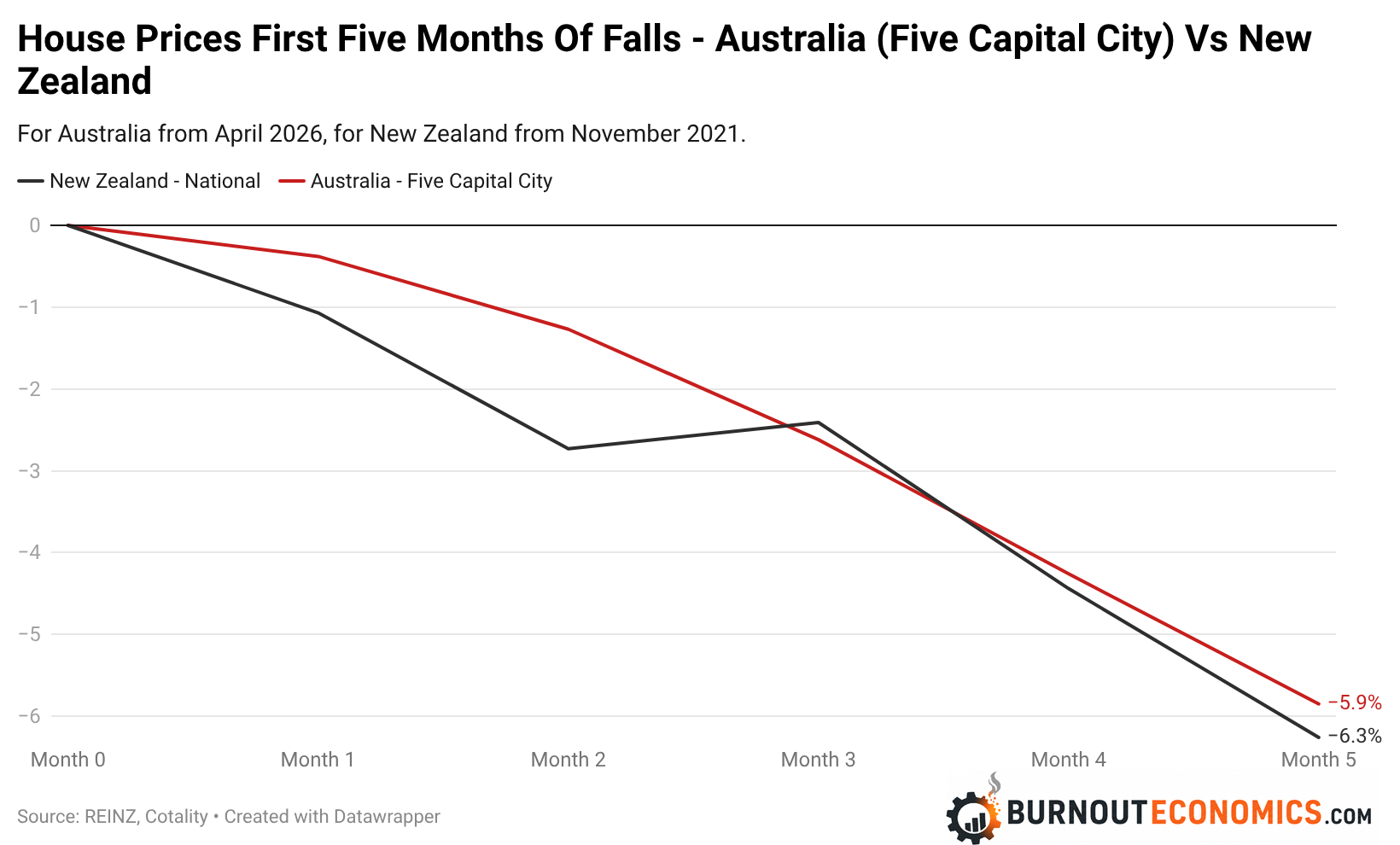
By comparing this data with that of the first five months of New Zealand’s housing price falls (November 2021 to March 2022), we can gain some perspective on where Australia’s property market stands.
The figures that will be contrasted is the REINZ National House Price Index for New Zealand and the five capital city aggregate from Cotality for Australia.
Over this duration, New Zealand’s housing prices fell by 6.3%, compared to 5.9% for Australia’s five largest capital cities.
The Takeaway
Over the course of the still persisting housing cycle, prices in New Zealand would end up dropping over 18% at a national level, with markets such as Wellington and Auckland dropping even further, down by 30% and 25%, respectively.
With housing prices at a five capital city level on track to record the largest price falls in over 40 years in the coming days, observers are increasingly asking the question, how much will Australia’s housing price falls follow the path laid out by New Zealand.
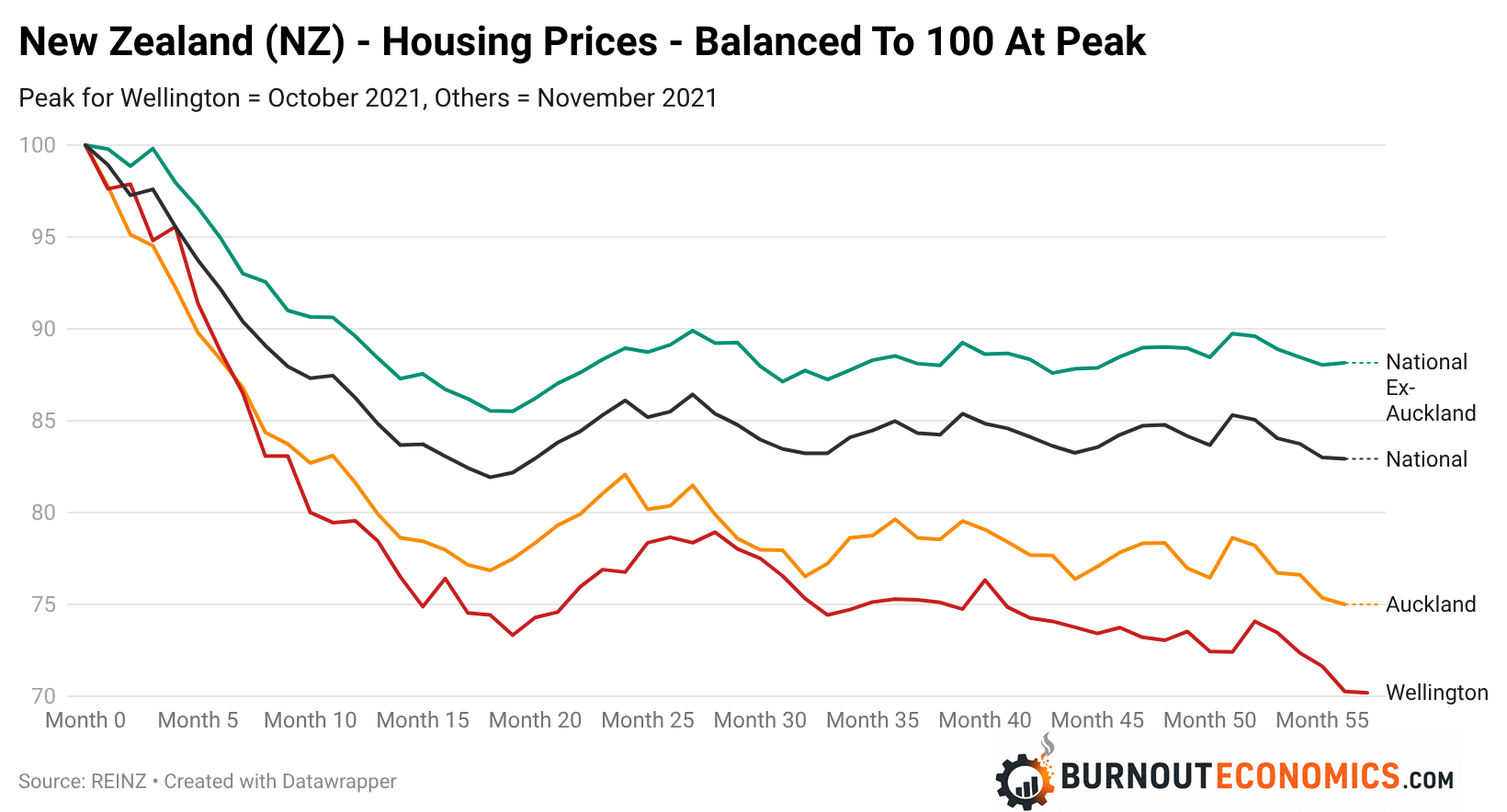
At this stage, Australia appears to trending down in roughly the same way as New Zealand.
But taking a step back and viewing the comparison through a lens of a longer term comparison, there may be additional downside catalysts in Australia.
In New Zealand, as the market really hit the skids the rate of net overseas migration was ramped up to the highest level in Kiwi history by a sizable margin, significantly exacerbating and prolonging the already present rental crisis.
In Australia, migration is still extremely high compared with even pre-pandemic norms, but it is set to moderate even further in the new year, amidst a dramatic drop off in approvals for student visas for offshore applicants.
Meanwhile, Australia faces predictions of a major rise of unemployment in the new year and a continued slowing of the nation’s economy, an economy unaccustomed to the downturns and recessions that are the norm beyond the shores of the ‘Lucky Country’.
Ultimately, the bottom for the Australian housing market may be far lower than any mainstream forecast suggests.
