

The Reserve Bank has raised the cash rate to 4.85%, a decision made by a six-to-three split board in November. Repayments are at their highest, house prices are dropping, and many families are cutting back on discretionary spending. Overseas travel is an obvious target, but Australians are still travelling.
The dollar is less of a problem than a year ago, buying 62 euro cents on the latest RBA rates, up from about 56 last November. Even so, at roughly $1.62 to the euro, a €150 hotel bill still costs $243. If you still want Europe, the job is to trim the bill, not the trip.
What two weeks in Europe costs two people
Here’s a sample budget for a couple flying economy in shoulder season from an East Coast capital, spending 13 nights across three cities. Your numbers will differ, but the proportions are what matter.
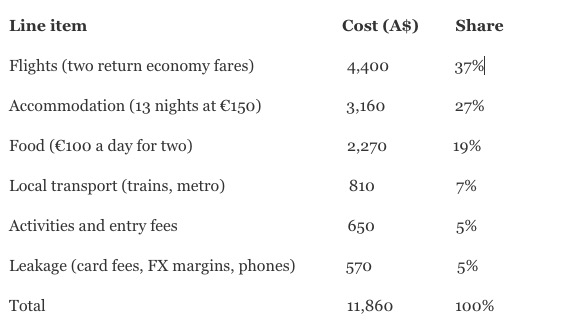
Flights, accommodation and food make up 83% of the total. Leakage is the smallest line, but it buys you nothing, and many travellers still pay all of it. The ABS counted 1,066,070 short-term resident returns in September, up 1.5% on a year earlier.
Rank the cuts by savings per hour
Not every saving is worth the effort. An evening spent on flight dates can save more than a month of skipped coffees, so start with the big lines.
1. Move your dates. Flying a week or two earlier, or in May or September rather than July, often cuts both flights and rooms. A 15% cut on those two lines saves about $1,130 for an hour or two of flexible-date searching.
2. Change the type of accommodation. An apartment a few metro stops from the centre is usually cheaper than a central hotel, and you can make your own breakfast. That saves about $630, but check cancellation terms, as the cheapest rooms may be non-refundable.
3. Skip a city. Every extra base adds a train fare, half a day of packing and often a pricier short booking. Dropping one could save $200 to $300 and give you back a day of holiday.
Then tackle the small fixed costs, which are quick to fix.
The phone bill, three ways
Phone costs sit in the $570 leakage line, and each of the three main options has a catch.
1. Carrier roaming pass. Telstra’s Europe Day Pass is $10 a day with 2GB of data and unlimited standard calls and texts. Vodafone charges $5 a day using your plan’s data. It’s easy and you keep your number, but two phones for 14 days on Telstra cost $280.
2. Local SIM. Usually the cheapest data per gigabyte, but you need a shop on arrival, may face ID checks, and swapping out your Australian SIM can mean missing texts such as banking codes. An EU SIM may not roam in the UK or Switzerland.
3. Prepaid regional eSIM. Often sold as an Saily eSIM Europe plan, it’s installed before you fly and covers several countries on one purchase. Many are data-only, so calls and texts still go through your home number or an app. Your phone has to be unlocked and eSIM-enabled. Coverage and speeds will depend on the local networks used by the provider.
For most couples, the cheapest setup is a regional eSIM for data plus the Australian SIM for calls, texts and banking codes, with data roaming turned off on that SIM so you don’t pay twice.
Card fees and paying in local currency
1. Use a card with no international fee. Most charge about 3% per overseas transaction, which on roughly $6,900 of euro spending is about $210.
2. Always pay in euros. If a terminal or ATM offers Australian dollars, say no, as the conversion includes a margin.
3. Make fewer, larger cash withdrawals if you’re charged per transaction.
Lock in what you can control
Sort the details at home, where no one’s rushing you: dates, bookings, cards and how your phone will stay connected. Combine the three big savings with the card savings, and you’ll save about $2,200, roughly one-fifth of the trip. Whatever’s left, from a pricey coffee in Rome to an unplanned taxi, is simply the price of going.