

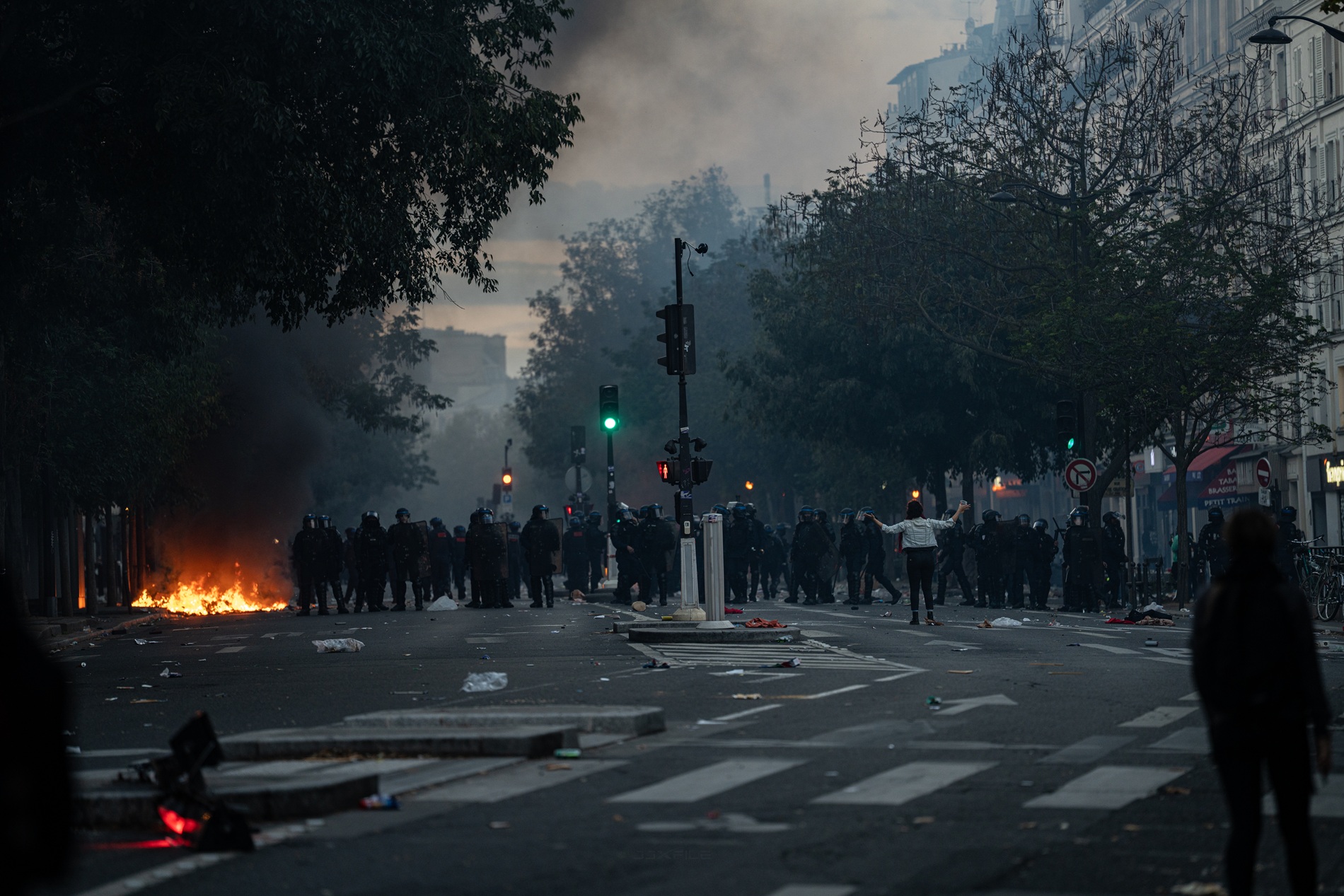
Dusk in Paris last week
Photo By Jorge Jaramillo – Own work, CC BY-SA 4.0, commons.wikimedia.org
The signs are all about us.
Unhappy people; continents full of them, feeble democratic and institutional processes, and a mainstream media which has lost the ability to tell us what is and why and seems steeped in selling us things we don’t need or lecturing us on ‘important’ issues we simply don’t believe are that important.
That all makes for a polity exposed for what it all too often is – unrepresentative and not unduly concerned with what the majority of people actually do want and do consider important. All too often in the person of self selected psychopaths solely after a personal payoff and far more concerned about that than any ‘national interest’.
All while delivering outcomes for the 1%.
Some of us can recall the start of Neo Liberalism. Ushered in by US President Ronald Reagan and UK Prime Minister Margaret Thatcher its presentation was as a saviour from the failings of a by then moribund Keynesian post WW2 straitjacket, which would address the stagflation which had engulfed the developed world in the late 1970s.
From the get-go its mantras were individual responsibility, deregulation and a lot of lip service to concepts like entrepreneurialism and initiative. It pointed with alarm at the budget deficits of much of the developed world, as well as the rigidity imposed on investment of capital by regulation and social protections – welfare, medical care, legal rights and services, for starters.
It pooh poohed the idea of labour rights and unions as well as government intervention in the economy in the form of industry policy and social spending, and championed the ‘trickle down’ effect of tax cuts for the rich and for capital per se, regardless of what any given capital was actually doing. It exhorted all nations to do what they were good at and to trade in the rest. It exhorted financial markets to free up and to engage with risks and to profit from the risks capital took
From there it would bring in the recently developed economies like Japan and hold open the prospect of other nations and societies joining them, into the ‘rules base international order’ dominated by the United States and a Europe which had learned the hard way that wars were to be avoided. And the resulting peace and economic liberalisation would provide for the bounteous future.
Alas things haven’t panned out quite that way. 60 years later it has left utter carnage across the developed world. The results are on our screens every night and in the media every day.
Riots and overturned cars in Paris Greece and the UK, protests against far too liberal immigration across Europe and North America. Democratic ‘leaders’ launching decapitation strikes against nations providing key economic inputs across the world, and once respected international institutions bypassed and discredited.
The backdrop to that is we have all too often pawned or lost control of our own economic substance, at a widespread individual and national level, and our own ability to uphold institutional safeguards that our societies want. The same phenomena occur over and over again across nations, even though the forms of the causes of protest may differ from nation to nation.
Entire societies have been immersed in private debt which has pulled forward future demand to benefit income earners and asset owners in the present but impoverish investment in the same of the future.
Nowhere is this more spectacularly obvious than housing prices.
Australia is the standout example, but Canada, New Zealand, Eire and the United Kingdom and parts of the United States have all experienced generational price rises placing housing out of the reach of many, and the stressed debt mortgaging requirement of most. Even in Europe, which long considered unaffordable housing a problem of the English speaking world, the period after about 2012 has seen housing costs spiral in Germany, Sweden, and other parts of the EU, despite once strong laws to prevent precisely this.
Beyond the housing itself, life inside the house has become increasingly financialised, and once financialised has seen price increases far greater than income earned by labour. The insurance, the medical care, the educations, and the recreations and sporting interests of the people inside those houses have been financialised.
Observe the generational price rises for all these across the developed world. These have been the drivers of inflation across a generation since the late 1990s, offsetting falling real prices for agricultural produce – the meats, the grains, the fruits and the vegetables – and the mainstays of household life – the furniture, the bedding the clothing and the footwear, as well as the TVs and Music players.
The key factors in the falling real costs of the physical goods in people’s houses has been the offshoring of production of these to locations where labour is paid less. Again Australia has been a standout example. Essentially trading away its manufacturing capacity in exchange for access to offshore locales for its agricultural produce, with the politicians and bureaucrats party to that decision not seeking to replace the employment they were offshoring.
For a nation which has touted skills shortages for a generation, the idea that, at an economic planning level, one person employed, no matter how, was the same as any other, underlines the idea that one arm of government doesn’t have any idea what other arms may be doing. Or maybe all arms are making things up as they go, to wiggle in with whatever imperatives are being imposed.
But well beyond Australia, the dynamics were largely the same. The carmakers, the whitegoods, the industrial refining and processing, and the electronics, coalesced around large producers, who often transplanted significant production to cheaper labour markets with longer production runs. Smaller producers in smaller markets either found niches or departed the industry, or became brands for larger producers.
The cheaper goods came with the financialisation of a range of services, and the conversion of people into revenue streams, as renters, for those seeking to access those services. In addition to the privatisation of education, and the often government subsidisation of healthcare, came the advent of privatised aged care, across Australia New Zealand, North America and Europe. Very large corporate interests maximise their returns to capital by harvesting our loved ones – who often sell their homes to afford such care – in the their final years.
Technology came part and parcel with financialisation. We could buy computers and monitors and they were ours. Initially we could buy operating systems and games on CDs and they were ours too. Over time those DVDs and CDs became subscriptions, and at that point we became renters. The same has happened for our TV, movies, and our music, our ancestries over the same period.
Strangely, the only thing owned in the online dynamic now is the right to place cookies, and the information they glean, which is so lucrative for advertisers and those with access to those cookies, which never need to be renewed or renegotiated. They are on our computers and mobile phones, and the people who are never negotiated with is us.
It was in the early 2000s the expression ‘If you are getting something for free you are the product’ gained currency. 25 years later, whether we just want news, to share information with families, or to create art, videos, music, let alone all forms of comment about politics or economics, we are all products. Everywhere we look there is a chance we are being dynamically priced for anything we actually want or to do.
And if that wasn’t enough our sports and recreations were financialised too. A generation ago our sports teams were administered, for the most part by marginally competent people who loved the clubs and the sports they were administering.
Since then, US venture capital, Russian oligarchs and Arab Sheikhs have bought football clubs, the Indians bought cricket, various American magnates having already purchased the NBA, NFL and the NHL earlier, all with an eye to revenues and advertising. Often with an eye to political and social cachet they can extract from the position.
Match day attendees have been harvested for the profit maximising ticket prices, as players of all sorts became uber riche pawns of the uber wealthy for whom their sports became ‘just business’. There are countless examples in all sports of books being fudged, contracts being manipulated and takeovers being leveraged to provide for fans who love their sports and teams maximising their payoff to the magnates who now own their games.
Why anyone is surprised at what Manchester City has done is a mystery. The owners have been overt since buying the club about what they were doing. They will almost certainly get away with it as the UK Premier League seeks a balance which we can be sure will recognise the economic impact of the Abu Dhabi investors departure from the game before it recognises fans perceptions of integrity of the game they love.
After all that look at the actions of our administrations. Across the OECD they have embedded the private sector into their functions, or outsourced entire functions altogether, leaving those administrations captive to the outsourced providers. Then there are the public institutions which have been sold off or commercialised – the water the electricity and the public transport, or the post and the phones or internet. That is before we look at privatised roads or airports, or even ports, all turning citizens into revenue streams. Then there are the Universities and educational institutions now financialised into addiction to foreign students.
At the same time look at the once widespread expectation of ‘frank and fearless’ advice being provided to politicians, and how this has morphed into ‘managing the message’ for public consumption, or selling off the perception of ‘integrity’ which public sectors often once had. Australia had Robodebt to display as to how craven our public sector executives have become. Almost every other nation in the OECD has something in the same league.
The handling of Covid, and total absence of any form of public investigation into how and why it arrived in our lives, the virtual absence of legal sanction for the main players involved in the GFC, and the actual reason a ‘Coalition of the Willing’ invaded Iraq in 2003 as well as embarked on a 2 decade, trillion dollar, occupation of Afghanistan. All are about as well explained as the ‘Weapons of Mass Destruction’ which was the excuse for the latter. Or the decapitation strike which took out Iranian Supreme Leader Ali Khamenei on 28 February this year. Just how much consideration was involved? What does it say about our institutional agency or integrity? Or anyone else’s in the ‘Rules based’ international order?
Then there are the policy failures, starting with immigration. It isn’t just Australia, large numbers of people across the developed world feel their thoughts about heavy immigration volumes in Europe and North America, have been completely dismissed, or they have been accused of racism when their concerns are largely economic. If one follows the money the beneficiaries are the same people who have benefitted from almost everything else.
On top of all that comes the media – the very conduit of information about what is happening shaping our world. Globally, it was demonstrably pawned for commentary purposes in Iraq, during the GFC, and during Covid, and well beyond. Of course President Trump assumes he can sell an excuse for financially profiting from executive decisions made during his Presidency. He can, and he has made a case for arguing that the public institutions, the public and the media can’t do a thing about it.
Not all nations have Australia’s spectacular display of mainstream media financialisation into loss leading, taxpayer subsidised, irrelevance, but almost all have a pervasive backdrop of buyers of media product thinking that the call they get in their media was somehow better at some point in the past, making ordinary people less inclined to pay for it today.
Somewhere along the way we have let go of our sense of ourselves as people and been replaced in the eyes of those shaping our future as domesticated revenue agents.
That is what our politicians need to somehow address. Ordinary people think the system is about harvesting them, and gaming their representation, to maximise financial profit for others.
And for that we can thank the Neo liberal consensus and the elites which have profited from it for two generations.
It will be a long way back from here.