
Energy tsar, Chris Bowen, is right.
Climate Change and Energy Minister Chris Bowen has unleashed a mammoth attack against Australia’s ageing coal-fired power plants, warning their frequent unplanned outages are making electricity bills dearer as he prepares to lead pre-COP talks in the Pacific.
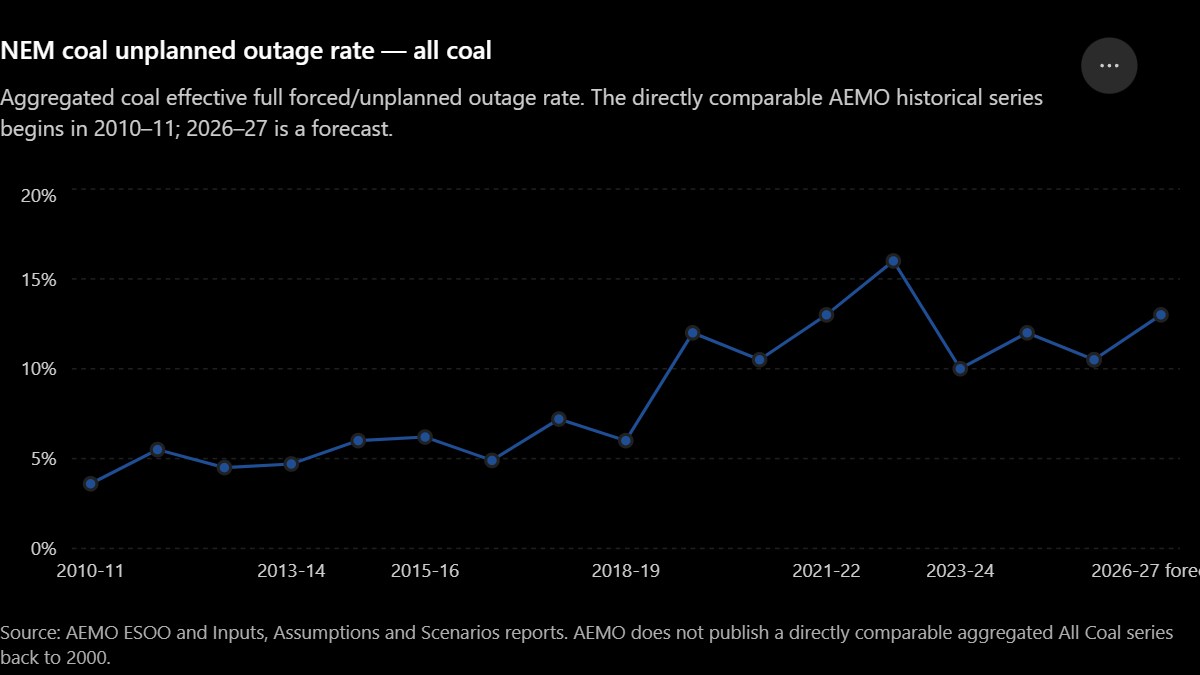
Mr Bowen, who has travelled to Saudi Arabia and India in the past week to shore up fuel security and discuss electrification, said there hadn’t been a day in the past four years that a coal power station in Australia hadn’t broken down without notice.
That statistic alone, he said, proved renewables produced a more reliable grid.
Here’s the AEMO chart of the unplanned coal outage rate.
However, in many ways, Bowen is wrong and even ridiculous.
The risks around the energy transition are now very high.
- Grassroots politics is turning against the rollout of the distribution network.
- The Albanese government’s failure to deliver a reliable domestic gas reservation regime means gas supply insecurity continues. Nobody will build the gas power capacity to backstop the grid.
- Wind power growth has stalled owing to surging costs, and offshore is basically written off.
- The New England REZ has not even begun construction.
- Surging populism threatens further irrational decision-making and construction of high-cost alternatives.
In short, problems run through the meat of the transition, and, notably, the insurance of firm, despatchable power that guarantees reliability has all but disappeared.
Bowen can blather all he likes about the real problems with ageing coal, but the transition is, at best, falling well short of forecast and, at worst, forcing states to rely more on coal as capacity insurance.
The cheapest way to fix the situation is to invest in cheap renovations of failing coal power plants, though that assumes their components are not too broken.
It makes no economic sense, given that the plants will run less and less, which makes the return on renovation investment uneconomic. However, as the transition runs into multiple headwinds, this is the only way to ensure NEM reliability without killing the transition itself.
Renovated coal plants can still be phased out, but on a new timetable that ensures the NEM can build out the storage and backup power that it needs to guarantee reliability.
Bowen’s alternative is that we fall short of renewables and coal power.
