
In mid-August 2025, the Albanese government gathered together economists, business leaders and policymakers for its ‘Economic Reform Roundtable’.
The focus of the gathering was jump-starting the nation’s dismal productivity growth, thereby improving the nation’s economic growth prospects.
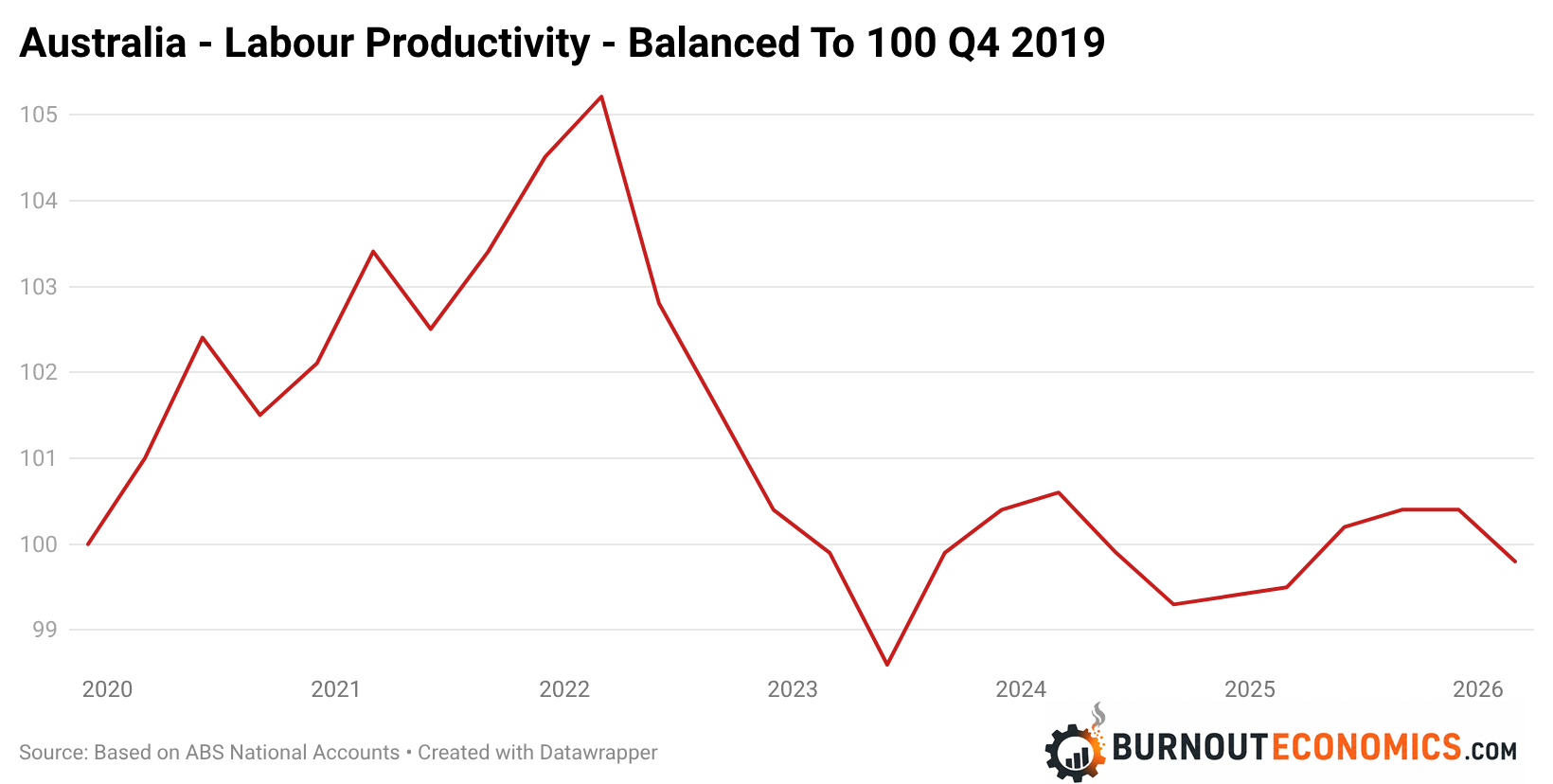
To put the state of productivity at the time into perspective, between December 2019 and the labour productivity snapshot for that quarter in September 2025, productivity had cumulatively grown by 0.40%.
On a more recent time horizon between the Albanese government’s election in the June quarter of 2022 and the September quarter of 2025, it fell 2.33%.
To be entirely fair to the Albanese government, the run-up in productivity during the pandemic was temporary, driven by government stimulus and lower-value-per-hour migrant workers exiting the country, amongst other things.
Since the Albanese government gathered together stakeholders for its roundtable, the news has not been good, with labour productivity declining by 0.60% in the quarters since.
It’s here that real-world observation and economics combine in something of a rare occurrence, an instance where something as major a driver of something as complex as productivity growth can be easily explained by a sight most of us see regularly: migrants working low-skill jobs.
While the drivers of labour productivity are complex, its actual measure is very simple: total GDP divided by total hours worked = labour productivity.
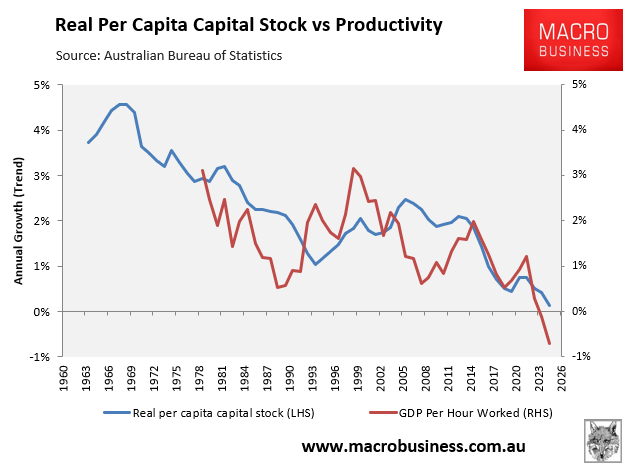
So if you add more people doing low-skill, low-value-add work, it inherently drags on productivity. It is basic primary school maths, although perhaps with a few extra digits added.
In a 2024 speech to the Sydney Institute, Assistant Minister for Immigration Matt Thistlethwaite concluded that:
“For many decades Australia has not had a migration strategy”
“Migration has been unresponsive to Australia’s needs; it has provided marginal economic benefit and has not enhanced labour productivity” he said.
It’s worth taking a step back and reflecting on Thistlethwaite’s commentary for a moment.
Through migration, a nation can theoretically choose the best and most productive possible new members of its society: the top surgeon who will keep more people alive, healthy and productive, or the innovative entrepreneur who will create jobs and improve manufacturing output.
Yet that isn’t what Australia ends up with, by the minister’s own admission.
It’s here that the complete fruitlessness of the current migration intake, when viewed through the lens of productivity, should be realised and then shelved as a failure forever.
The Takeaway
The “Won’t someone think of the hospitality sector and Uber driver numbers” migration narrative simply doesn’t hold water.
If migration is targeted at low-skill jobs like cooks, waiters and delivery drivers, then it is much harder to grow productivity, which in turn makes it harder for the economy to grow without that growth being inflationary.
That is perhaps the most ironic thing in the entire debate: some of the same people pushing for high and poorly targeted migration then complain that the RBA raises rates, which is heavily driven by the impact of high and poorly targeted migration.
Ultimately, as migration is increasingly seen as an ideological issue rather than a practical one (housing availability, infrastructure/services viability) or an economic one (productivity, capital shallowing), the more we are likely to see failed strategies not only pursued by policymakers but also defended, even by those who should really know better.
