
Data centre power peace breaks out, but will you pay?
A peace deal has broken out in Australia’s conflict over power for data centres.
The Albanese government has reached a settlement with Queensland and the Northern Territory on regulations governing the rapidly growing data centre industry, allowing both jurisdictions to use gas (and coal, though that won’t happen behind the metre).
Queensland and the NT opposed the federal government’s proposed stringent renewable energy rules for the $150 billion datacentre industry. According to Queensland Premier David Crisafulli, developers should be free to choose their energy mix as long as they comply with social license, water protection, and community consultation regulations.
The state government will take over planning decisions from councils to ensure this “social licence” is met.
Chief Minister Lia Finocchiaro highlighted the gas reserves in the Beetaloo Basin to secure similar flexibility for the NT.
I still expect a substantial proportion of the energy to be renewable, given that it is the cheapest and fastest to build.
Typical time from project approval to electricity
| Power source | Construction / installation | Typical total to operation* | Speed |
|---|---|---|---|
| Battery | ~9 months | 1–2.5 years | 🟢 Very fast |
| Solar PV | ~7 months | 1–2.5 years | 🟢 Very fast |
| Gas peaker (OCGT) | ~1.5–2 years | 2–4 years | 🟢 Fast |
| Onshore wind | ~1–2 years | 2–5 years | 🟢/🟡 |
| Gas combined-cycle (CCGT) | ~2+ years | 3–5 years | 🟡 |
| Coal | ~4–6+ years | 7–10+ years | 🟠 Slow |
| Geothermal | ~3–5 years | 4–7 years | 🟠 |
| Pumped hydro | ~5–8+ years | 6–10+ years | 🔴 Slow |
| Large hydro | ~5–10+ years | 7–15+ years | 🔴 Slow |
| Offshore wind | ~3–5 years | 6–10+ years | 🔴 Very slow |
| Nuclear | ~6–10+ years | 10–15+ years | 🔴 Extremely slow |
*Including development, approvals, financing and grid connection rather than just physical construction. Actual times vary enormously by country and project.
Gas is expensive and, while faster to build than coal, is still slower and more expensive than renewables.
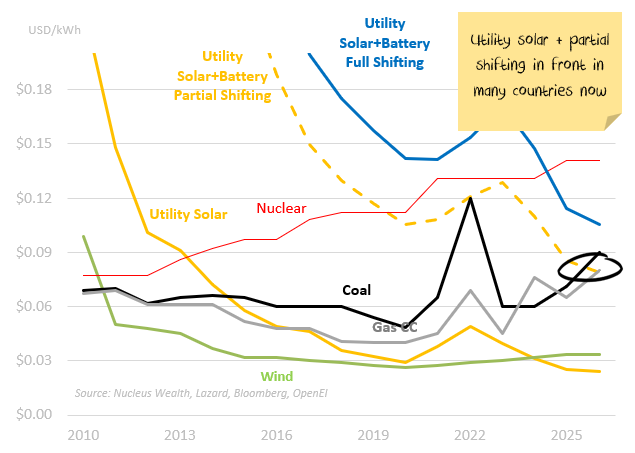
Renewables plus gas peakers are the clear winner.
