
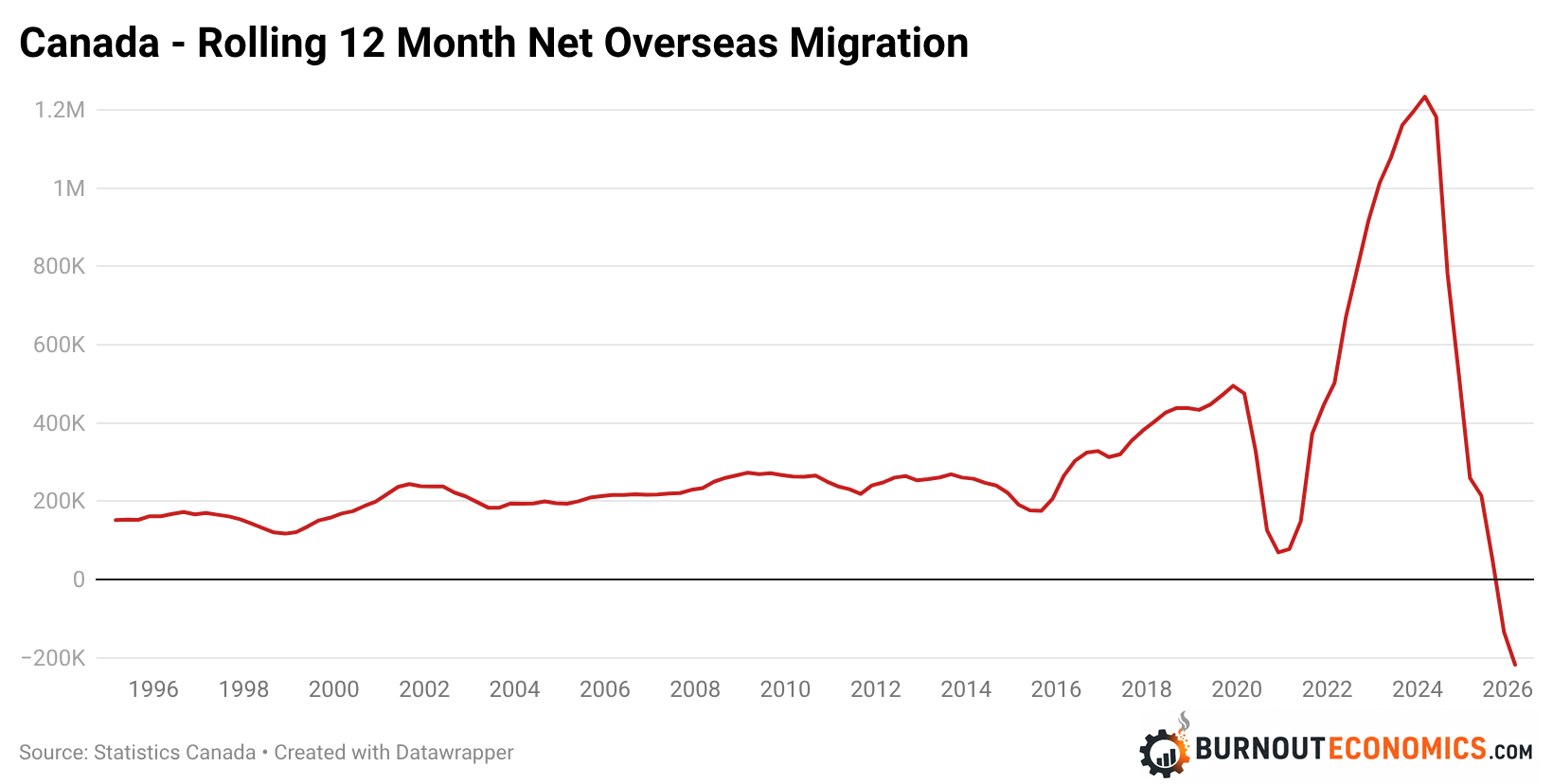
Since Canada slashed net overseas migration from it’s peak in the March quarter of 2024, one of the last major remaining pillars supporting the already vulnerable Canadian housing market has been removed, leaving it on increasingly risky ground.
According to figures from the Bank for International Settlements, housing prices nationally are down by over 20% in Canada since the peak in the first quarter of 2022.
While the surge in migration to all time highs provided a temporary boost, it did not last and prices resumed their downward path amidst an atmosphere of high inflation, rising unemployment and arguably an overvalued market.
Looking at the data at a city or province level, it reveals that markets have enjoyed vastly different outcomes over the last four years.
For example, according to data from the Toronto Real Estate Board, the median price of a home in Toronto has fallen by 26.2% since the peak in early 2022.
At the other end of the spectrum, the city of Winnipeg, a smaller locale in what is effectively Canada’s regional interior, recently saw prices hit an all time high.
The apartment markets of Canada’s largest cities have been some of the hardest hit by falling prices, with Toronto and Vancouver in particular experiencing crashes in prices.
As a result of falling home prices, Canada has become something of a poster child for allowing markets to function and for homes to become cheaper, a stark departure from the approach of the Albanese government which was to support home prices using whatever levers it had its disposal up until May’s federal budget.
But Canada’s run of its housing market being allowed to be more akin to an actual free market is seemingly drawing to a close.
In June, the Carney government announced that federal government funds would be used to buy up what the Canadian national post is calling “a glut of unsold Vancouver condos” in order to convert them into government operated rental housing.
At a press conference, British Columbia Premier David Eby and Prime Minister Mark Carney announced the launch of the ‘Canada-British Columbia Partnership on Condo Conversion’.
It’s goal is it to buy up to 2,200 vacant Vancouver condos that are not selling on the open market and convert them into affordable homes.
A press release on the partnership read:
“one of the fastest and most efficient ways to increase housing supply.”
Later that week Prime Minister Carney revealed the real reason was preventing developers to have to lower their sale prices.
“With higher interest rates (and) weaker investment demand, developers are stuck,”
“They don’t want to sell at a loss, they can’t afford to hold those empty units indefinitely.” Carney said.
The Canadian National post estimated that given the scope of the program and the median price of Vancouver condos, it could cost the Canadian taxpayer as much as $1.5 billion CAD.
A price tag was not placed on the “partnership,” but with Vancouver’s benchmark condo price currently standing at about $700,000, it could work out to as much as $1.5 billion.
The move was swiftly called out as a “bailout” of the increasingly troubled property development sector.
Andy Yan, director of Simon Fraser University’s City Program, told the Canadian national broadcaster that it was a “bailout” of “bad business decisions.
Conservative Leader Pierre Poilievre held his own press conference in Vancouver to criticize the plan under the slogan:
“Stop Liberal Housing Developer Bailouts.”
This isn’t the first time a Canadian government has stepped in to bailout property developers in a weak market, but it is the first time the federal government has done so on such a scale.
In March 2025, the government of the province of Ontario announced a very similar plan to buy 2,200 unsold vacant condos in Toronto to convert them to government run rental units.
It reportedly cost $1.3 billion CAD and served to protect developers from significant financial downside, as well as preventing home prices from falling further.
The Takeaway
While Canada’s housing bust has been something of a beacon of hope for citizens in other nations hoping for their nation’s housing market’s to be allowed to function as free markets, to what degree that has been driven by fiscal and political necessity to this point is open to debate.
The Carney government’s bailout has been widely criticized, but one can’t help but wonder if the leaders of other nation’s will take inspiration from it.
As things stand today, Australia has what may be the worst housing shortage in over 70 years, keeping demand for property extremely high.
But if a scenario in the future was to be realized where migration was slashed to due to political and/or economic necessity, and all of a sudden there was a glut of unsold homes, one wonders if the Albanese government or its successors would pull the trigger on a similar scheme.
After all it would not be unprecedented for the government to step in and buy homes for use as public housing, as they have already on a much, much smaller scale as part of the efforts of the Housing Australia Future Fund.
