
Canada’s recession outshines Australia’s per capita economy
In the last 18 months, the Canadian economy has faced significant challenges as it has tried to adapt to a trade war with the world’s largest economy, with which it shares an almost 9,000-km land border.
Since the start of the U.S.-Canada trade war in early 2025, the Canadian economy has faced significant challenges as it has tried to adapt to a business environment with tariffs as high as 50%, which has had a major impact on confidence and economic activity.
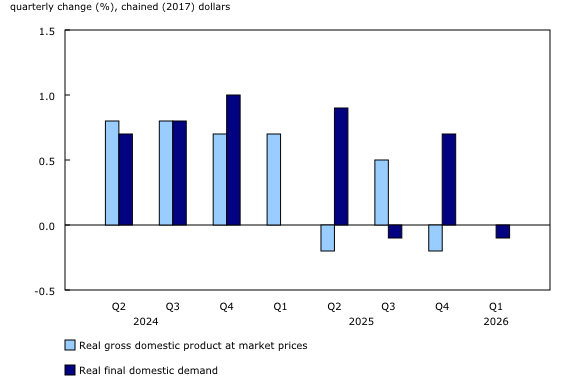
As of the latest Canadian national accounts data, the Canuck economy entered a technical recession by the narrowest of margins after experiencing two quarters of negative headline GDP growth, with the March quarter figure showing a contraction of less than 0.1% in unrounded terms.
Source: Statistics Canada
While this is naturally not a favourable outcome in headline terms, it masks a different story for Canadian households.
Household consumption has risen by 1.1% during the two quarters when the Canadian economy has been contracting in headline terms.
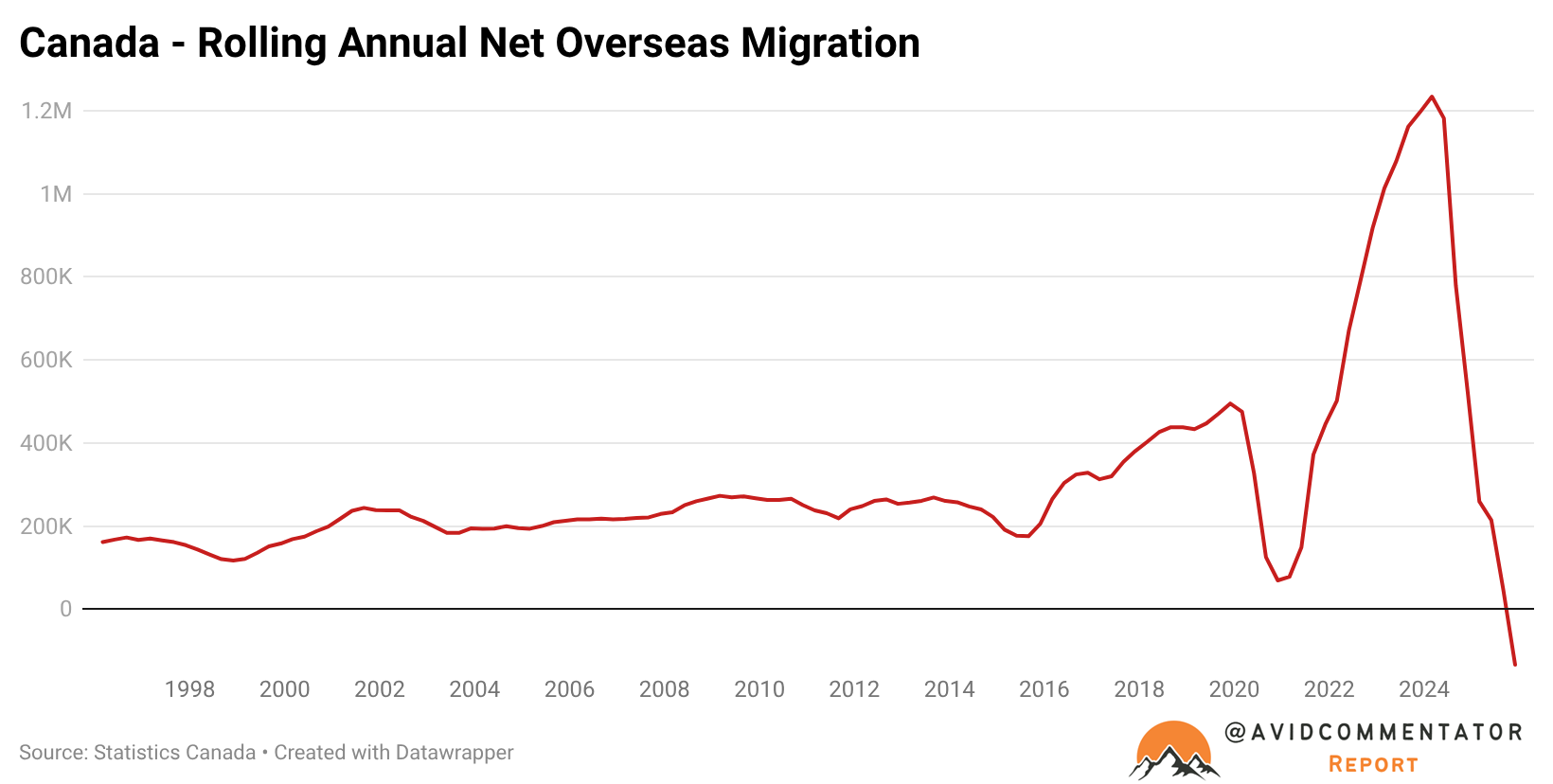
But this is where the picture really starts to get interesting; across the last two quarters of data, Canada’s population has contracted.
If we take the final quarter of 2023 as our starting point, since then Canada’s per capita GDP has cumulatively risen by 1.27%, compared with 0.48% growth for Australia.
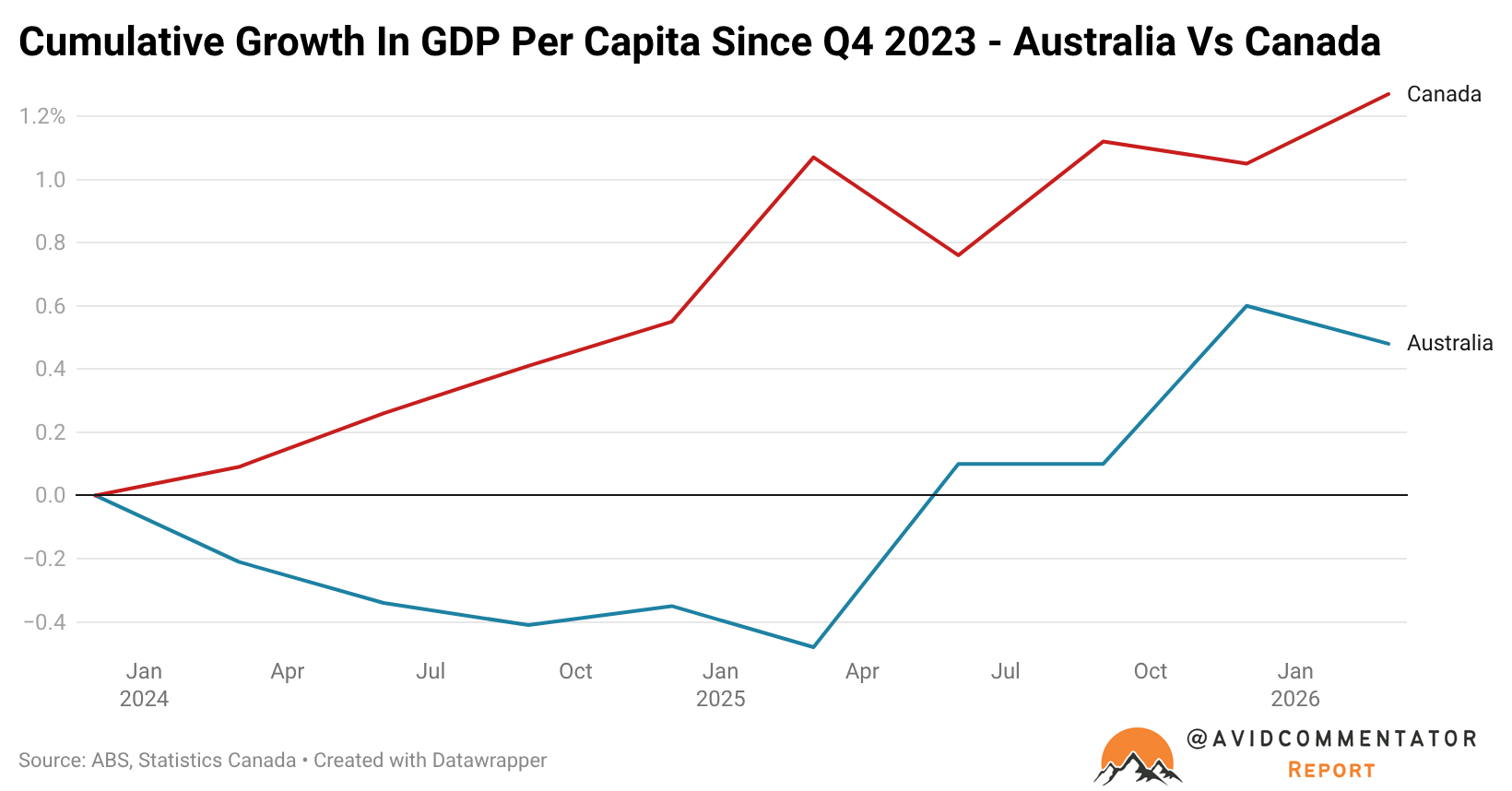
This has been driven by the complete collapse of net overseas migration into Canada since it peaked at almost 1.2 million on a rolling annualised basis in the December quarter of 2023; this is why this has been chosen as the starting point for the chart above.
This is not to say there haven’t been challenges for Canadian households; unemployment has risen by 2.1 percentage points (4.8% to 6.9%) since the post-pandemic lows.
But given how the Canadian labour market would have been impacted by higher interest rates, falling home construction rates and the trade war with Washington, had migration not been cut, the outlook would have been even weaker than it has been in reality.
The Takeaway
Australia and Canada have both chosen very different pathways and face significantly different circumstances.
In Australia, there is the scope for the government to continue to effectively “print jobs” through various non-market industries and for government expenditure growth in aggregate to continue to support headline growth.
Since the economic reopening following the pandemic, extremely high levels of migration have been part of the strategy to support Australian headline growth, and despite its costs, this trend does not appear set to change.
In Canada, a combination of the reality surrounding housing, infrastructure and politics has driven a dramatically different approach to migration levels.
Going forward, both nations may face a crisis stemming from the war in the Middle East and the economic knock-on effects, but right now the superior trade-off for households appears to be the Canadian path.
