
As the conflict in the Middle East continues and growth forecasts are downgraded by central banks and Wall Street analysts, hope springs eternal that the AI and data centre boom in the United States will still deliver a robust year for the American economy.
However, much like many other trends in 2026, there is a problem.
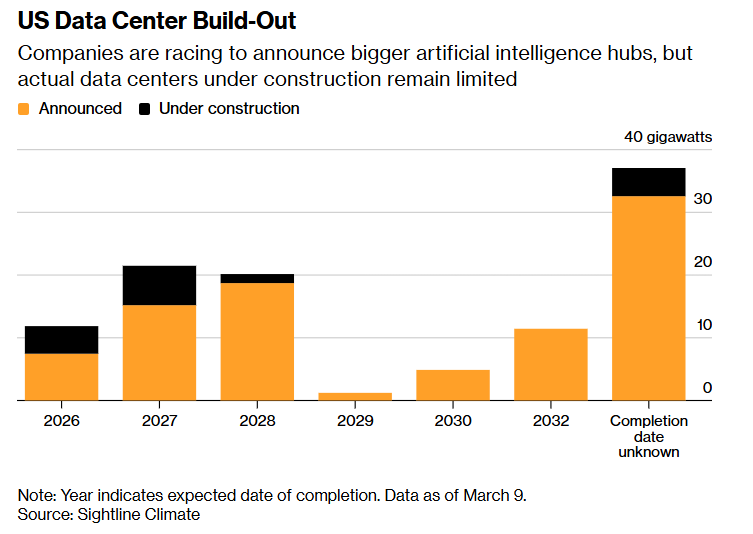
According to Bloomberg reports, just under half of the data centres planned for the U.S. this year are expected to be delayed or cancelled.
Source: Bloomberg
While there are a multitude of reasons for the deterioration in the completion outlook, from community outcry prompting cancellations to increasing capital availability issues, one major reason is a shortage of key electrical equipment.
Vital components of data centre electrical infrastructure such as transformers, switchgear and batteries simply aren’t being made in large enough numbers in the U.S. to keep up with demand, forcing data centre builders to rely on imports.
“There’s not enough domestic capacity to go around, so people are pretty much forced to go to the export market,” said Benjamin Boucher, a senior analyst with research and consulting firm Wood Mackenzie.
According to Andrew Likens, the energy and infrastructure lead at data centre builder Crusoe:
“If one piece of your supply chain is delayed, then your whole project can’t deliver”.
“It is a pretty wild puzzle at the moment.”
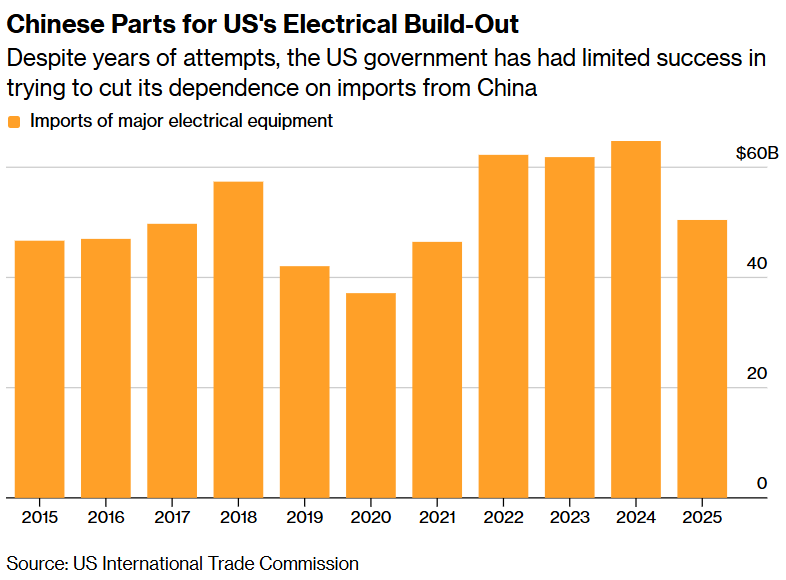
Despite what some analysts are calling an ongoing “Tech War” between the United States and China, exemplified by the race to make a superior AI, it is now ironically America relying on China to provide the nuts and bolts electrical infrastructure components for a sizable proportion of its new data centres.
Part of the problem is that much of the same electrical infrastructure componentry that is facilitating the rise of AI is used in everything from much-needed electrical grid revitalisation programs to the expansion of Electric Vehicle (EV) charging infrastructure.
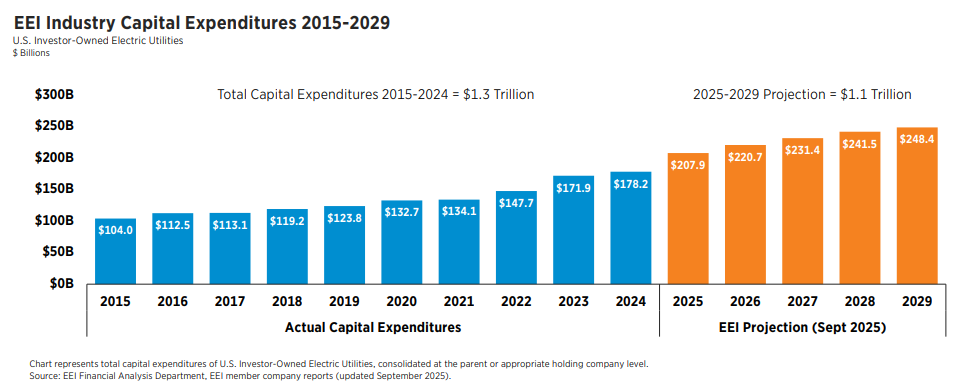
Chart: EEI
While the U.S. has attempted to expand its manufacturing of major electrical equipment over the past decade in particular, the rise in domestic demand coupled with a relatively slow ramp-up in production has seen a strong degree of reliance on China remain.
The Takeaway
One suspects that if the throttling of traffic through the Strait of Hormuz continues, narratives stemming from the positive economic boost to be derived from AI and data centre construction are likely to be front and centre.
However, given the growing issues with private credit risks, community backlash, and the supply of basic componentry, it increasingly appears that hope and positivity may be overstated compared to what reality may deliver.
On a geopolitical front, the flow of Chinese-made components into America’s vital data centre infrastructure is rather ironic. Given that U.S. President Donald Trump has made the case that it is imperative that Washington defeat Beijing in the race for the best AI.
Ultimately, this situation represents just the latest in a long line of ironic contradictions, where the U.S. and China, or ‘Chimerica’, as historian Niall Ferguson calls them, are forced to work together by the still symbiotic nature of their economic and trade relationship.
