
Albo’s cowards won’t tell you the truth even with a gun to their heads.
But it’s coming out anyway because this is a problem Canberra scum can’t hide.
Malaysia, the country’s top supplier of crude and third-largest source of petrol and diesel, has warned shipments to Australia could be disrupted if the conflict in the Middle East drags on, saying it may need to prioritise the needs of its citizens over its trading partners.
This is the tip of the iceberg. As gasoline supplies became more scarce and prices skyrocketed, all of Asia’s energy grid has entered crisis mode.
Major regional suppliers’ shipments of refined products have plummeted, directly exposing Australia, falling as much as 35% in the most recent week and about 30% during a ten-day period.
Jet fuel saw the biggest drops (more than 40%), followed by gasoline (more than 30%) and diesel (more than 20%).
Diesel has emerged as the primary bottleneck, increasing transportation costs and compelling governments to limit use.
In order to stretch scarce resources, nations including Bangladesh, the Philippines, Sri Lanka, Pakistan, Thailand, Vietnam, and Myanmar have implemented policies like shorter workweeks, school closures, remote employment, and fuel rationing.
In an effort to control prices, authorities are also getting involved in the fuel sector.
As jet fuel approaches $200 a barrel, the aviation industry is under severe strain.
Fuel surcharges and route reductions by airlines have rendered many flights unprofitable and decreased demand for travel.
Carriers, both domestic and foreign, have reduced their operations.
Petrochemical operations are most sensitive and are shutting down across the region. In due course, this will hit everything from plastics to fertiliser.
Refer to this terrifying chart from JPM.
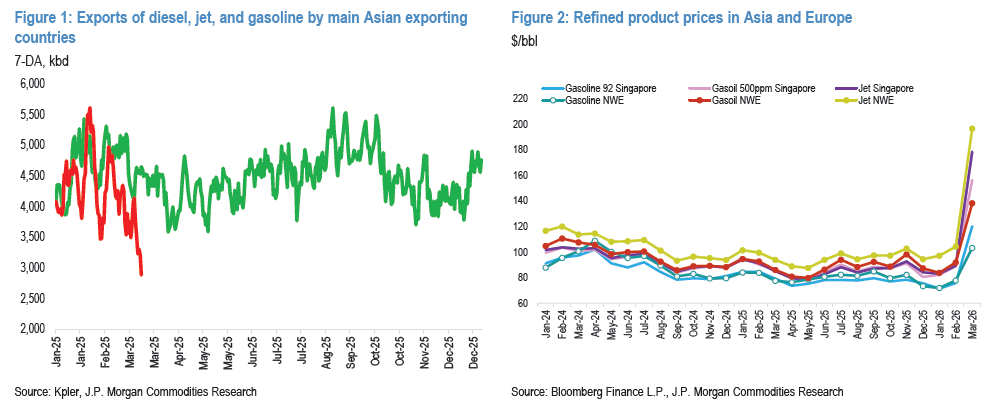
Much of the demand destruction is based upon factors other than price. There is simply no product to sell.
I am no longer confident that Australia’s share of this scarcity shock will equal its 15% of reduced global oil output.
Increasingly, it looks like it could rise very quickly to 30-40% of the oil feedstock processed in Asia from the Middle East.
It could easily exceed that number if Albo’s cowards don’t act quickly.
I would consider temporarily nationalising LNG sales and using Australia’s exports as a bargaining tool to secure fuel in return.
But Albo’s cowards are nowhere near these kinds of crisis measures, unlike other governments, even though we are more exposed than any country on earth.
Our model of doing politics is not built for this crisis, and it’s going to turn out as serious as a national crisis can get in two weeks, as large swathes of the economy simply start to shut down.
